

Once a cell has been fused with two or more sperm, it becomes possible to create
various polyploids through fertilization. By fertilizing a sperm that has had genetic
material introduced through electroporation, it is possible to insert it relatively
easily into nuclear DNA within the embryo (Singh 1994; Terán and Singh 2009).
B. Creating Clones (Hetero)
As described previously, whatever clones are produced from continued
inbreeding or gynogenesis are not genetic copies of the initial parent organism.
Also, because most gene locations are subject to homozygosis, recessive genes
possessed by the parents often manifest new activities. In such cases, there is a high
probability of undesirable traits appearing in addition to desirable ones. Today, if
one has a genetically superior organism and wishes to make another organism with
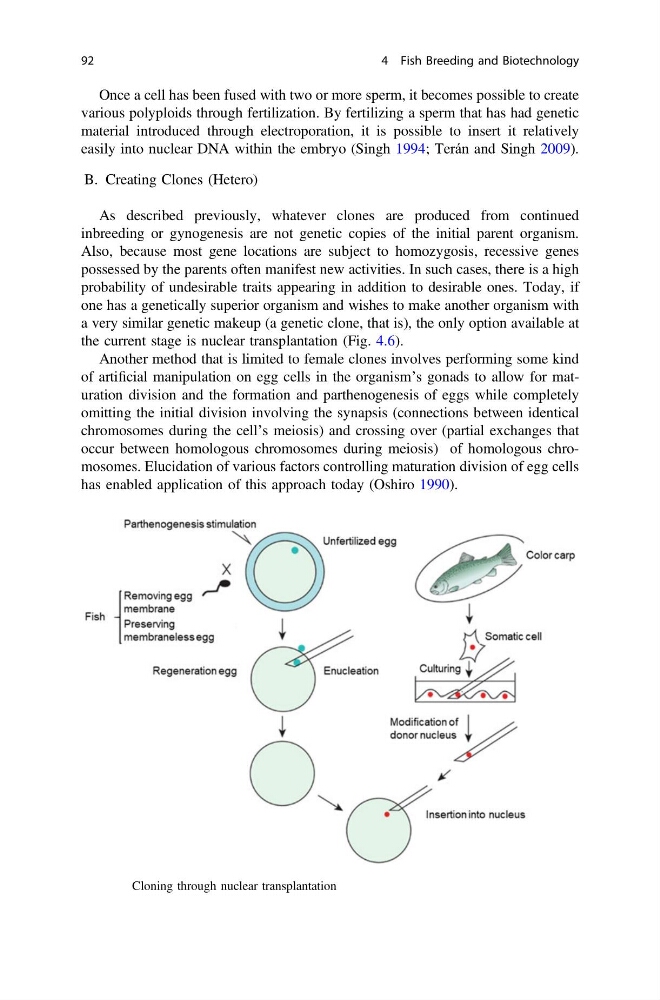
a very similar genetic makeup (a genetic clone, that is), the only option available at
the current stage is nuclear transplantation (Fig. 4.6).
Another method that is limited to female clones involves performing some kind
of artificial manipulation on egg cells in the organism’s gonads to allow for maturation division and the formation and parthenogenesis of eggs while completely
omitting the initial division involving the synapsis (connections between identical
chromosomes during the cell’s meiosis) and crossing over (partial exchanges that
occur between homologous chromosomes during meiosis) of homologous chromosomes. Elucidation of various factors controlling maturation division of egg cells
has enabled application of this approach today (Oshiro 1990).
Fig. 4.6 Cloning through nuclear transplantation
92
4 Fish Breeding and Biotechnology
various polyploids through fertilization. By fertilizing a sperm that has had genetic
material introduced through electroporation, it is possible to insert it relatively
easily into nuclear DNA within the embryo (Singh 1994; Terán and Singh 2009).
B. Creating Clones (Hetero)
As described previously, whatever clones are produced from continued
inbreeding or gynogenesis are not genetic copies of the initial parent organism.
Also, because most gene locations are subject to homozygosis, recessive genes
possessed by the parents often manifest new activities. In such cases, there is a high
probability of undesirable traits appearing in addition to desirable ones. Today, if
one has a genetically superior organism and wishes to make another organism with
a very similar genetic makeup (a genetic clone, that is), the only option available at
the current stage is nuclear transplantation (Fig. 4.6).
Another method that is limited to female clones involves performing some kind
of artificial manipulation on egg cells in the organism’s gonads to allow for maturation division and the formation and parthenogenesis of eggs while completely
omitting the initial division involving the synapsis (connections between identical
chromosomes during the cell’s meiosis) and crossing over (partial exchanges that
occur between homologous chromosomes during meiosis) of homologous chromosomes. Elucidation of various factors controlling maturation division of egg cells
has enabled application of this approach today (Oshiro 1990).
Fig. 4.6 Cloning through nuclear transplantation
92
4 Fish Breeding and Biotechnology