

The Great Barrier Reef
78
shells, carapaces of crustaceans, foraminifera tests and
sponge spicules. Only sediments adjacent to the coast
or large islands have a component of terrestrially derived sediments.
Storm activity will dislodge coral colonies both live
and dead (Fig. 8.1B), which have often been weakened
by borers attacking the base and branches of corals.
These coral colonies and broken off branches of the staghorn corals (Acropora) can be washed down to the bottom
of the reef slope or thrown up onto sand cays. This band
of coral rubble, which is often well developed on the
windward side of cays, forms an important coral reef
habitat for a wide range of organisms. Coral rubble is
itself subjected to further bioerosion, although often
it develops a protective coat of coralline algae that
provides some protection from the colonisation of the
substratum by endolithic algae. Such surfaces lacking
endolithic algae are therefore not grazed by parrotfish
(B)
(C)
(A)
(E)
(F)
(D)
(G)
(H)
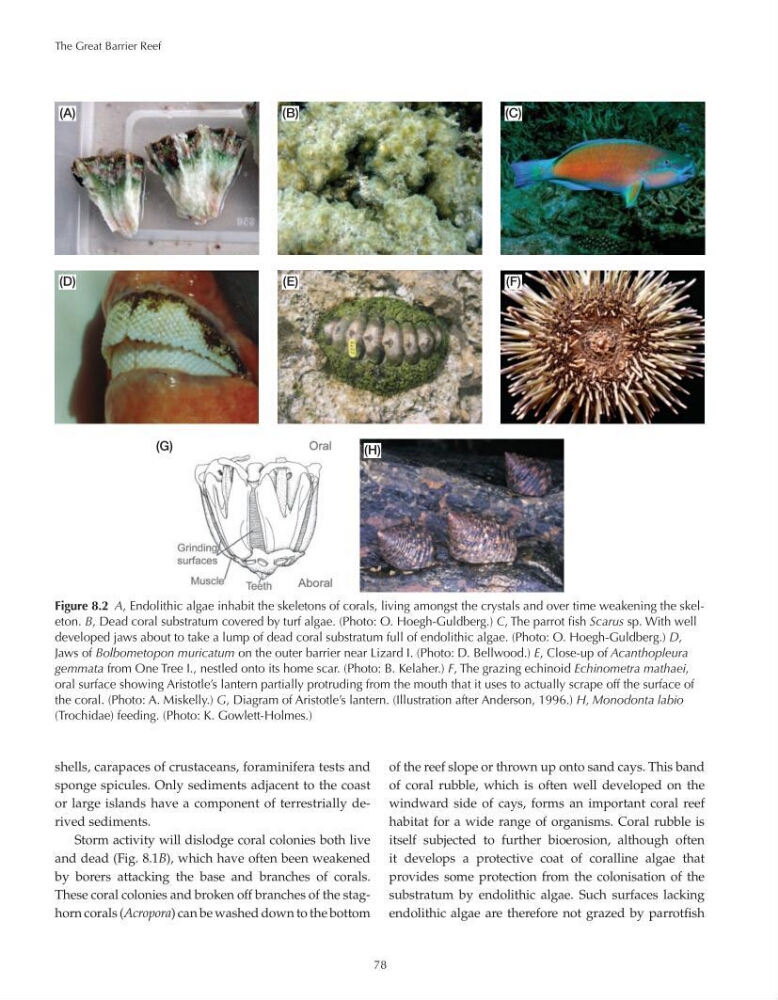
Figure 8.2 A, Endolithic algae inhabit the skeletons of corals, living amongst the crystals and over time weakening the skeleton. B, Dead coral substratum covered by turf algae. (Photo: O. Hoegh-Guldberg.) C, The parrot fish Scarus sp. With well
developed jaws about to take a lump of dead coral substratum full of endolithic algae. (Photo: O. Hoegh-Guldberg.) D,
Jaws of Bolbometopon muricatum on the outer barrier near Lizard I. (Photo: D. Bellwood.) E, Close-up of Acanthopleura
gemmata from One Tree I., nestled onto its home scar. (Photo: B. Kelaher.) F, The grazing echinoid Echinometra mathaei,
oral surface showing Aristotle’s lantern partially protruding from the mouth that it uses to actually scrape off the surface of
the coral. (Photo: A. Miskelly.) G, Diagram of Aristotle’s lantern. (Illustration after Anderson, 1996.) H, Monodonta labio
(Trochidae) feeding. (Photo: K. Gowlett-Holmes.)
78
shells, carapaces of crustaceans, foraminifera tests and
sponge spicules. Only sediments adjacent to the coast
or large islands have a component of terrestrially derived sediments.
Storm activity will dislodge coral colonies both live
and dead (Fig. 8.1B), which have often been weakened
by borers attacking the base and branches of corals.
These coral colonies and broken off branches of the staghorn corals (Acropora) can be washed down to the bottom
of the reef slope or thrown up onto sand cays. This band
of coral rubble, which is often well developed on the
windward side of cays, forms an important coral reef
habitat for a wide range of organisms. Coral rubble is
itself subjected to further bioerosion, although often
it develops a protective coat of coralline algae that
provides some protection from the colonisation of the
substratum by endolithic algae. Such surfaces lacking
endolithic algae are therefore not grazed by parrotfish
(B)
(C)
(A)
(E)
(F)
(D)
(G)
(H)
Figure 8.2 A, Endolithic algae inhabit the skeletons of corals, living amongst the crystals and over time weakening the skeleton. B, Dead coral substratum covered by turf algae. (Photo: O. Hoegh-Guldberg.) C, The parrot fish Scarus sp. With well
developed jaws about to take a lump of dead coral substratum full of endolithic algae. (Photo: O. Hoegh-Guldberg.) D,
Jaws of Bolbometopon muricatum on the outer barrier near Lizard I. (Photo: D. Bellwood.) E, Close-up of Acanthopleura
gemmata from One Tree I., nestled onto its home scar. (Photo: B. Kelaher.) F, The grazing echinoid Echinometra mathaei,
oral surface showing Aristotle’s lantern partially protruding from the mouth that it uses to actually scrape off the surface of
the coral. (Photo: A. Miskelly.) G, Diagram of Aristotle’s lantern. (Illustration after Anderson, 1996.) H, Monodonta labio
(Trochidae) feeding. (Photo: K. Gowlett-Holmes.)