

8 – Calcification, Erosion and the Establishment of the Framework of Coral Reefs
79
and echinoids. Dead coral substrata adjacent to river
mouths, where large plumes of sediment loaded water
flow out onto the reef during the wet season (see Chapter 11), tend to be covered in a thick layer of silt that
again protects the substratum from endolithic algal colonisation. This has been documented on reefs adjacent to
Low Isles and those at the mouth of the Daintree River in
North Queensland. Live coral colonies have mechanisms
to eject the sediment as it settles on the coral polyps,
whereas it can accumulate on dead substratum.
While live coral colonies are typically unbored, once
parts of the colony die the substratum is rapidly colonised
by borers. As all borers have pelagic larvae it is difficult
for them to settle on the living veneer of a coral colony
without being eaten by the coral polyps. In cases where
borers have settled in living colonies it is presumed that
larvae have settled on damaged polyps allowing them to
metamorphose and rapidly bore into the substratum before being eaten by a neighbouring polyp. Once coral substratum becomes available for colonisation by borers, a
distinct succession occurs, with the early settlers being
bacteria, fungi and endolithic algae that appear to condition the substratum and facilitate the next suite of colonisers, primarily polychaete worms, and later sponges,
sipunculans and molluscs including bivalves and boring
barnacles. Many of these early colonisers are short-lived
(A)
(C)
(D)
(B)
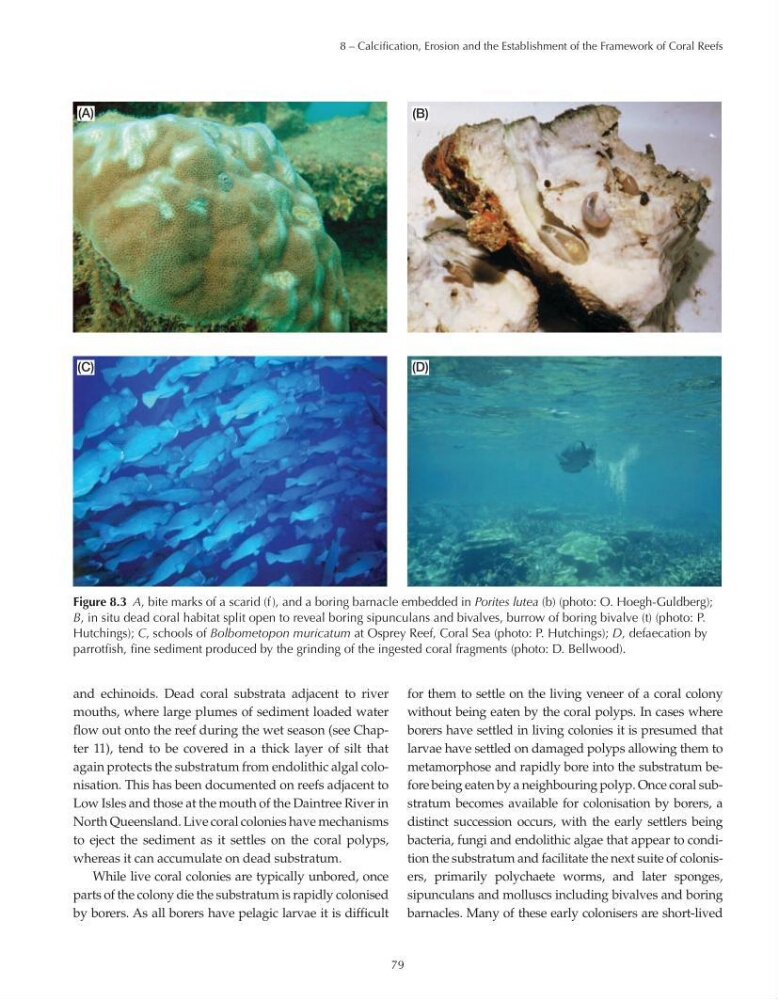
Figure 8.3 A, bite marks of a scarid (f ), and a boring barnacle embedded in Porites lutea (b) (photo: O. Hoegh-Guldberg);
B, in situ dead coral habitat split open to reveal boring sipunculans and bivalves, burrow of boring bivalve (t) (photo: P.
Hutchings); C, schools of Bolbometopon muricatum at Osprey Reef, Coral Sea (photo: P. Hutchings); D, defaecation by
parrotfish, fine sediment produced by the grinding of the ingested coral fragments (photo: D. Bellwood).
79
and echinoids. Dead coral substrata adjacent to river
mouths, where large plumes of sediment loaded water
flow out onto the reef during the wet season (see Chapter 11), tend to be covered in a thick layer of silt that
again protects the substratum from endolithic algal colonisation. This has been documented on reefs adjacent to
Low Isles and those at the mouth of the Daintree River in
North Queensland. Live coral colonies have mechanisms
to eject the sediment as it settles on the coral polyps,
whereas it can accumulate on dead substratum.
While live coral colonies are typically unbored, once
parts of the colony die the substratum is rapidly colonised
by borers. As all borers have pelagic larvae it is difficult
for them to settle on the living veneer of a coral colony
without being eaten by the coral polyps. In cases where
borers have settled in living colonies it is presumed that
larvae have settled on damaged polyps allowing them to
metamorphose and rapidly bore into the substratum before being eaten by a neighbouring polyp. Once coral substratum becomes available for colonisation by borers, a
distinct succession occurs, with the early settlers being
bacteria, fungi and endolithic algae that appear to condition the substratum and facilitate the next suite of colonisers, primarily polychaete worms, and later sponges,
sipunculans and molluscs including bivalves and boring
barnacles. Many of these early colonisers are short-lived
(A)
(C)
(D)
(B)
Figure 8.3 A, bite marks of a scarid (f ), and a boring barnacle embedded in Porites lutea (b) (photo: O. Hoegh-Guldberg);
B, in situ dead coral habitat split open to reveal boring sipunculans and bivalves, burrow of boring bivalve (t) (photo: P.
Hutchings); C, schools of Bolbometopon muricatum at Osprey Reef, Coral Sea (photo: P. Hutchings); D, defaecation by
parrotfish, fine sediment produced by the grinding of the ingested coral fragments (photo: D. Bellwood).