

The Great Barrier Reef
54
these soft sediments. Further offshore where the turbidity is lower the muddy sediments (blue areas,
Fig. 6.1) are of carbonate, indicating their biological
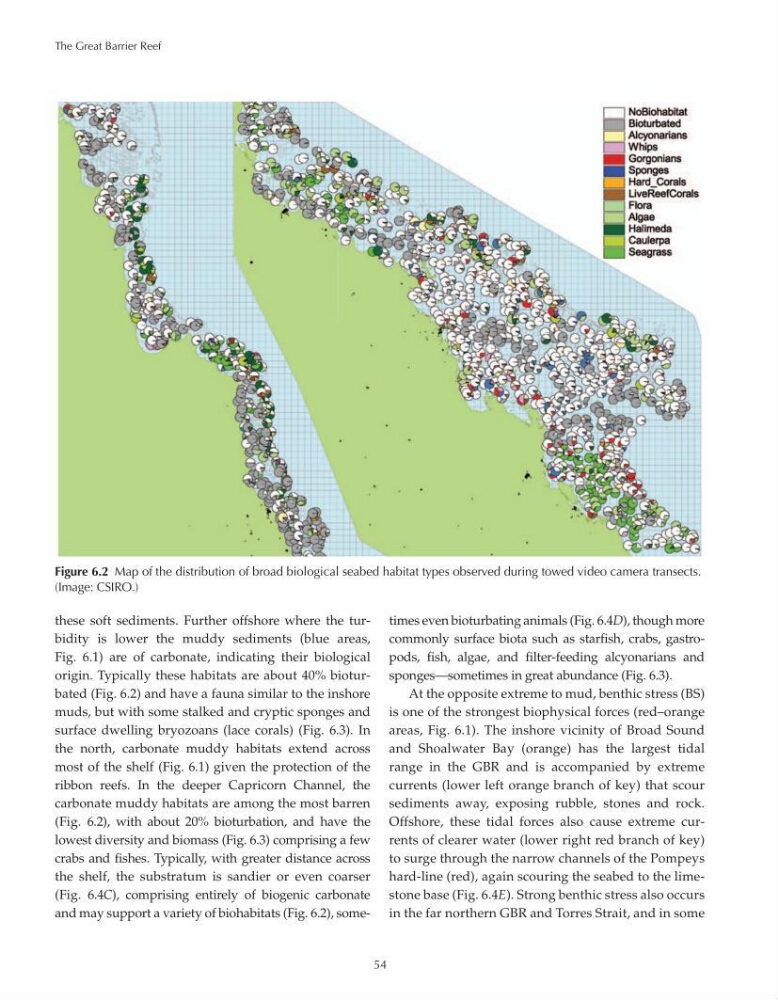
origin. Typically these habitats are about 40% bioturbated (Fig. 6.2) and have a fauna similar to the inshore
muds, but with some stalked and cryptic sponges and
surface dwelling bryozoans (lace corals) (Fig. 6.3). In
the north, carbonate muddy habitats extend across
most of the shelf (Fig. 6.1) given the protection of the
ribbon reefs. In the deeper Capricorn Channel, the
carbonate muddy habitats are among the most barren
(Fig. 6.2), with about 20% bioturbation, and have the
lowest diversity and biomass (Fig. 6.3) comprising a few
crabs and fishes. Typically, with greater distance across
the shelf, the substratum is sandier or even coarser
(Fig. 6.4C), comprising entirely of biogenic carbonate
and may support a variety of biohabitats (Fig. 6.2), sometimes even bioturbating animals (Fig. 6.4D), though more
commonly surface biota such as starfish, crabs, gastropods, fish, algae, and filter-feeding alcyonarians and
sponges—sometimes in great abundance (Fig. 6.3).
At the opposite extreme to mud, benthic stress (BS)
is one of the strongest biophysical forces (red–orange
areas, Fig. 6.1). The inshore vicinity of Broad Sound
and Shoalwater Bay (orange) has the largest tidal
range in the GBR and is accompanied by extreme
currents (lower left orange branch of key) that scour
sediments away, exposing rubble, stones and rock.
Offshore, these tidal forces also cause extreme currents of clearer water (lower right red branch of key)
to surge through the narrow channels of the Pompeys
hard-line (red), again scouring the seabed to the limestone base (Fig. 6.4E). Strong benthic stress also occurs
in the far northern GBR and Torres Strait, and in some
Figure 6.2 Map of the distribution of broad biological seabed habitat types observed during towed video camera transects.
(Image: CSIRO.)
54
these soft sediments. Further offshore where the turbidity is lower the muddy sediments (blue areas,
Fig. 6.1) are of carbonate, indicating their biological
origin. Typically these habitats are about 40% bioturbated (Fig. 6.2) and have a fauna similar to the inshore
muds, but with some stalked and cryptic sponges and
surface dwelling bryozoans (lace corals) (Fig. 6.3). In
the north, carbonate muddy habitats extend across
most of the shelf (Fig. 6.1) given the protection of the
ribbon reefs. In the deeper Capricorn Channel, the
carbonate muddy habitats are among the most barren
(Fig. 6.2), with about 20% bioturbation, and have the
lowest diversity and biomass (Fig. 6.3) comprising a few
crabs and fishes. Typically, with greater distance across
the shelf, the substratum is sandier or even coarser
(Fig. 6.4C), comprising entirely of biogenic carbonate
and may support a variety of biohabitats (Fig. 6.2), sometimes even bioturbating animals (Fig. 6.4D), though more
commonly surface biota such as starfish, crabs, gastropods, fish, algae, and filter-feeding alcyonarians and
sponges—sometimes in great abundance (Fig. 6.3).
At the opposite extreme to mud, benthic stress (BS)
is one of the strongest biophysical forces (red–orange
areas, Fig. 6.1). The inshore vicinity of Broad Sound
and Shoalwater Bay (orange) has the largest tidal
range in the GBR and is accompanied by extreme
currents (lower left orange branch of key) that scour
sediments away, exposing rubble, stones and rock.
Offshore, these tidal forces also cause extreme currents of clearer water (lower right red branch of key)
to surge through the narrow channels of the Pompeys
hard-line (red), again scouring the seabed to the limestone base (Fig. 6.4E). Strong benthic stress also occurs
in the far northern GBR and Torres Strait, and in some
Figure 6.2 Map of the distribution of broad biological seabed habitat types observed during towed video camera transects.
(Image: CSIRO.)