

The Great Barrier Reef
232
Surface sclerites are generally poorly formed clubs.
Colour: brown, cream, yellow or green. Members of
this genus are widely distributed, and abundant in
high light environments. Similar genus: Sarcophyton.
Family Nephtheidae. A wide range of genera
with a wide range of ecological characteristics are
grouped in this family, some probably erroneously.
Most have bushy, globe-shaped or arborescent growth
forms, while a few are massive, or consist of finger-like
lobes united by a common base. Many genera contain
highly coloured species that are azooxanthellate. In
most cases, the polyps, singly or in small clusters, are
more or less restricted to the upper and outer twigs or
branches. In a few cases, polyps grow directly on main
branches. A small number of broad primary polyp
canals extend longitudinally through the stem of
arborescent colonies, subdividing into groups that extend up into the distal lobes and branches. The canal
(A)
(B)
(C)
(D)
Surface
Interior
0.1 mm
1 mm
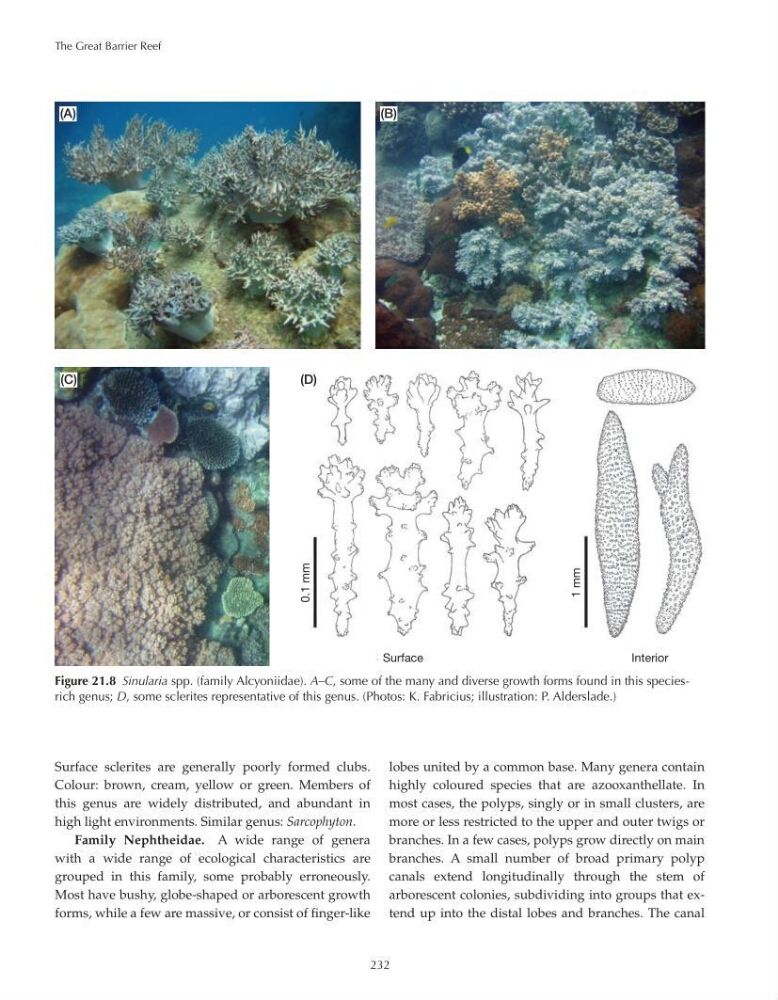
Figure 21.8 Sinularia spp. (family Alcyoniidae). A–C, some of the many and diverse growth forms found in this speciesrich genus; D, some sclerites representative of this genus. (Photos: K. Fabricius; illustration: P. Alderslade.)
232
Surface sclerites are generally poorly formed clubs.
Colour: brown, cream, yellow or green. Members of
this genus are widely distributed, and abundant in
high light environments. Similar genus: Sarcophyton.
Family Nephtheidae. A wide range of genera
with a wide range of ecological characteristics are
grouped in this family, some probably erroneously.
Most have bushy, globe-shaped or arborescent growth
forms, while a few are massive, or consist of finger-like
lobes united by a common base. Many genera contain
highly coloured species that are azooxanthellate. In
most cases, the polyps, singly or in small clusters, are
more or less restricted to the upper and outer twigs or
branches. In a few cases, polyps grow directly on main
branches. A small number of broad primary polyp
canals extend longitudinally through the stem of
arborescent colonies, subdividing into groups that extend up into the distal lobes and branches. The canal
(A)
(B)
(C)
(D)
Surface
Interior
0.1 mm
1 mm
Figure 21.8 Sinularia spp. (family Alcyoniidae). A–C, some of the many and diverse growth forms found in this speciesrich genus; D, some sclerites representative of this genus. (Photos: K. Fabricius; illustration: P. Alderslade.)