

16 – Mangroves and Seagrasses
167
Genus Lumnitzera (3)
1. Inflorescence axillary, style central, petals white, stamens equal or slightly exceeding petals, shrub or small tree to 8 m ............................................... Lumnitzera racemosa
– Inflorescence terminal, style off-centre ..........................................................................2
2. Petals pink, stamens equal or slightly exceeding petals .................. Lumnitzera X rosea
– Petals red, stamens twice as long as petals ......................................Lumnitzera littorea
N SEAGRASSES
Australia is fortunate in having nearly half the 60 species of the world’s seagrasses represented, 14 of which
occur on Australian coral reefs. However, in reef waters
in Australia, seagrasses may be inconspicuous because
they are grazed heavily by invertebrates, fish, turtles
and dugongs (Box 16.2, Fig. 16.9). In protected areas
they form dense, lush meadows, which harbour a diversity of animal and algal life.
BOX 16.2 SEAGRASS BEDS AND MACROGRAZERS
The larger species of seagrass in the GBR, Zostera muelleri, Cymodocea serrulata, C. rotundata, Thalassia hemprichii, Enhalus acoroides, and Thalassodendron ciliatum form dense beds
near the coast and in sheltered bays offshore on continental islands. These beds are usually formed from several species of seagrass and present a wide diversity of habitats for
infauna and inflora. Many epiphytes, epizoans and an extensive microflora occur on the
seagrass fronds. Many animals and algae grow on or in the sediment between the seagrass plants. Organic substances and oxygen released into the sediments from the roots
of seagrasses support a specialised habitat of microflora, protists and invertebrate grazers around the roots.
It is therefore not surprising that macrograzers are found in or near seagrass beds.
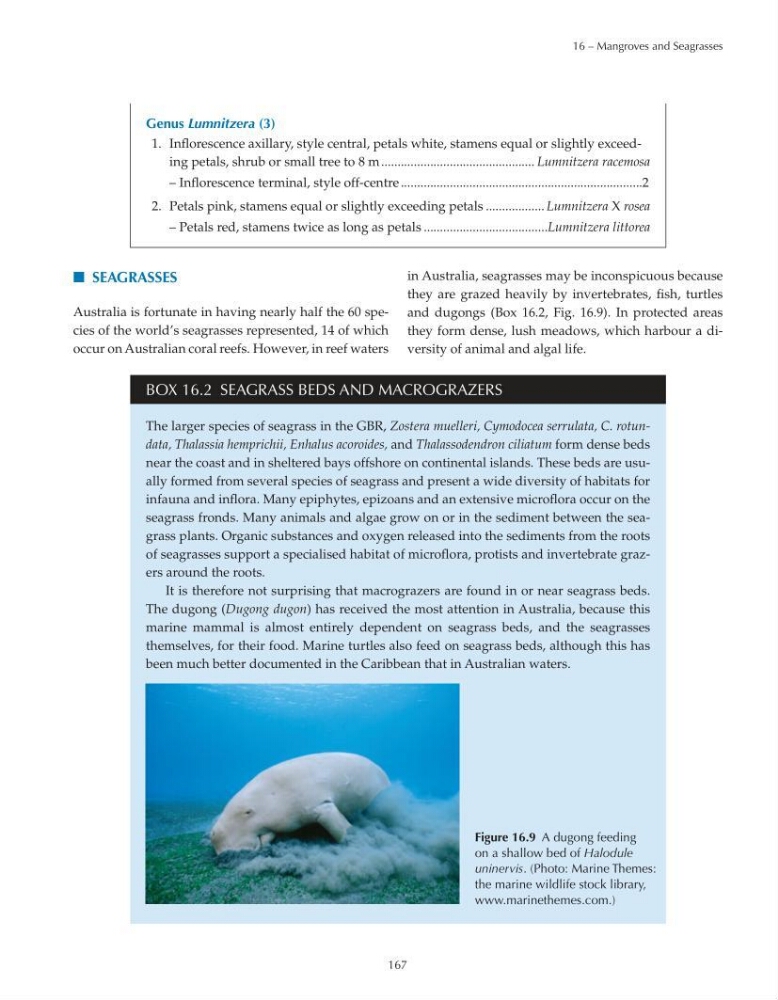
The dugong (Dugong dugon) has received the most attention in Australia, because this
marine mammal is almost entirely dependent on seagrass beds, and the seagrasses
themselves, for their food. Marine turtles also feed on seagrass beds, although this has
been much better documented in the Caribbean that in Australian waters.
Figure 16.9 A dugong feeding
on a shallow bed of Halodule
uninervis. (Photo: Marine Themes:
the marine wildlife stock library,
www.marinethemes.com.)
167
Genus Lumnitzera (3)
1. Inflorescence axillary, style central, petals white, stamens equal or slightly exceeding petals, shrub or small tree to 8 m ............................................... Lumnitzera racemosa
– Inflorescence terminal, style off-centre ..........................................................................2
2. Petals pink, stamens equal or slightly exceeding petals .................. Lumnitzera X rosea
– Petals red, stamens twice as long as petals ......................................Lumnitzera littorea
N SEAGRASSES
Australia is fortunate in having nearly half the 60 species of the world’s seagrasses represented, 14 of which
occur on Australian coral reefs. However, in reef waters
in Australia, seagrasses may be inconspicuous because
they are grazed heavily by invertebrates, fish, turtles
and dugongs (Box 16.2, Fig. 16.9). In protected areas
they form dense, lush meadows, which harbour a diversity of animal and algal life.
BOX 16.2 SEAGRASS BEDS AND MACROGRAZERS
The larger species of seagrass in the GBR, Zostera muelleri, Cymodocea serrulata, C. rotundata, Thalassia hemprichii, Enhalus acoroides, and Thalassodendron ciliatum form dense beds
near the coast and in sheltered bays offshore on continental islands. These beds are usually formed from several species of seagrass and present a wide diversity of habitats for
infauna and inflora. Many epiphytes, epizoans and an extensive microflora occur on the
seagrass fronds. Many animals and algae grow on or in the sediment between the seagrass plants. Organic substances and oxygen released into the sediments from the roots
of seagrasses support a specialised habitat of microflora, protists and invertebrate grazers around the roots.
It is therefore not surprising that macrograzers are found in or near seagrass beds.
The dugong (Dugong dugon) has received the most attention in Australia, because this
marine mammal is almost entirely dependent on seagrass beds, and the seagrasses
themselves, for their food. Marine turtles also feed on seagrass beds, although this has
been much better documented in the Caribbean that in Australian waters.
Figure 16.9 A dugong feeding
on a shallow bed of Halodule
uninervis. (Photo: Marine Themes:
the marine wildlife stock library,
www.marinethemes.com.)