

The Great Barrier Reef
168
and are the only vascular plants that are aquatic and
inhabit the sea.
Seagrasses grow mainly on soft substrates (silt
and sand) in shallow, sheltered marine or estuarine
situations. There are two exceptions to this generalisation: (1) Thalassodendron ciliatum, which grows directly on hard substrates (such as dead coral), as it
has specialised roots that allow it to become firmly
attached to these substrates; (2) many species of Halophila that can grow at considerable depths, especially
H. capricorni, H. decipiens, H. spinulosa and H. tricostata, which can grow down to 60 m. Thus, these latter
species of Halophila are often found growing on deep
sediments outside coral reefs or in inter-reefal environments on the GBR.
In the main, seagrasses on coral reefs are found in
lagoons or in shallow inter-reefal areas, where they
support large populations of herbivores. They therefore form a very important source of primary production. In the GBR Zone these same species of
seagrass are often found growing on shallow, sheltered sediments in coastal situations, where there are
no corals.
Only three species of seagrass, all in the genus Halophila, are present in the Bunker-Capricorn Groups at
the southern end of the GBR (H. capricorni, H. decipiens
and H. spinulosa). Further north, seagrasses are both
more numerous in terms of species (all the species in
the Key (14) may be represented in a fairly small area)
and they are more conspicuous. Further information is
available in Additional reading.
Thalassia
hemprichii
Zostera
capricorni
Cymodocea
rotundata
Cymodocea
serrulata
Halodule
uninervis
Thalassodendron
ciliatum
Enhalus
acoroides
Halophila
spinulosa
Halophila
ovalis
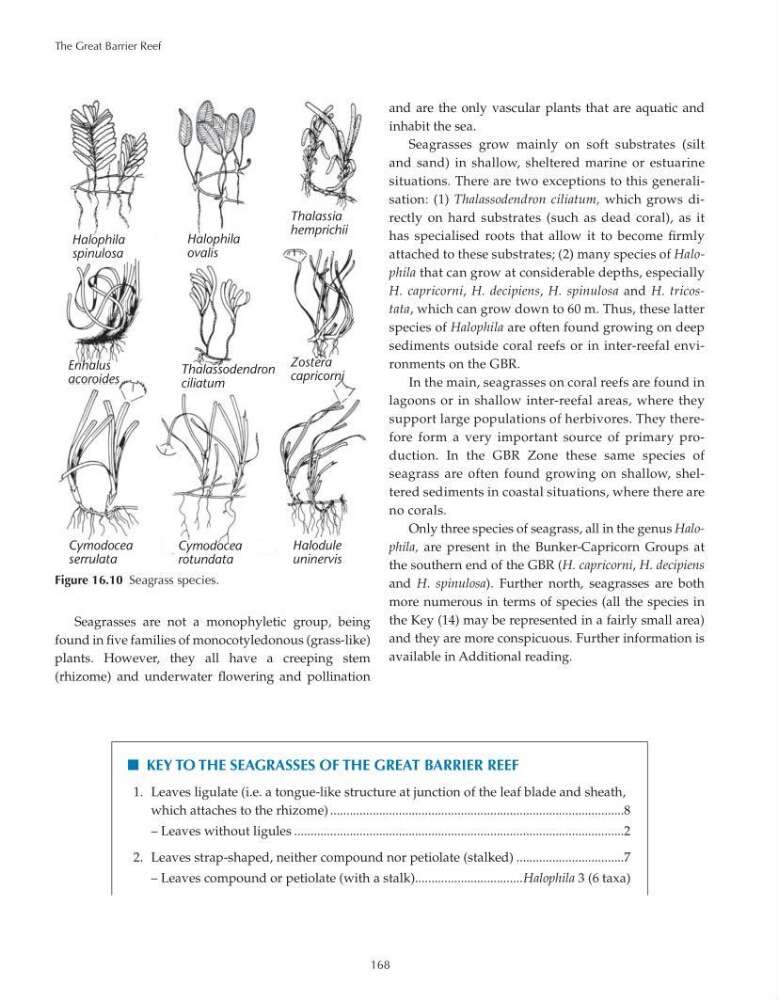
Figure 16.10 Seagrass species.
Seagrasses are not a monophyletic group, being
found in five families of monocotyledonous (grass-like)
plants. However, they all have a creeping stem
( rhizome) and underwater flowering and pollination
N KEY TO THE SEAGRASSES OF THE GREAT BARRIER REEF
1. Leaves ligulate (i.e. a tongue-like structure at junction of the leaf blade and sheath,
which attaches to the rhizome) ..........................................................................................8
– Leaves without ligules .....................................................................................................2
2. Leaves strap-shaped, neither compound nor petiolate (stalked) .................................7
– Leaves compound or petiolate (with a stalk) .................................Halophila 3 (6 taxa)
168
and are the only vascular plants that are aquatic and
inhabit the sea.
Seagrasses grow mainly on soft substrates (silt
and sand) in shallow, sheltered marine or estuarine
situations. There are two exceptions to this generalisation: (1) Thalassodendron ciliatum, which grows directly on hard substrates (such as dead coral), as it
has specialised roots that allow it to become firmly
attached to these substrates; (2) many species of Halophila that can grow at considerable depths, especially
H. capricorni, H. decipiens, H. spinulosa and H. tricostata, which can grow down to 60 m. Thus, these latter
species of Halophila are often found growing on deep
sediments outside coral reefs or in inter-reefal environments on the GBR.
In the main, seagrasses on coral reefs are found in
lagoons or in shallow inter-reefal areas, where they
support large populations of herbivores. They therefore form a very important source of primary production. In the GBR Zone these same species of
seagrass are often found growing on shallow, sheltered sediments in coastal situations, where there are
no corals.
Only three species of seagrass, all in the genus Halophila, are present in the Bunker-Capricorn Groups at
the southern end of the GBR (H. capricorni, H. decipiens
and H. spinulosa). Further north, seagrasses are both
more numerous in terms of species (all the species in
the Key (14) may be represented in a fairly small area)
and they are more conspicuous. Further information is
available in Additional reading.
Thalassia
hemprichii
Zostera
capricorni
Cymodocea
rotundata
Cymodocea
serrulata
Halodule
uninervis
Thalassodendron
ciliatum
Enhalus
acoroides
Halophila
spinulosa
Halophila
ovalis
Figure 16.10 Seagrass species.
Seagrasses are not a monophyletic group, being
found in five families of monocotyledonous (grass-like)
plants. However, they all have a creeping stem
( rhizome) and underwater flowering and pollination
N KEY TO THE SEAGRASSES OF THE GREAT BARRIER REEF
1. Leaves ligulate (i.e. a tongue-like structure at junction of the leaf blade and sheath,
which attaches to the rhizome) ..........................................................................................8
– Leaves without ligules .....................................................................................................2
2. Leaves strap-shaped, neither compound nor petiolate (stalked) .................................7
– Leaves compound or petiolate (with a stalk) .................................Halophila 3 (6 taxa)