

The Great Barrier Reef
166
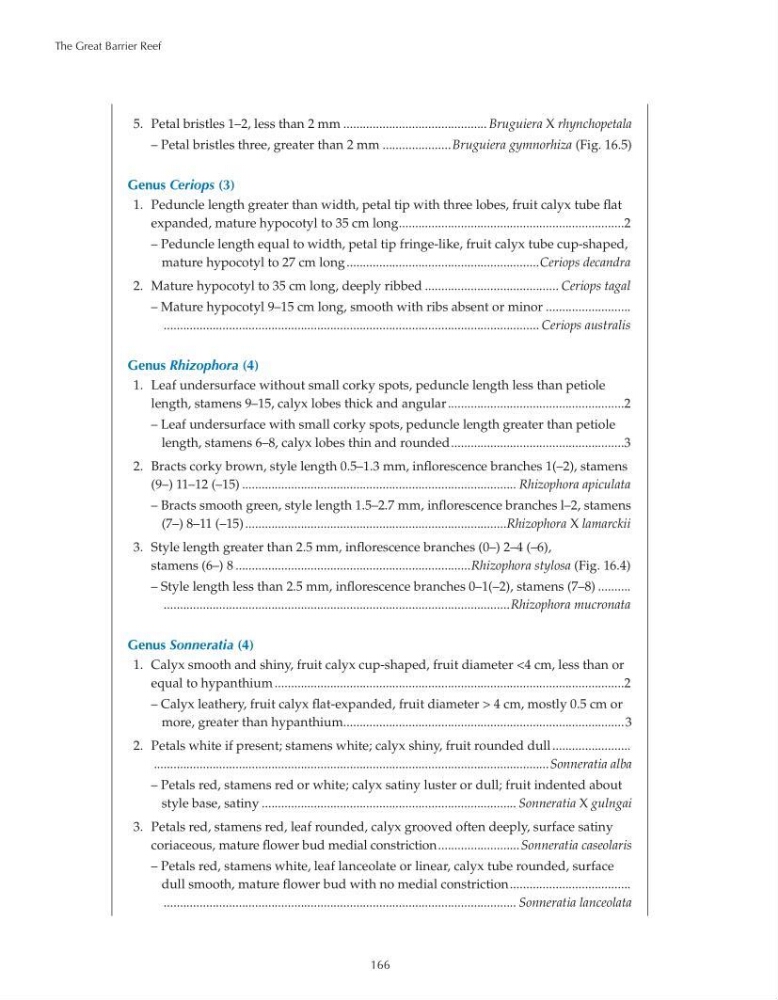
5. Petal bristles 1–2, less than 2 mm ............................................ Bruguiera X rhynchopetala
– Petal bristles three, greater than 2 mm ..................... Bruguiera gymnorhiza (Fig. 16.5)
Genus Ceriops (3)
1. Peduncle length greater than width, petal tip with three lobes, fruit calyx tube flat
expanded, mature hypocotyl to 35 cm long .....................................................................2
– Peduncle length equal to width, petal tip fringe-like, fruit calyx tube cup-shaped,
mature hypocotyl to 27 cm long ...........................................................Ceriops decandra
2. Mature hypocotyl to 35 cm long, deeply ribbed ......................................... Ceriops tagal
– Mature hypocotyl 9–15 cm long, smooth with ribs absent or minor ..........................
................................................................................................................... Ceriops australis
Genus Rhizophora (4)
1. Leaf undersurface without small corky spots, peduncle length less than petiole
length, stamens 9–15, calyx lobes thick and angular ......................................................2
– Leaf undersurface with small corky spots, peduncle length greater than petiole
length, stamens 6–8, calyx lobes thin and rounded .....................................................3
2. Bracts corky brown, style length 0.5–1.3 mm, inflorescence branches 1(–2), stamens
(9–) 11–12 (–15) .................................................................................... Rhizophora apiculata
– Bracts smooth green, style length 1.5–2.7 mm, inflorescence branches l–2, stamens
(7–) 8–11 (–15) ................................................................................Rhizophora X lamarckii
3. Style length greater than 2.5 mm, inflorescence branches (0–) 2–4 (–6),
stamens (6–) 8 ........................................................................Rhizophora stylosa (Fig. 16.4)
– Style length less than 2.5 mm, inflorescence branches 0–1(–2), stamens (7–8) ..........
..........................................................................................................Rhizophora mucronata
Genus Sonneratia (4)
1. Calyx smooth and shiny, fruit calyx cup-shaped, fruit diameter <4 cm, less than or
equal to hypanthium ...........................................................................................................2
– Calyx leathery, fruit calyx flat-expanded, fruit diameter > 4 cm, mostly 0.5 cm or
more, greater than hypanthium ......................................................................................3
2. Petals white if present; stamens white; calyx shiny, fruit rounded dull ........................
.........................................................................................................................Sonneratia alba
– Petals red, stamens red or white; calyx satiny luster or dull; fruit indented about
style base, satiny .............................................................................. Sonneratia X gulngai
3. Petals red, stamens red, leaf rounded, calyx grooved often deeply, surface satiny
coriaceous, mature flower bud medial constriction ......................... Sonneratia caseolaris
– Petals red, stamens white, leaf lanceolate or linear, calyx tube rounded, surface
dull smooth, mature flower bud with no medial constriction .....................................
............................................................................................................ Sonneratia lanceolata
166
5. Petal bristles 1–2, less than 2 mm ............................................ Bruguiera X rhynchopetala
– Petal bristles three, greater than 2 mm ..................... Bruguiera gymnorhiza (Fig. 16.5)
Genus Ceriops (3)
1. Peduncle length greater than width, petal tip with three lobes, fruit calyx tube flat
expanded, mature hypocotyl to 35 cm long .....................................................................2
– Peduncle length equal to width, petal tip fringe-like, fruit calyx tube cup-shaped,
mature hypocotyl to 27 cm long ...........................................................Ceriops decandra
2. Mature hypocotyl to 35 cm long, deeply ribbed ......................................... Ceriops tagal
– Mature hypocotyl 9–15 cm long, smooth with ribs absent or minor ..........................
................................................................................................................... Ceriops australis
Genus Rhizophora (4)
1. Leaf undersurface without small corky spots, peduncle length less than petiole
length, stamens 9–15, calyx lobes thick and angular ......................................................2
– Leaf undersurface with small corky spots, peduncle length greater than petiole
length, stamens 6–8, calyx lobes thin and rounded .....................................................3
2. Bracts corky brown, style length 0.5–1.3 mm, inflorescence branches 1(–2), stamens
(9–) 11–12 (–15) .................................................................................... Rhizophora apiculata
– Bracts smooth green, style length 1.5–2.7 mm, inflorescence branches l–2, stamens
(7–) 8–11 (–15) ................................................................................Rhizophora X lamarckii
3. Style length greater than 2.5 mm, inflorescence branches (0–) 2–4 (–6),
stamens (6–) 8 ........................................................................Rhizophora stylosa (Fig. 16.4)
– Style length less than 2.5 mm, inflorescence branches 0–1(–2), stamens (7–8) ..........
..........................................................................................................Rhizophora mucronata
Genus Sonneratia (4)
1. Calyx smooth and shiny, fruit calyx cup-shaped, fruit diameter <4 cm, less than or
equal to hypanthium ...........................................................................................................2
– Calyx leathery, fruit calyx flat-expanded, fruit diameter > 4 cm, mostly 0.5 cm or
more, greater than hypanthium ......................................................................................3
2. Petals white if present; stamens white; calyx shiny, fruit rounded dull ........................
.........................................................................................................................Sonneratia alba
– Petals red, stamens red or white; calyx satiny luster or dull; fruit indented about
style base, satiny .............................................................................. Sonneratia X gulngai
3. Petals red, stamens red, leaf rounded, calyx grooved often deeply, surface satiny
coriaceous, mature flower bud medial constriction ......................... Sonneratia caseolaris
– Petals red, stamens white, leaf lanceolate or linear, calyx tube rounded, surface
dull smooth, mature flower bud with no medial constriction .....................................
............................................................................................................ Sonneratia lanceolata