

The Great Barrier Reef
140
Conspicuous neustonic taxa are often species of
the Class Hydrozoa. The Portuguese man-of-war or
blue-bottle (Physalia sp.), smaller taxa that include the
by-the-wind sailor (Velella vellella) and Porpita sp. float
and are common as drift on beaches and are well
known for their painful stings. Siphonophores (Class
Siphonophora; 32 species on GBR) are voracious
predators of plankton and are solitary or form long
strings (colonies) that drift and swim by hydraulic
pumping of seawater.
Other gelatinous zooplankters that sometimes form
strings, but are unrelated to siphonophores are the
salps and doliolids (Phylum Chordata, Class Thaliacea;
nine species on GBR) (Fig. 14.13). Their abundance is
often influenced by temperature and biologists have
focused on this group as an indicator of variation in
planktonic assemblages due to climate change. Individuals are often only a centimetre or so long, but they
generally form strings and some colonies form cylinders that can be a few metres in length (e.g. Pyrosoma).
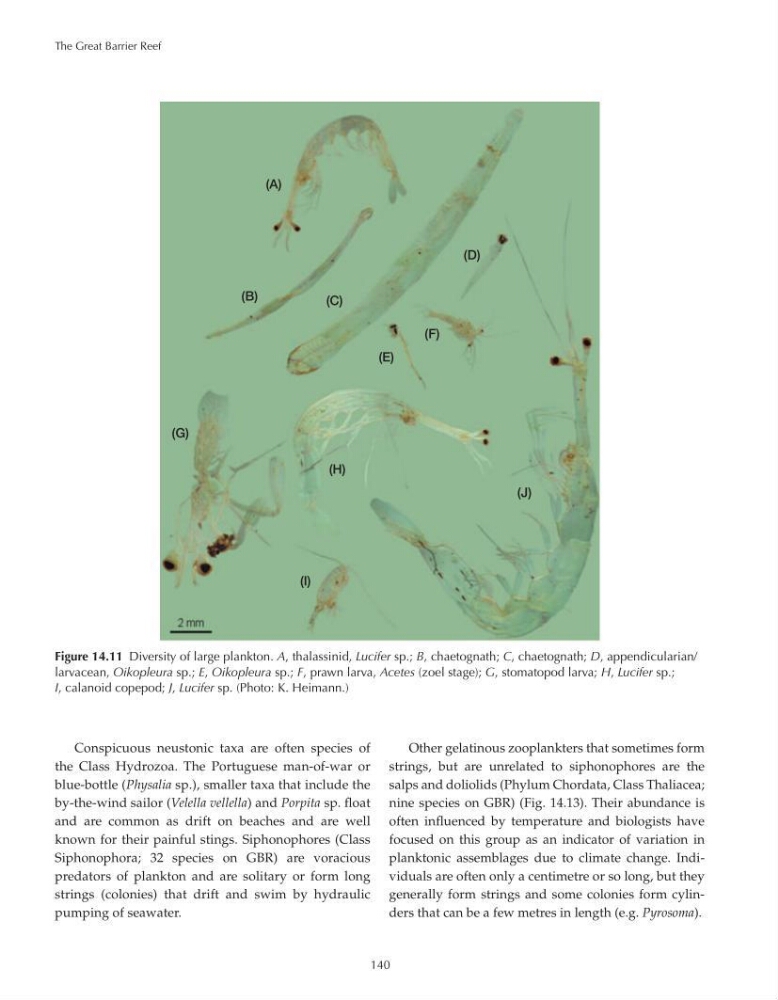
Figure 14.11 Diversity of large plankton. A, thalassinid, Lucifer sp.; B, chaetognath; C, chaetognath; D, appendicularian/
larvacean, Oikopleura sp.; E, Oikopleura sp.; F, prawn larva, Acetes (zoel stage); G, stomatopod larva; H, Lucifer sp.;
I, calanoid copepod; J, Lucifer sp. (Photo: K. Heimann.)
(A)
(B)
(G)
(I)
(F)
(D)
(E)
(H)
(J)
(C)
140
Conspicuous neustonic taxa are often species of
the Class Hydrozoa. The Portuguese man-of-war or
blue-bottle (Physalia sp.), smaller taxa that include the
by-the-wind sailor (Velella vellella) and Porpita sp. float
and are common as drift on beaches and are well
known for their painful stings. Siphonophores (Class
Siphonophora; 32 species on GBR) are voracious
predators of plankton and are solitary or form long
strings (colonies) that drift and swim by hydraulic
pumping of seawater.
Other gelatinous zooplankters that sometimes form
strings, but are unrelated to siphonophores are the
salps and doliolids (Phylum Chordata, Class Thaliacea;
nine species on GBR) (Fig. 14.13). Their abundance is
often influenced by temperature and biologists have
focused on this group as an indicator of variation in
planktonic assemblages due to climate change. Individuals are often only a centimetre or so long, but they
generally form strings and some colonies form cylinders that can be a few metres in length (e.g. Pyrosoma).
Figure 14.11 Diversity of large plankton. A, thalassinid, Lucifer sp.; B, chaetognath; C, chaetognath; D, appendicularian/
larvacean, Oikopleura sp.; E, Oikopleura sp.; F, prawn larva, Acetes (zoel stage); G, stomatopod larva; H, Lucifer sp.;
I, calanoid copepod; J, Lucifer sp. (Photo: K. Heimann.)
(A)
(B)
(G)
(I)
(F)
(D)
(E)
(H)
(J)
(C)