

14 – Plankton
141
Insects are periodically collected and these are not
always an allochthonous (land derived) component
lost from land. Halobates, the only truly marine insect,
is a cosmopolitan pleustonic marine bug that skims
the water surface feeding on surface-associated prey;
mites are also occasionally found in the ocean,
although common in sediments.
N LINKS BETWEEN ENVIRONMENTS
AND MIGRATIONS
Links with the substratum
Planktonic organisms often have strong links with the
substratum. For example, most jellyfishes start life on
the substratum. The fertilised eggs of jellyfishes develop into ‘hairy’ planula, which settle on the substratum and grow into polyps. The polyps grow and bud
into other polyps. When conditions in the water column are suitable the polyps ‘strobilate’ (i.e. bud) and
release tiny (~2 mm) ‘ephyrae’ into the water column.
They grow into tiny jellyfish and grow rapidly to adult
form. For example, the polyps of stingers are found in
estuaries and the release of small jellyfish is triggered
by the input of freshwater.
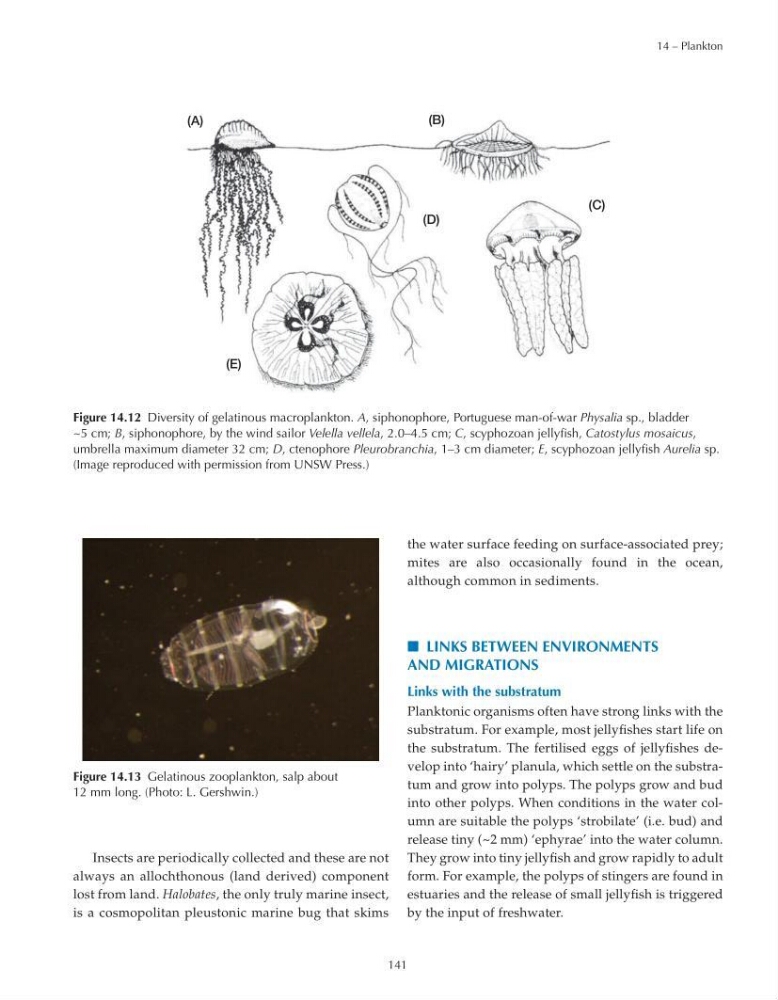
Figure 14.12 Diversity of gelatinous macroplankton. A, siphonophore, Portuguese man-of-war Physalia sp., bladder
~5 cm; B, siphonophore, by the wind sailor Velella vellela, 2.0–4.5 cm; C, scyphozoan jellyfish, Catostylus mosaicus,
umbrella maximum diameter 32 cm; D, ctenophore Pleurobranchia, 1–3 cm diameter; E, scyphozoan jellyfish Aurelia sp.
(Image reproduced with permission from UNSW Press.)
(A)
(B)
(C)
(D)
(E)
Figure 14.13 Gelatinous zooplankton, salp about
12 mm long. (Photo: L. Gershwin.)
141
Insects are periodically collected and these are not
always an allochthonous (land derived) component
lost from land. Halobates, the only truly marine insect,
is a cosmopolitan pleustonic marine bug that skims
the water surface feeding on surface-associated prey;
mites are also occasionally found in the ocean,
although common in sediments.
N LINKS BETWEEN ENVIRONMENTS
AND MIGRATIONS
Links with the substratum
Planktonic organisms often have strong links with the
substratum. For example, most jellyfishes start life on
the substratum. The fertilised eggs of jellyfishes develop into ‘hairy’ planula, which settle on the substratum and grow into polyps. The polyps grow and bud
into other polyps. When conditions in the water column are suitable the polyps ‘strobilate’ (i.e. bud) and
release tiny (~2 mm) ‘ephyrae’ into the water column.
They grow into tiny jellyfish and grow rapidly to adult
form. For example, the polyps of stingers are found in
estuaries and the release of small jellyfish is triggered
by the input of freshwater.
Figure 14.12 Diversity of gelatinous macroplankton. A, siphonophore, Portuguese man-of-war Physalia sp., bladder
~5 cm; B, siphonophore, by the wind sailor Velella vellela, 2.0–4.5 cm; C, scyphozoan jellyfish, Catostylus mosaicus,
umbrella maximum diameter 32 cm; D, ctenophore Pleurobranchia, 1–3 cm diameter; E, scyphozoan jellyfish Aurelia sp.
(Image reproduced with permission from UNSW Press.)
(A)
(B)
(C)
(D)
(E)
Figure 14.13 Gelatinous zooplankton, salp about
12 mm long. (Photo: L. Gershwin.)