

14 – Plankton
135
organisms swim very fast, changing directions frequently diving in and out of the focal plain of the high
resolution objectives. In most instances, verification by
optical and electron microscopy (scanning electron
microscopy for surface structures and flagellation and
transmission electron microscopy for chloroplast and
flagellar apparatus characteristics) is required to assign these organisms to a particular phylum/class.
Another problem in analysing the species composition
and abundance of nanoplankton is that unambiguous
identification requires knowledge about the ‘colour’
of these organisms (i.e. pigments—the presence and
combinations of the various chlorophylls). Typically
the colour of individual cells is not readily observed
due to their small size, adding to the problem of positively identifying members of the nanoplankton
BOX 14.2 TRICHODESMIUM – A SMALL BUT IMPORTANT BLUE
GREEN ALGA (= CYANOBACTERIA)
Trichodesmium is a filamentous blue green alga that is often abundant in the water column and aggregated at the surface of tropical waters. Trichodesmium will form visible
blooms under ideal environmental conditions (calm) and colonies (tuft colonies generated by the parallel alignment of filaments or puff colonies due to radial alignment are
0.5–3 mm in diameter, so often visible to the naked eye). Great drifts, usually of dead
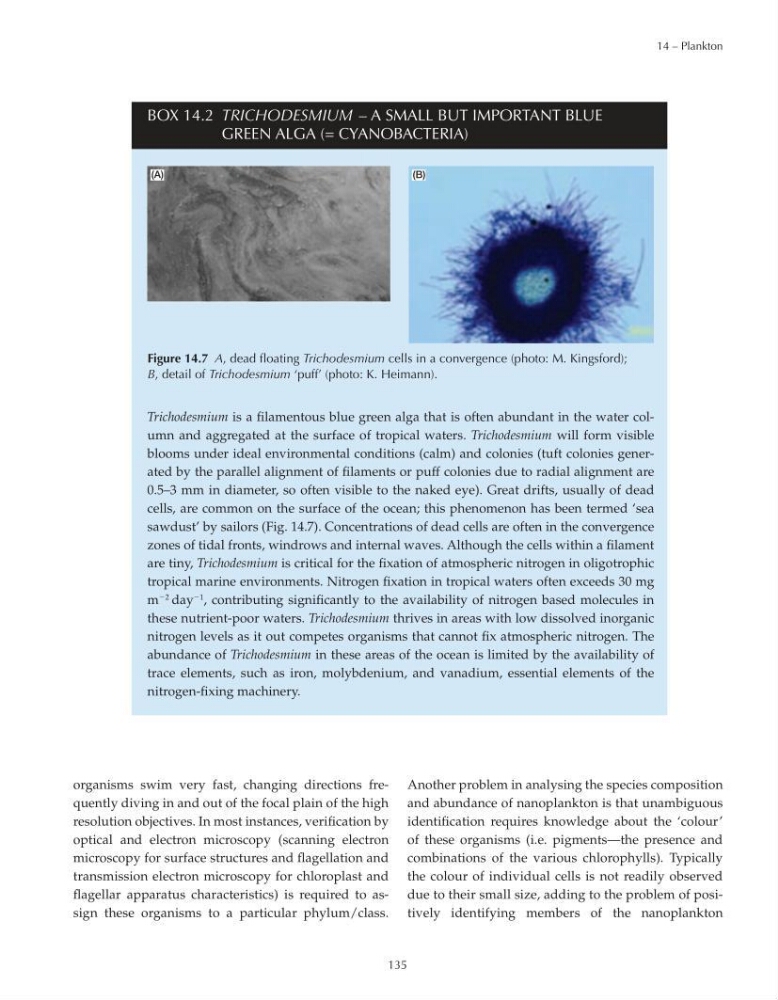
cells, are common on the surface of the ocean; this phenomenon has been termed ‘sea
sawdust’ by sailors (Fig. 14.7). Concentrations of dead cells are often in the convergence
zones of tidal fronts, windrows and internal waves. Although the cells within a filament
are tiny, Trichodesmium is critical for the fixation of atmospheric nitrogen in oligotrophic
tropical marine environments. Nitrogen fixation in tropical waters often exceeds 30 mg
m
2 day
1
, contributing significantly to the availability of nitrogen based molecules in
these nutrient-poor waters. Trichodesmium thrives in areas with low dissolved inorganic
nitrogen levels as it out competes organisms that cannot fix atmospheric nitrogen. The
abundance of Trichodesmium in these areas of the ocean is limited by the availability of
trace elements, such as iron, molybdenium, and vanadium, essential elements of the
nitrogen-fixing machinery.
(A)
Figure 14.7 A, dead floating Trichodesmium cells in a convergence (photo: M. Kingsford);
B, detail of Trichodesmium ‘puff’ (photo: K. Heimann).
(B)
135
organisms swim very fast, changing directions frequently diving in and out of the focal plain of the high
resolution objectives. In most instances, verification by
optical and electron microscopy (scanning electron
microscopy for surface structures and flagellation and
transmission electron microscopy for chloroplast and
flagellar apparatus characteristics) is required to assign these organisms to a particular phylum/class.
Another problem in analysing the species composition
and abundance of nanoplankton is that unambiguous
identification requires knowledge about the ‘colour’
of these organisms (i.e. pigments—the presence and
combinations of the various chlorophylls). Typically
the colour of individual cells is not readily observed
due to their small size, adding to the problem of positively identifying members of the nanoplankton
BOX 14.2 TRICHODESMIUM – A SMALL BUT IMPORTANT BLUE
GREEN ALGA (= CYANOBACTERIA)
Trichodesmium is a filamentous blue green alga that is often abundant in the water column and aggregated at the surface of tropical waters. Trichodesmium will form visible
blooms under ideal environmental conditions (calm) and colonies (tuft colonies generated by the parallel alignment of filaments or puff colonies due to radial alignment are
0.5–3 mm in diameter, so often visible to the naked eye). Great drifts, usually of dead
cells, are common on the surface of the ocean; this phenomenon has been termed ‘sea
sawdust’ by sailors (Fig. 14.7). Concentrations of dead cells are often in the convergence
zones of tidal fronts, windrows and internal waves. Although the cells within a filament
are tiny, Trichodesmium is critical for the fixation of atmospheric nitrogen in oligotrophic
tropical marine environments. Nitrogen fixation in tropical waters often exceeds 30 mg
m
2 day
1
, contributing significantly to the availability of nitrogen based molecules in
these nutrient-poor waters. Trichodesmium thrives in areas with low dissolved inorganic
nitrogen levels as it out competes organisms that cannot fix atmospheric nitrogen. The
abundance of Trichodesmium in these areas of the ocean is limited by the availability of
trace elements, such as iron, molybdenium, and vanadium, essential elements of the
nitrogen-fixing machinery.
(A)
Figure 14.7 A, dead floating Trichodesmium cells in a convergence (photo: M. Kingsford);
B, detail of Trichodesmium ‘puff’ (photo: K. Heimann).
(B)