

The Great Barrier Reef
136
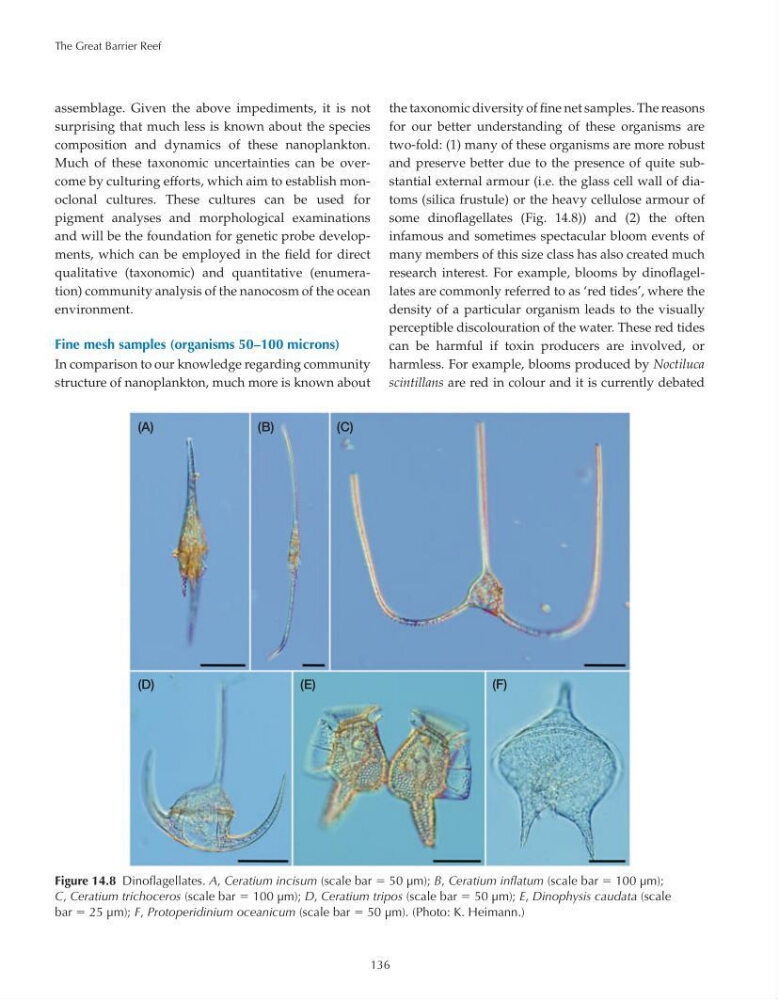
Figure 14.8 Dinoflagellates. A, Ceratium incisum (scale bar 50 μm); B, Ceratium inflatum (scale bar 100 μm);
C, Ceratium trichoceros (scale bar 100 μm); D, Ceratium tripos (scale bar 50 μm); E, Dinophysis caudata (scale
bar 25 μm); F, Protoperidinium oceanicum (scale bar 50 μm). (Photo: K. Heimann.)
(A)
(B)
(C)
(E)
(D)
(F)
assemblage. Given the above impediments, it is not
surprising that much less is known about the species
composition and dynamics of these nanoplankton.
Much of these taxonomic uncertainties can be overcome by culturing efforts, which aim to establish monoclonal cultures. These cultures can be used for
pigment analyses and morphological examinations
and will be the foundation for genetic probe developments, which can be employed in the field for direct
qualitative (taxonomic) and quantitative (enumeration) community analysis of the nanocosm of the ocean
environment.
Fine mesh samples (organisms 50–100 microns)
In comparison to our knowledge regarding community
structure of nanoplankton, much more is known about
the taxonomic diversity of fine net samples. The reasons
for our better understanding of these organisms are
two-fold: (1) many of these organisms are more robust
and preserve better due to the presence of quite substantial external armour (i.e. the glass cell wall of diatoms (silica frustule) or the heavy cellulose armour of
some dinoflagellates (Fig. 14.8)) and (2) the often
infamous and sometimes spectacular bloom events of
many members of this size class has also created much
research interest. For example, blooms by dinoflagellates are commonly referred to as ‘red tides’, where the
density of a particular organism leads to the visually
perceptible discolouration of the water. These red tides
can be harmful if toxin producers are involved, or
harmless. For example, blooms produced by Noctiluca
scintillans are red in colour and it is currently debated
136
Figure 14.8 Dinoflagellates. A, Ceratium incisum (scale bar 50 μm); B, Ceratium inflatum (scale bar 100 μm);
C, Ceratium trichoceros (scale bar 100 μm); D, Ceratium tripos (scale bar 50 μm); E, Dinophysis caudata (scale
bar 25 μm); F, Protoperidinium oceanicum (scale bar 50 μm). (Photo: K. Heimann.)
(A)
(B)
(C)
(E)
(D)
(F)
assemblage. Given the above impediments, it is not
surprising that much less is known about the species
composition and dynamics of these nanoplankton.
Much of these taxonomic uncertainties can be overcome by culturing efforts, which aim to establish monoclonal cultures. These cultures can be used for
pigment analyses and morphological examinations
and will be the foundation for genetic probe developments, which can be employed in the field for direct
qualitative (taxonomic) and quantitative (enumeration) community analysis of the nanocosm of the ocean
environment.
Fine mesh samples (organisms 50–100 microns)
In comparison to our knowledge regarding community
structure of nanoplankton, much more is known about
the taxonomic diversity of fine net samples. The reasons
for our better understanding of these organisms are
two-fold: (1) many of these organisms are more robust
and preserve better due to the presence of quite substantial external armour (i.e. the glass cell wall of diatoms (silica frustule) or the heavy cellulose armour of
some dinoflagellates (Fig. 14.8)) and (2) the often
infamous and sometimes spectacular bloom events of
many members of this size class has also created much
research interest. For example, blooms by dinoflagellates are commonly referred to as ‘red tides’, where the
density of a particular organism leads to the visually
perceptible discolouration of the water. These red tides
can be harmful if toxin producers are involved, or
harmless. For example, blooms produced by Noctiluca
scintillans are red in colour and it is currently debated