

13 – Biodiversity
125
described, with several major biogeographic patterns
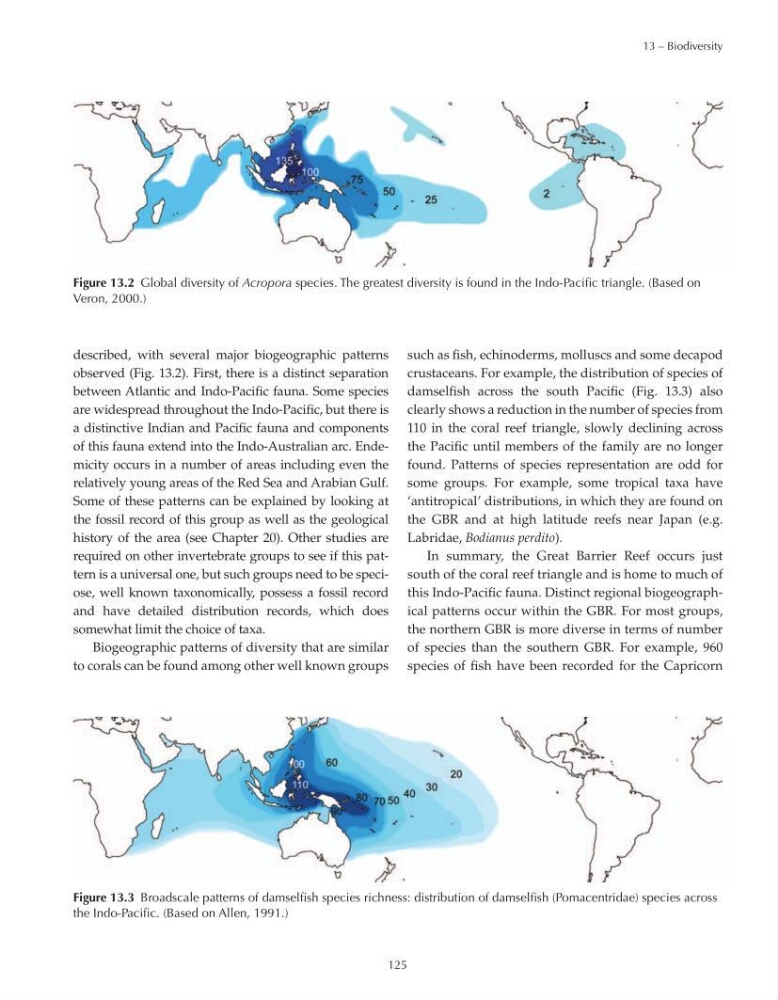
observed (Fig. 13.2). First, there is a distinct separation
between Atlantic and Indo-Pacific fauna. Some species
are widespread throughout the Indo-Pacific, but there is
a distinctive Indian and Pacific fauna and components
of this fauna extend into the Indo-Australian arc. Endemicity occurs in a number of areas including even the
relatively young areas of the Red Sea and Arabian Gulf.
Some of these patterns can be explained by looking at
the fossil record of this group as well as the geological
history of the area (see Chapter 20). Other studies are
required on other invertebrate groups to see if this pattern is a universal one, but such groups need to be speciose, well known taxonomically, possess a fossil record
and have detailed distribution records, which does
somewhat limit the choice of taxa.
Biogeographic patterns of diversity that are similar
to corals can be found among other well known groups
such as fish, echinoderms, molluscs and some decapod
crustaceans. For example, the distribution of species of
damselfish across the south Pacific (Fig. 13.3) also
clearly shows a reduction in the number of species from
110 in the coral reef triangle, slowly declining across
the Pacific until members of the family are no longer
found. Patterns of species representation are odd for
some groups. For example, some tropical taxa have
‘antitropical’ distributions, in which they are found on
the GBR and at high latitude reefs near Japan (e.g.
Labridae, Bodianus perdito).
In summary, the Great Barrier Reef occurs just
south of the coral reef triangle and is home to much of
this Indo-Pacific fauna. Distinct regional biogeographical patterns occur within the GBR. For most groups,
the northern GBR is more diverse in terms of number
of species than the southern GBR. For example, 960
species of fish have been recorded for the Capricorn
Figure 13.2 Global diversity of Acropora species. The greatest diversity is found in the Indo-Pacific triangle. (Based on
Veron, 2000.)
Figure 13.3 Broadscale patterns of damselfish species richness: distribution of damselfish (Pomacentridae) species across
the Indo-Pacific. (Based on Allen, 1991.)
125
described, with several major biogeographic patterns
observed (Fig. 13.2). First, there is a distinct separation
between Atlantic and Indo-Pacific fauna. Some species
are widespread throughout the Indo-Pacific, but there is
a distinctive Indian and Pacific fauna and components
of this fauna extend into the Indo-Australian arc. Endemicity occurs in a number of areas including even the
relatively young areas of the Red Sea and Arabian Gulf.
Some of these patterns can be explained by looking at
the fossil record of this group as well as the geological
history of the area (see Chapter 20). Other studies are
required on other invertebrate groups to see if this pattern is a universal one, but such groups need to be speciose, well known taxonomically, possess a fossil record
and have detailed distribution records, which does
somewhat limit the choice of taxa.
Biogeographic patterns of diversity that are similar
to corals can be found among other well known groups
such as fish, echinoderms, molluscs and some decapod
crustaceans. For example, the distribution of species of
damselfish across the south Pacific (Fig. 13.3) also
clearly shows a reduction in the number of species from
110 in the coral reef triangle, slowly declining across
the Pacific until members of the family are no longer
found. Patterns of species representation are odd for
some groups. For example, some tropical taxa have
‘antitropical’ distributions, in which they are found on
the GBR and at high latitude reefs near Japan (e.g.
Labridae, Bodianus perdito).
In summary, the Great Barrier Reef occurs just
south of the coral reef triangle and is home to much of
this Indo-Pacific fauna. Distinct regional biogeographical patterns occur within the GBR. For most groups,
the northern GBR is more diverse in terms of number
of species than the southern GBR. For example, 960
species of fish have been recorded for the Capricorn
Figure 13.2 Global diversity of Acropora species. The greatest diversity is found in the Indo-Pacific triangle. (Based on
Veron, 2000.)
Figure 13.3 Broadscale patterns of damselfish species richness: distribution of damselfish (Pomacentridae) species across
the Indo-Pacific. (Based on Allen, 1991.)