

The Great Barrier Reef
126
Group whereas over 1500 species have been found in
the Lizard Island area. While diversity of habitats may
explain some of this increase, warmer sea temperatures play a potentially important role. Certainly some
species occur throughout the GBR whereas others are
restricted to more northern regions. For example,
the leopard coral trout (Plectropomus leopardus) and
Chinese footballer (Plectropomus laevis) are found
throughout the GBR whereas the square tail grouper,
Plectropomus areolatus, is only found north of about
11°S (near Lizard Island).
In addition to latitudinal changes, the variation in
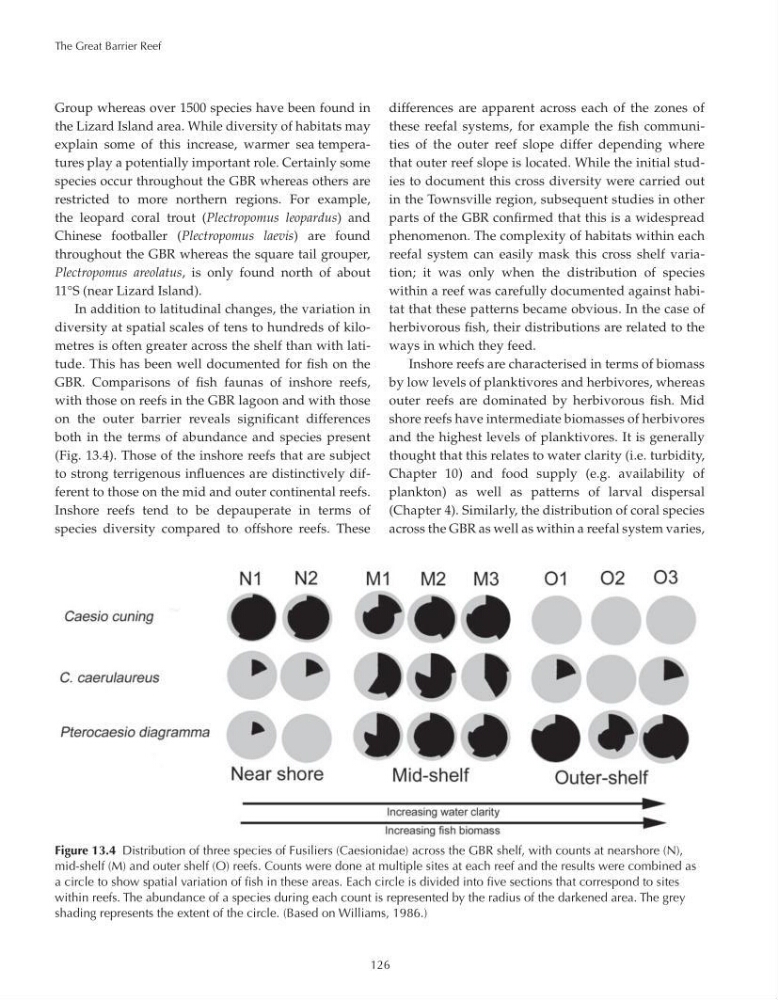
diversity at spatial scales of tens to hundreds of kilometres is often greater across the shelf than with latitude. This has been well documented for fish on the
GBR. Comparisons of fish faunas of inshore reefs,
with those on reefs in the GBR lagoon and with those
on the outer barrier reveals significant differences
both in the terms of abundance and species present
(Fig. 13.4). Those of the inshore reefs that are subject
to strong terrigenous influences are distinctively different to those on the mid and outer continental reefs.
Inshore reefs tend to be depauperate in terms of
species diversity compared to offshore reefs. These
differences are apparent across each of the zones of
these reefal systems, for example the fish communities of the outer reef slope differ depending where
that outer reef slope is located. While the initial studies to document this cross diversity were carried out
in the Townsville region, subsequent studies in other
parts of the GBR confirmed that this is a widespread
phenomenon. The complexity of habitats within each
reefal system can easily mask this cross shelf variation; it was only when the distribution of species
within a reef was carefully documented against habitat that these patterns became obvious. In the case of
herbivorous fish, their distributions are related to the
ways in which they feed.
Inshore reefs are characterised in terms of biomass
by low levels of planktivores and herbivores, whereas
outer reefs are dominated by herbivorous fish. Mid
shore reefs have intermediate biomasses of herbivores
and the highest levels of planktivores. It is generally
thought that this relates to water clarity (i.e. turbidity,
Chapter 10) and food supply (e.g. availability of
plankton) as well as patterns of larval dispersal
( Chapter 4). Similarly, the distribution of coral species
across the GBR as well as within a reefal system varies,
Figure 13.4 Distribution of three species of Fusiliers (Caesionidae) across the GBR shelf, with counts at nearshore (N),
mid-shelf (M) and outer shelf (O) reefs. Counts were done at multiple sites at each reef and the results were combined as
a circle to show spatial variation of fish in these areas. Each circle is divided into five sections that correspond to sites
within reefs. The abundance of a species during each count is represented by the radius of the darkened area. The grey
shading represents the extent of the circle. (Based on Williams, 1986.)
126
Group whereas over 1500 species have been found in
the Lizard Island area. While diversity of habitats may
explain some of this increase, warmer sea temperatures play a potentially important role. Certainly some
species occur throughout the GBR whereas others are
restricted to more northern regions. For example,
the leopard coral trout (Plectropomus leopardus) and
Chinese footballer (Plectropomus laevis) are found
throughout the GBR whereas the square tail grouper,
Plectropomus areolatus, is only found north of about
11°S (near Lizard Island).
In addition to latitudinal changes, the variation in
diversity at spatial scales of tens to hundreds of kilometres is often greater across the shelf than with latitude. This has been well documented for fish on the
GBR. Comparisons of fish faunas of inshore reefs,
with those on reefs in the GBR lagoon and with those
on the outer barrier reveals significant differences
both in the terms of abundance and species present
(Fig. 13.4). Those of the inshore reefs that are subject
to strong terrigenous influences are distinctively different to those on the mid and outer continental reefs.
Inshore reefs tend to be depauperate in terms of
species diversity compared to offshore reefs. These
differences are apparent across each of the zones of
these reefal systems, for example the fish communities of the outer reef slope differ depending where
that outer reef slope is located. While the initial studies to document this cross diversity were carried out
in the Townsville region, subsequent studies in other
parts of the GBR confirmed that this is a widespread
phenomenon. The complexity of habitats within each
reefal system can easily mask this cross shelf variation; it was only when the distribution of species
within a reef was carefully documented against habitat that these patterns became obvious. In the case of
herbivorous fish, their distributions are related to the
ways in which they feed.
Inshore reefs are characterised in terms of biomass
by low levels of planktivores and herbivores, whereas
outer reefs are dominated by herbivorous fish. Mid
shore reefs have intermediate biomasses of herbivores
and the highest levels of planktivores. It is generally
thought that this relates to water clarity (i.e. turbidity,
Chapter 10) and food supply (e.g. availability of
plankton) as well as patterns of larval dispersal
( Chapter 4). Similarly, the distribution of coral species
across the GBR as well as within a reefal system varies,
Figure 13.4 Distribution of three species of Fusiliers (Caesionidae) across the GBR shelf, with counts at nearshore (N),
mid-shelf (M) and outer shelf (O) reefs. Counts were done at multiple sites at each reef and the results were combined as
a circle to show spatial variation of fish in these areas. Each circle is divided into five sections that correspond to sites
within reefs. The abundance of a species during each count is represented by the radius of the darkened area. The grey
shading represents the extent of the circle. (Based on Williams, 1986.)