

The Great Barrier Reef
90
the frequency and intensity of warm water events is set
to rise in coming decades. Unprecedented large scale
coral bleaching occurred on the GBR in 1998 and 2002
(Chapter 10). On the GBR, researchers have documented a steady increase in the incidence of coral disease over recent years, which may relate to rising
sea-surface temperatures. In the longer term, ocean
acidification is also likely to affect the growth rate and
skeletal composition of corals.
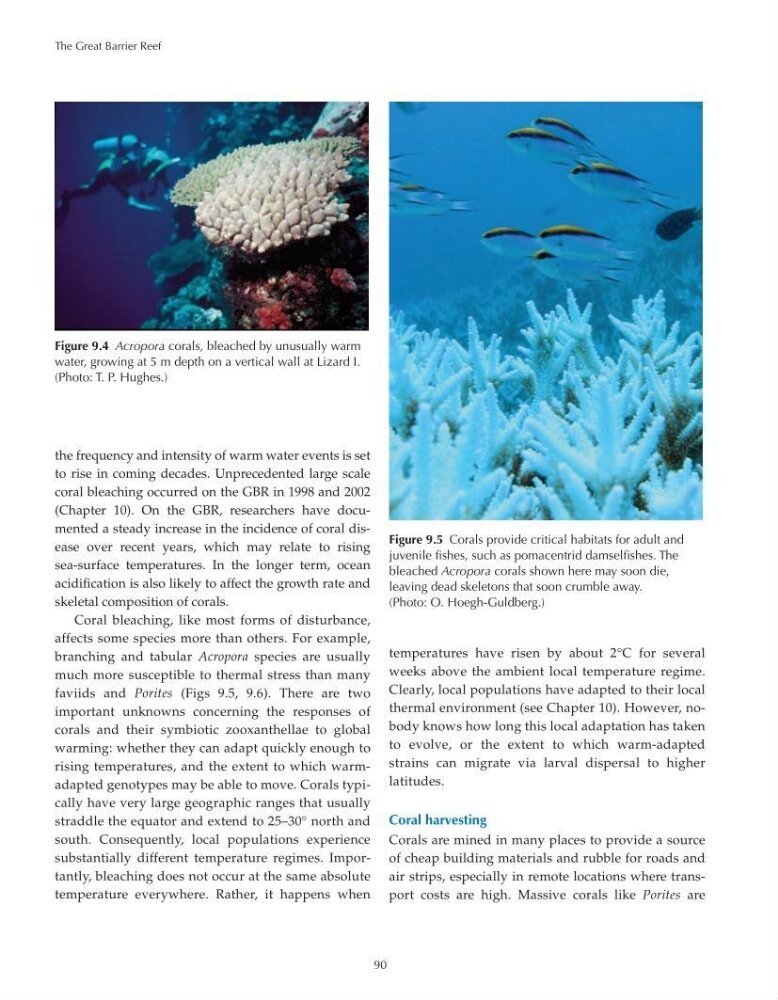
Coral bleaching, like most forms of disturbance,
affects some species more than others. For example,
branching and tabular Acropora species are usually
much more susceptible to thermal stress than many
faviids and Porites (Figs 9.5, 9.6). There are two
important unknowns concerning the responses of
corals and their symbiotic zooxanthellae to global
warming: whether they can adapt quickly enough to
rising temperatures, and the extent to which warmadapted genotypes may be able to move. Corals typically have very large geographic ranges that usually
straddle the equator and extend to 25–30° north and
south. Consequently, local populations experience
substantially different temperature regimes. Importantly, bleaching does not occur at the same absolute
temperature everywhere. Rather, it happens when
Figure 9.4 Acropora corals, bleached by unusually warm
water, growing at 5 m depth on a vertical wall at Lizard I.
(Photo: T. P. Hughes.)
Figure 9.5 Corals provide critical habitats for adult and
juvenile fishes, such as pomacentrid damselfishes. The
bleached Acropora corals shown here may soon die,
leaving dead skeletons that soon crumble away.
(Photo: O. Hoegh-Guldberg.)
temperatures have risen by about 2°C for several
weeks above the ambient local temperature regime.
Clearly, local populations have adapted to their local
thermal environment (see Chapter 10). However, nobody knows how long this local adaptation has taken
to evolve, or the extent to which warm-adapted
strains can migrate via larval dispersal to higher
latitudes.
Coral harvesting
Corals are mined in many places to provide a source
of cheap building materials and rubble for roads and
air strips, especially in remote locations where transport costs are high. Massive corals like Porites are
90
the frequency and intensity of warm water events is set
to rise in coming decades. Unprecedented large scale
coral bleaching occurred on the GBR in 1998 and 2002
(Chapter 10). On the GBR, researchers have documented a steady increase in the incidence of coral disease over recent years, which may relate to rising
sea-surface temperatures. In the longer term, ocean
acidification is also likely to affect the growth rate and
skeletal composition of corals.
Coral bleaching, like most forms of disturbance,
affects some species more than others. For example,
branching and tabular Acropora species are usually
much more susceptible to thermal stress than many
faviids and Porites (Figs 9.5, 9.6). There are two
important unknowns concerning the responses of
corals and their symbiotic zooxanthellae to global
warming: whether they can adapt quickly enough to
rising temperatures, and the extent to which warmadapted genotypes may be able to move. Corals typically have very large geographic ranges that usually
straddle the equator and extend to 25–30° north and
south. Consequently, local populations experience
substantially different temperature regimes. Importantly, bleaching does not occur at the same absolute
temperature everywhere. Rather, it happens when
Figure 9.4 Acropora corals, bleached by unusually warm
water, growing at 5 m depth on a vertical wall at Lizard I.
(Photo: T. P. Hughes.)
Figure 9.5 Corals provide critical habitats for adult and
juvenile fishes, such as pomacentrid damselfishes. The
bleached Acropora corals shown here may soon die,
leaving dead skeletons that soon crumble away.
(Photo: O. Hoegh-Guldberg.)
temperatures have risen by about 2°C for several
weeks above the ambient local temperature regime.
Clearly, local populations have adapted to their local
thermal environment (see Chapter 10). However, nobody knows how long this local adaptation has taken
to evolve, or the extent to which warm-adapted
strains can migrate via larval dispersal to higher
latitudes.
Coral harvesting
Corals are mined in many places to provide a source
of cheap building materials and rubble for roads and
air strips, especially in remote locations where transport costs are high. Massive corals like Porites are