

9 – Human Impact on Coral Reefs
89
suspended material) on inner reefs is typically 1–5 m,
and about 10–20 m on average further offshore on midshelf reefs. This compares with 40 m or more in, for example, the Caribbean and on oceanic reefs.
Bottom-up effects. Inputs from sewage and runoff of
fertilisers can potentially cause eutrophication on coral
reefs. The iconic example of sewage effects on a coral
reef come from Kaneohe Bay, Hawaii. The bay is very
shallow, connected to the ocean by a narrow opening
(i.e. it has a very low flushing rate compared to most
reefs), and the land area surrounding it is densely populated. It has a long history of other impacts such as
dredging and overfishing and has a high proportion of
pest species introduced by shipping. From 1963–1977
secondary sewage was discharged into Kaneohe Bay
from three outfalls at a rate of up to 20 000 m
3 of sewage
each day. There are also several streams entering the bay,
carrying urban and suburban runoff. The increased nutrients resulted in higher sediment loads and phytoplankton blooms. Coral patch reefs were colonised by
benthic macroalgae and suspension feeders (bivalves
and sponges), while coral cover declined sharply. These
effects exhibited a gradient away from the sewage outfalls. In 1977 the sewage pipe was extended (‘diverted’)
into deeper water. Water clarity improved, the filter feeders and algae declined, and the corals slowly increased.
Destructive population explosions of the coralfeeding crown-of-thorns starfish, Acanthaster planci, may
also be related to nutrient enrichment (see Chapters 11
and 26). The outbreaks were first observed in the late
1950s and 1960s, when many corals reefs in Australia,
Guam, Japan, the Red Sea and elsewhere were badly
damaged by enormous densities of starfish. Since then,
there have been repeated outbreaks throughout most of
the starfish’s geographic range, and they have become a
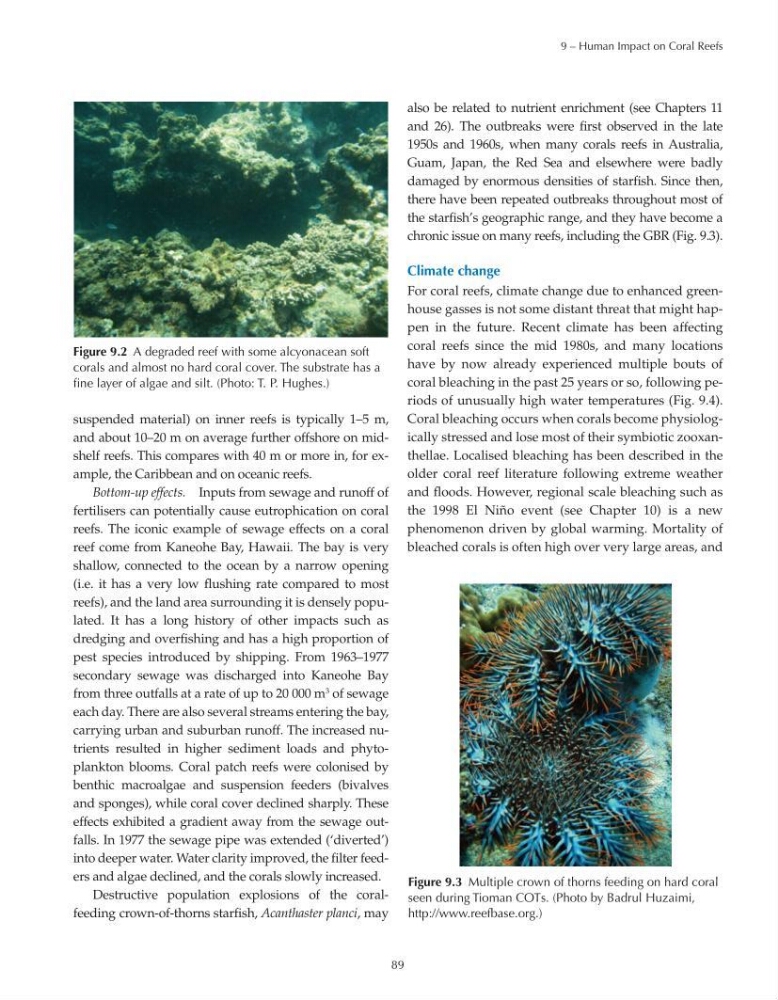
chronic issue on many reefs, including the GBR (Fig. 9.3).
Climate change
For coral reefs, climate change due to enhanced greenhouse gasses is not some distant threat that might happen in the future. Recent climate has been affecting
coral reefs since the mid 1980s, and many locations
have by now already experienced multiple bouts of
coral bleaching in the past 25 years or so, following periods of unusually high water temperatures (Fig. 9.4).
Coral bleaching occurs when corals become physiologically stressed and lose most of their symbiotic zooxanthellae. Localised bleaching has been described in the
older coral reef literature following extreme weather
and floods. However, regional scale bleaching such as
the 1998 El Niño event (see Chapter 10) is a new
phenomenon driven by global warming. Mortality of
bleached corals is often high over very large areas, and
Figure 9.2 A degraded reef with some alcyonacean soft
corals and almost no hard coral cover. The substrate has a
fine layer of algae and silt. (Photo: T. P. Hughes.)
Figure 9.3 Multiple crown of thorns feeding on hard coral
seen during Tioman COTs. (Photo by Badrul Huzaimi,
http://www.reefbase.org.)
89
suspended material) on inner reefs is typically 1–5 m,
and about 10–20 m on average further offshore on midshelf reefs. This compares with 40 m or more in, for example, the Caribbean and on oceanic reefs.
Bottom-up effects. Inputs from sewage and runoff of
fertilisers can potentially cause eutrophication on coral
reefs. The iconic example of sewage effects on a coral
reef come from Kaneohe Bay, Hawaii. The bay is very
shallow, connected to the ocean by a narrow opening
(i.e. it has a very low flushing rate compared to most
reefs), and the land area surrounding it is densely populated. It has a long history of other impacts such as
dredging and overfishing and has a high proportion of
pest species introduced by shipping. From 1963–1977
secondary sewage was discharged into Kaneohe Bay
from three outfalls at a rate of up to 20 000 m
3 of sewage
each day. There are also several streams entering the bay,
carrying urban and suburban runoff. The increased nutrients resulted in higher sediment loads and phytoplankton blooms. Coral patch reefs were colonised by
benthic macroalgae and suspension feeders (bivalves
and sponges), while coral cover declined sharply. These
effects exhibited a gradient away from the sewage outfalls. In 1977 the sewage pipe was extended (‘diverted’)
into deeper water. Water clarity improved, the filter feeders and algae declined, and the corals slowly increased.
Destructive population explosions of the coralfeeding crown-of-thorns starfish, Acanthaster planci, may
also be related to nutrient enrichment (see Chapters 11
and 26). The outbreaks were first observed in the late
1950s and 1960s, when many corals reefs in Australia,
Guam, Japan, the Red Sea and elsewhere were badly
damaged by enormous densities of starfish. Since then,
there have been repeated outbreaks throughout most of
the starfish’s geographic range, and they have become a
chronic issue on many reefs, including the GBR (Fig. 9.3).
Climate change
For coral reefs, climate change due to enhanced greenhouse gasses is not some distant threat that might happen in the future. Recent climate has been affecting
coral reefs since the mid 1980s, and many locations
have by now already experienced multiple bouts of
coral bleaching in the past 25 years or so, following periods of unusually high water temperatures (Fig. 9.4).
Coral bleaching occurs when corals become physiologically stressed and lose most of their symbiotic zooxanthellae. Localised bleaching has been described in the
older coral reef literature following extreme weather
and floods. However, regional scale bleaching such as
the 1998 El Niño event (see Chapter 10) is a new
phenomenon driven by global warming. Mortality of
bleached corals is often high over very large areas, and
Figure 9.2 A degraded reef with some alcyonacean soft
corals and almost no hard coral cover. The substrate has a
fine layer of algae and silt. (Photo: T. P. Hughes.)
Figure 9.3 Multiple crown of thorns feeding on hard coral
seen during Tioman COTs. (Photo by Badrul Huzaimi,
http://www.reefbase.org.)