

Organic compounds in non-saline sediments 163
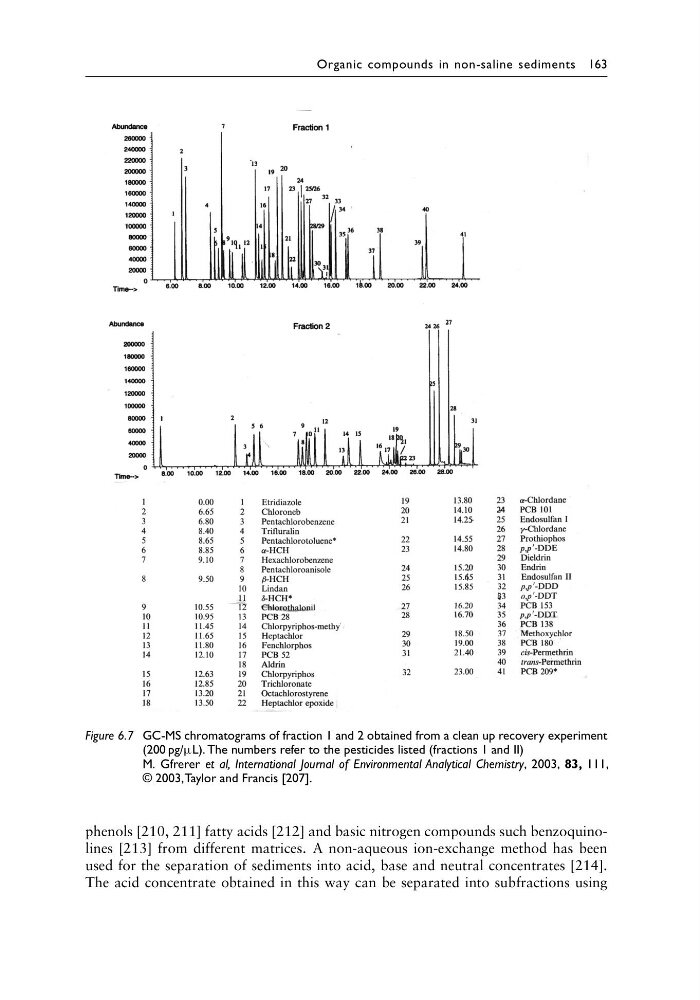
Figure 6.7 GC-MS chromatograms of fraction 1 and 2 obtained from a clean up recovery experiment
(200 pg/µL). The numbers refer to the pesticides listed (fractions 1 and II)
M. Gfrerer et al, International Journal of Environmental Analytical Chemistry, 2003, 83, 111,
© 2003,Taylor and Francis [207].
phenols [210, 211] fatty acids [212] and basic nitrogen compounds such benzoquinolines [213] from different matrices. A non-aqueous ion-exchange method has been
used for the separation of sediments into acid, base and neutral concentrates [214].
The acid concentrate obtained in this way can be separated into subfractions using
Figure 6.7 GC-MS chromatograms of fraction 1 and 2 obtained from a clean up recovery experiment
(200 pg/µL). The numbers refer to the pesticides listed (fractions 1 and II)
M. Gfrerer et al, International Journal of Environmental Analytical Chemistry, 2003, 83, 111,
© 2003,Taylor and Francis [207].
phenols [210, 211] fatty acids [212] and basic nitrogen compounds such benzoquinolines [213] from different matrices. A non-aqueous ion-exchange method has been
used for the separation of sediments into acid, base and neutral concentrates [214].
The acid concentrate obtained in this way can be separated into subfractions using