

Extraction of organic compounds from sediments 127
Table 5.2 Chemical Leaching of Sediments.
Cadmium. % of total
cadmium content of
unfractionated sample
Extractant
Species Extracted
found in the fraction
LiCl-CsCl MeOH @ 20
◦ C
readily exchanged ions
17
CH 3 COONa pH 5.0 @ 20
◦ C
carbonate bound surface
31
oxide bound ions
NH 2 OH · HCl-CH 3 COOH @ 20
◦ C
ions bound to Fe and Min oxides
34
H 2 O 2 pH 2.0 @ 90
◦ C
organically and sulphide bound ions
12
aqua regia-HF-HCl-H 2 O 2
ions bound to residue phase
6
Source: Author’s own files.
size range, these filters can be used to separate different size classes of material we
would normally consider as colloidal. At the smaller end, the separation is made on the
basis of molecular size. The results are presented in terms of molecular weight, but the
molecular weight calibration is done with spherical molecules. The results are therefore
given as equivalent spheres rather than as true molecular weights. The techniques
have been applied to coastal sea water. Ultrafiltration as a fractionation method gave
recoveries of 80–100% when the carbon present in each fraction is summed.
In ultrafiltration techniques employing membrane filters and those using hollow
fibres, both worked well for the concentration and desalting of humic and fulvic acids.
However, the high priming volume needed for the hollow fibre apparatus restricts it
to large volume applications. This is not likely to be a problem in marine work, where
large volumes are required because of the low concentrations of organic materials.
Both membrane and fibres retained material well below the expected molecular
weight cut-off.
These techniques are only just coming into use in marine organic chemistry. The
apparatus is now available for processing large quantities of sea water at pilot plant
levels, to yield gram quantities of dissolved organic materials in specified molecular size
classes. This should be one of the most fruitful methods of accumulation, separation
and rough fractionation of dissolved organic materials.
5.2.3.1 Fractionation by chemical leaching
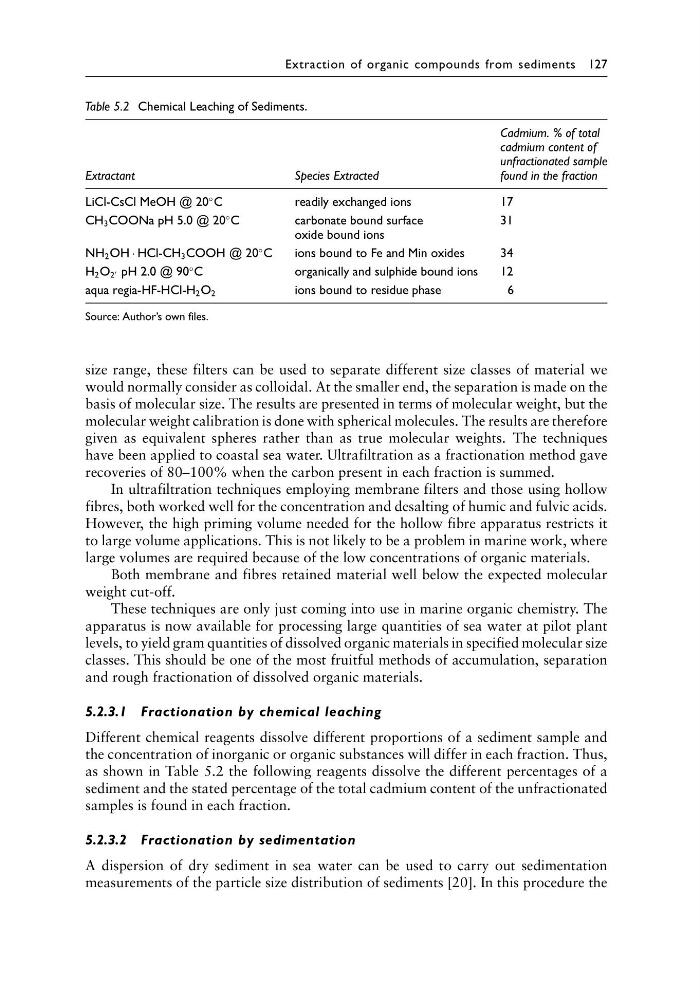
Different chemical reagents dissolve different proportions of a sediment sample and
the concentration of inorganic or organic substances will differ in each fraction. Thus,
as shown in Table 5.2 the following reagents dissolve the different percentages of a
sediment and the stated percentage of the total cadmium content of the unfractionated
samples is found in each fraction.
5.2.3.2 Fractionation by sedimentation
A dispersion of dry sediment in sea water can be used to carry out sedimentation
measurements of the particle size distribution of sediments [20]. In this procedure the
Table 5.2 Chemical Leaching of Sediments.
Cadmium. % of total
cadmium content of
unfractionated sample
Extractant
Species Extracted
found in the fraction
LiCl-CsCl MeOH @ 20
◦ C
readily exchanged ions
17
CH 3 COONa pH 5.0 @ 20
◦ C
carbonate bound surface
31
oxide bound ions
NH 2 OH · HCl-CH 3 COOH @ 20
◦ C
ions bound to Fe and Min oxides
34
H 2 O 2 pH 2.0 @ 90
◦ C
organically and sulphide bound ions
12
aqua regia-HF-HCl-H 2 O 2
ions bound to residue phase
6
Source: Author’s own files.
size range, these filters can be used to separate different size classes of material we
would normally consider as colloidal. At the smaller end, the separation is made on the
basis of molecular size. The results are presented in terms of molecular weight, but the
molecular weight calibration is done with spherical molecules. The results are therefore
given as equivalent spheres rather than as true molecular weights. The techniques
have been applied to coastal sea water. Ultrafiltration as a fractionation method gave
recoveries of 80–100% when the carbon present in each fraction is summed.
In ultrafiltration techniques employing membrane filters and those using hollow
fibres, both worked well for the concentration and desalting of humic and fulvic acids.
However, the high priming volume needed for the hollow fibre apparatus restricts it
to large volume applications. This is not likely to be a problem in marine work, where
large volumes are required because of the low concentrations of organic materials.
Both membrane and fibres retained material well below the expected molecular
weight cut-off.
These techniques are only just coming into use in marine organic chemistry. The
apparatus is now available for processing large quantities of sea water at pilot plant
levels, to yield gram quantities of dissolved organic materials in specified molecular size
classes. This should be one of the most fruitful methods of accumulation, separation
and rough fractionation of dissolved organic materials.
5.2.3.1 Fractionation by chemical leaching
Different chemical reagents dissolve different proportions of a sediment sample and
the concentration of inorganic or organic substances will differ in each fraction. Thus,
as shown in Table 5.2 the following reagents dissolve the different percentages of a
sediment and the stated percentage of the total cadmium content of the unfractionated
samples is found in each fraction.
5.2.3.2 Fractionation by sedimentation
A dispersion of dry sediment in sea water can be used to carry out sedimentation
measurements of the particle size distribution of sediments [20]. In this procedure the