

128 Organic compounds in soils, sediments & sludges
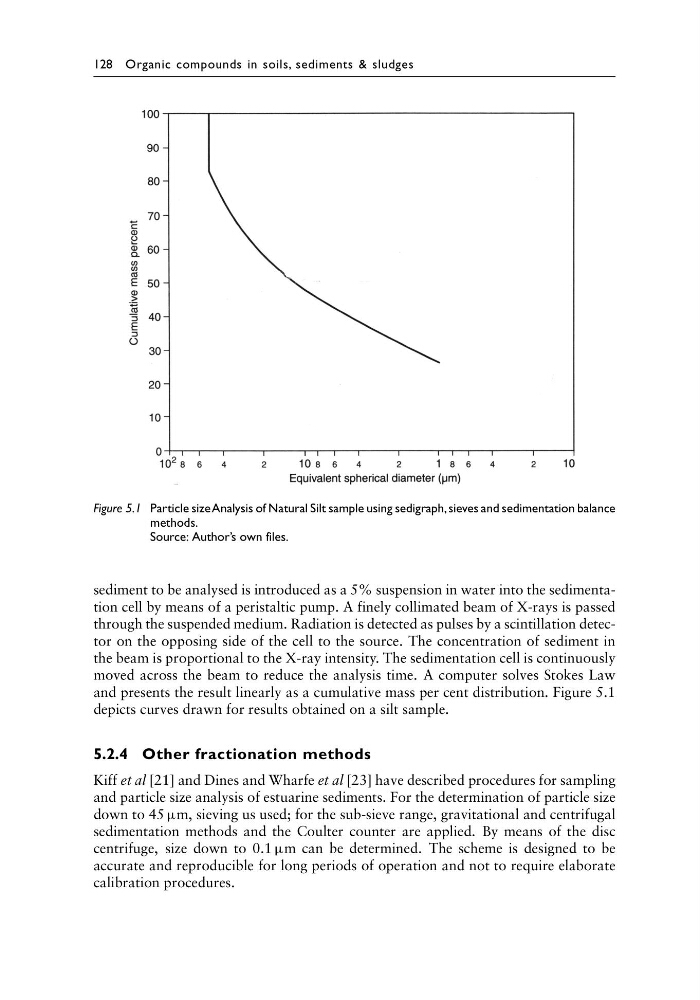
Figure 5.1 Particle sizeAnalysis of Natural Silt sample using sedigraph, sieves and sedimentation balance
methods.
Source: Author’s own files.
sediment to be analysed is introduced as a 5% suspension in water into the sedimentation cell by means of a peristaltic pump. A finely collimated beam of X-rays is passed
through the suspended medium. Radiation is detected as pulses by a scintillation detector on the opposing side of the cell to the source. The concentration of sediment in
the beam is proportional to the X-ray intensity. The sedimentation cell is continuously
moved across the beam to reduce the analysis time. A computer solves Stokes Law
and presents the result linearly as a cumulative mass per cent distribution. Figure 5.1
depicts curves drawn for results obtained on a silt sample.
5.2.4 Other fractionation methods
Kiff et al [21] and Dines and Wharfe et al [23] have described procedures for sampling
and particle size analysis of estuarine sediments. For the determination of particle size
down to 45 µm, sieving us used; for the sub-sieve range, gravitational and centrifugal
sedimentation methods and the Coulter counter are applied. By means of the disc
centrifuge, size down to 0.1 µm can be determined. The scheme is designed to be
accurate and reproducible for long periods of operation and not to require elaborate
calibration procedures.
Figure 5.1 Particle sizeAnalysis of Natural Silt sample using sedigraph, sieves and sedimentation balance
methods.
Source: Author’s own files.
sediment to be analysed is introduced as a 5% suspension in water into the sedimentation cell by means of a peristaltic pump. A finely collimated beam of X-rays is passed
through the suspended medium. Radiation is detected as pulses by a scintillation detector on the opposing side of the cell to the source. The concentration of sediment in
the beam is proportional to the X-ray intensity. The sedimentation cell is continuously
moved across the beam to reduce the analysis time. A computer solves Stokes Law
and presents the result linearly as a cumulative mass per cent distribution. Figure 5.1
depicts curves drawn for results obtained on a silt sample.
5.2.4 Other fractionation methods
Kiff et al [21] and Dines and Wharfe et al [23] have described procedures for sampling
and particle size analysis of estuarine sediments. For the determination of particle size
down to 45 µm, sieving us used; for the sub-sieve range, gravitational and centrifugal
sedimentation methods and the Coulter counter are applied. By means of the disc
centrifuge, size down to 0.1 µm can be determined. The scheme is designed to be
accurate and reproducible for long periods of operation and not to require elaborate
calibration procedures.