

126 Organic compounds in soils, sediments & sludges
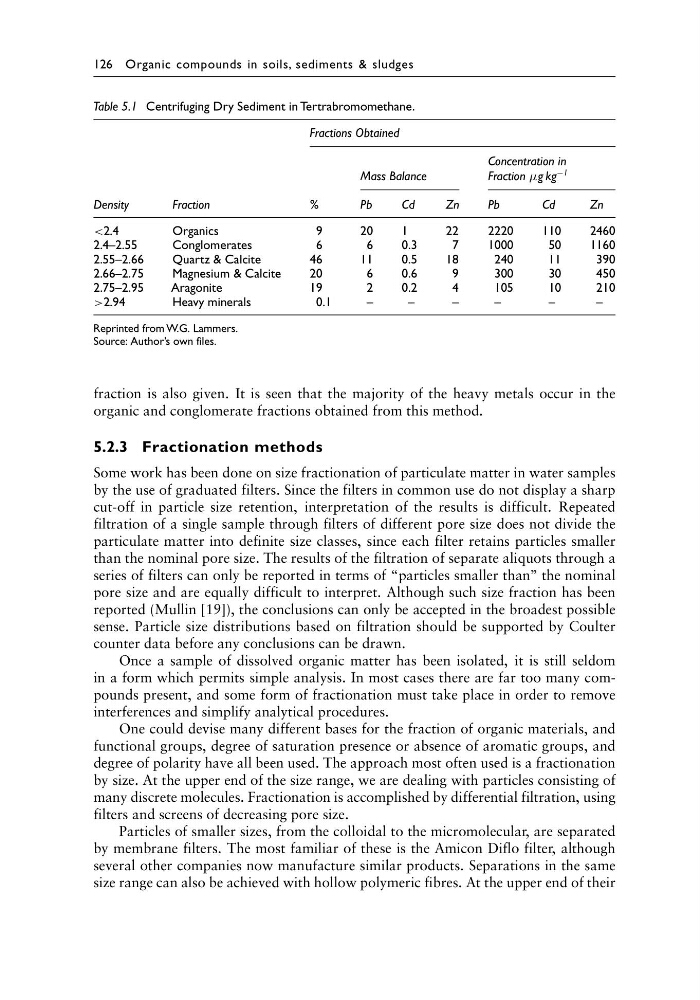
Table 5.1 Centrifuging Dry Sediment in Tertrabromomethane.
Fractions Obtained
Concentration in
Mass Balance
Fraction µg kg
−1
Density
Fraction
%
Pb
Cd
Zn
Pb
Cd
Zn
<2.4
Organics
9
20
1
22
2220
110
2460
2.4–2.55
Conglomerates
6
6
0.3
7
1000
50
1160
2.55–2.66
Quartz & Calcite
46
11
0.5
18
240
11
390
2.66–2.75
Magnesium & Calcite
20
6
0.6
9
300
30
450
2.75–2.95
Aragonite
19
2
0.2
4
105
10
210
>2.94
Heavy minerals
0.1
–
–
–
–
–
–
Reprinted from W.G. Lammers.
Source: Author’s own files.
fraction is also given. It is seen that the majority of the heavy metals occur in the
organic and conglomerate fractions obtained from this method.
5.2.3 Fractionation methods
Some work has been done on size fractionation of particulate matter in water samples
by the use of graduated filters. Since the filters in common use do not display a sharp
cut-off in particle size retention, interpretation of the results is difficult. Repeated
filtration of a single sample through filters of different pore size does not divide the
particulate matter into definite size classes, since each filter retains particles smaller
than the nominal pore size. The results of the filtration of separate aliquots through a
series of filters can only be reported in terms of “particles smaller than’’ the nominal
pore size and are equally difficult to interpret. Although such size fraction has been
reported (Mullin [19]), the conclusions can only be accepted in the broadest possible
sense. Particle size distributions based on filtration should be supported by Coulter
counter data before any conclusions can be drawn.
Once a sample of dissolved organic matter has been isolated, it is still seldom
in a form which permits simple analysis. In most cases there are far too many compounds present, and some form of fractionation must take place in order to remove
interferences and simplify analytical procedures.
One could devise many different bases for the fraction of organic materials, and
functional groups, degree of saturation presence or absence of aromatic groups, and
degree of polarity have all been used. The approach most often used is a fractionation
by size. At the upper end of the size range, we are dealing with particles consisting of
many discrete molecules. Fractionation is accomplished by differential filtration, using
filters and screens of decreasing pore size.
Particles of smaller sizes, from the colloidal to the micromolecular, are separated
by membrane filters. The most familiar of these is the Amicon Diflo filter, although
several other companies now manufacture similar products. Separations in the same
size range can also be achieved with hollow polymeric fibres. At the upper end of their
Table 5.1 Centrifuging Dry Sediment in Tertrabromomethane.
Fractions Obtained
Concentration in
Mass Balance
Fraction µg kg
−1
Density
Fraction
%
Pb
Cd
Zn
Pb
Cd
Zn
<2.4
Organics
9
20
1
22
2220
110
2460
2.4–2.55
Conglomerates
6
6
0.3
7
1000
50
1160
2.55–2.66
Quartz & Calcite
46
11
0.5
18
240
11
390
2.66–2.75
Magnesium & Calcite
20
6
0.6
9
300
30
450
2.75–2.95
Aragonite
19
2
0.2
4
105
10
210
>2.94
Heavy minerals
0.1
–
–
–
–
–
–
Reprinted from W.G. Lammers.
Source: Author’s own files.
fraction is also given. It is seen that the majority of the heavy metals occur in the
organic and conglomerate fractions obtained from this method.
5.2.3 Fractionation methods
Some work has been done on size fractionation of particulate matter in water samples
by the use of graduated filters. Since the filters in common use do not display a sharp
cut-off in particle size retention, interpretation of the results is difficult. Repeated
filtration of a single sample through filters of different pore size does not divide the
particulate matter into definite size classes, since each filter retains particles smaller
than the nominal pore size. The results of the filtration of separate aliquots through a
series of filters can only be reported in terms of “particles smaller than’’ the nominal
pore size and are equally difficult to interpret. Although such size fraction has been
reported (Mullin [19]), the conclusions can only be accepted in the broadest possible
sense. Particle size distributions based on filtration should be supported by Coulter
counter data before any conclusions can be drawn.
Once a sample of dissolved organic matter has been isolated, it is still seldom
in a form which permits simple analysis. In most cases there are far too many compounds present, and some form of fractionation must take place in order to remove
interferences and simplify analytical procedures.
One could devise many different bases for the fraction of organic materials, and
functional groups, degree of saturation presence or absence of aromatic groups, and
degree of polarity have all been used. The approach most often used is a fractionation
by size. At the upper end of the size range, we are dealing with particles consisting of
many discrete molecules. Fractionation is accomplished by differential filtration, using
filters and screens of decreasing pore size.
Particles of smaller sizes, from the colloidal to the micromolecular, are separated
by membrane filters. The most familiar of these is the Amicon Diflo filter, although
several other companies now manufacture similar products. Separations in the same
size range can also be achieved with hollow polymeric fibres. At the upper end of their