

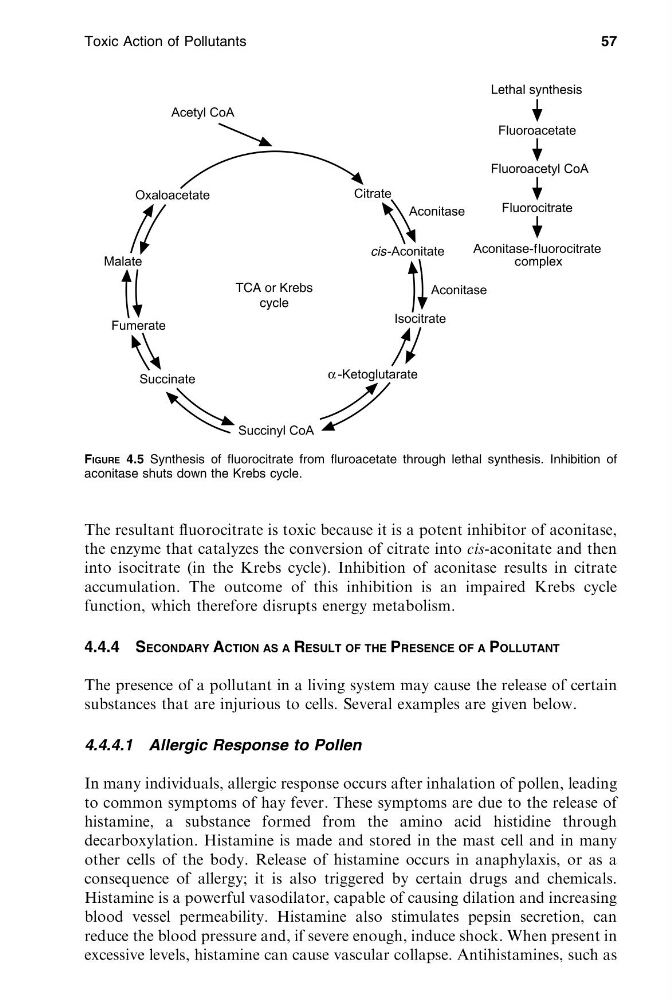
The resultant fluorocitrate is toxic because it is a potent inhibitor of aconitase,
the enzyme that catalyzes the conversion of citrate into cis-aconitate and then
into isocitrate (in the Krebs cycle). Inhibition of aconitase results in citrate
accumulation. The outcome of this inhibition is an impaired Krebs cycle
function, which therefore disrupts energy metabolism.
4.4.4 SECONDARY ACTION AS A RESULT OF THE PRESENCE OF A POLLUTANT
The presence of a pollutant in a living system may cause the release of certain
substances that are injurious to cells. Several examples are given below.
4.4.4.1 Allergic Response to Pollen
In many individuals, allergic response occurs after inhalation of pollen, leading
to common symptoms of hay fever. These symptoms are due to the release of
histamine, a substance formed from the amino acid histidine through
decarboxylation. Histamine is made and stored in the mast cell and in many
other cells of the body. Release of histamine occurs in anaphylaxis, or as a
consequence of allergy; it is also triggered by certain drugs and chemicals.
Histamine is a powerful vasodilator, capable of causing dilation and increasing
blood vessel permeability. Histamine also stimulates pepsin secretion, can
reduce the blood pressure and, if severe enough, induce shock. When present in
excessive levels, histamine can cause vascular collapse. Antihistamines, such as
Toxic Action of Pollutants
57
[16:54 26/8/04 P:/CRC PRESS/4365 MING-HO.751 (1670)/4365-004.3d]
Ref: 4365 MING-HO YU Chap-004 Page: 57 45-64
FIGURE 4.5 Synthesis of fluorocitrate from fluroacetate through lethal synthesis. Inhibition of
aconitase shuts down the Krebs cycle.
the enzyme that catalyzes the conversion of citrate into cis-aconitate and then
into isocitrate (in the Krebs cycle). Inhibition of aconitase results in citrate
accumulation. The outcome of this inhibition is an impaired Krebs cycle
function, which therefore disrupts energy metabolism.
4.4.4 SECONDARY ACTION AS A RESULT OF THE PRESENCE OF A POLLUTANT
The presence of a pollutant in a living system may cause the release of certain
substances that are injurious to cells. Several examples are given below.
4.4.4.1 Allergic Response to Pollen
In many individuals, allergic response occurs after inhalation of pollen, leading
to common symptoms of hay fever. These symptoms are due to the release of
histamine, a substance formed from the amino acid histidine through
decarboxylation. Histamine is made and stored in the mast cell and in many
other cells of the body. Release of histamine occurs in anaphylaxis, or as a
consequence of allergy; it is also triggered by certain drugs and chemicals.
Histamine is a powerful vasodilator, capable of causing dilation and increasing
blood vessel permeability. Histamine also stimulates pepsin secretion, can
reduce the blood pressure and, if severe enough, induce shock. When present in
excessive levels, histamine can cause vascular collapse. Antihistamines, such as
Toxic Action of Pollutants
57
[16:54 26/8/04 P:/CRC PRESS/4365 MING-HO.751 (1670)/4365-004.3d]
Ref: 4365 MING-HO YU Chap-004 Page: 57 45-64
FIGURE 4.5 Synthesis of fluorocitrate from fluroacetate through lethal synthesis. Inhibition of
aconitase shuts down the Krebs cycle.