

diphenylhydramine and antergan, are compounds whose structures are similar
to that of histamine and can prevent physiologic changes induced by histamine.
4.4.4.2 Carbon Tetrachloride
The way in which carbon tetrachloride (CCl 4 ) affects humans is another
example. Once taken up into the body, CCl 4 is known to cause a massive
discharge of epinephrine from sympathetic nerves, eventually resulting in liver
damage. Epinephrine is a potent hormone, involved in many critical biological
reactions in animals and humans, including:
stimulation of glycogenolysis (breakdown of glycogen into glucose) in the
liver and muscle: in the liver, the resultant glucose enters blood circulation; in
the muscle, the resultant glucose does not enter blood circulation but instead
is converted to lactic acid before being transferred back to the liver
lipolysis (breakdown of fats): involves the breakdown of triacylglycerol into
fatty acids and glycerol
glucagon secretion
inhibition of glucose uptake by muscle
insulin secretion
Epinephrine also causes the blood pressure to rise. Like other hormones,
epinephrine is rapidly broken down when it finishes its function. The
breakdown of epinephrine occurs mainly in the liver. Studies show that in
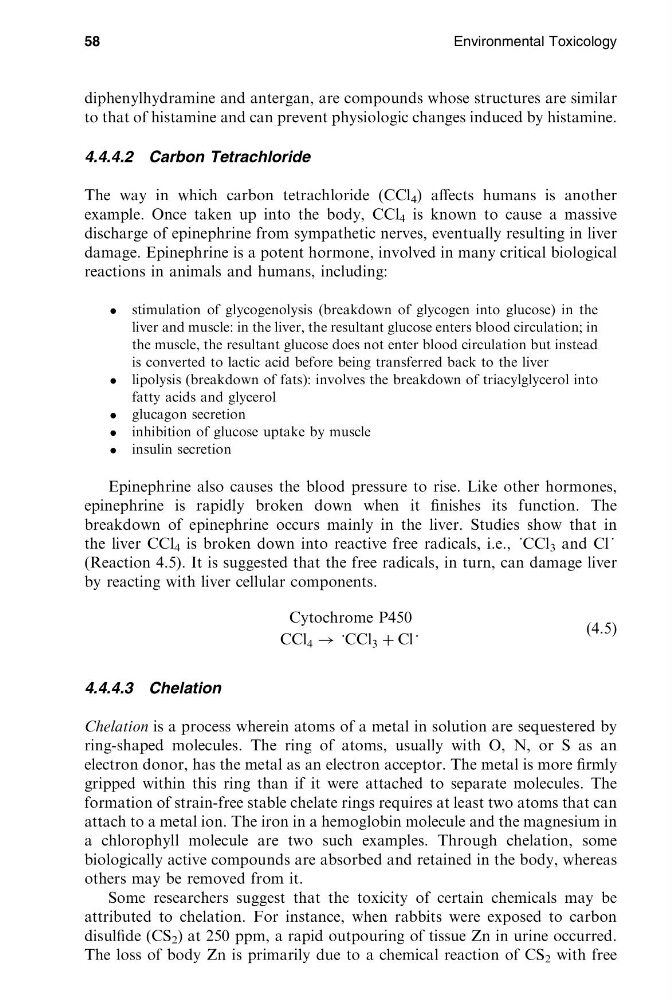
the liver CCl 4 is broken down into reactive free radicals, i.e.,
Á CCl 3 and Cl
Á
(Reaction 4.5). It is suggested that the free radicals, in turn, can damage liver
by reacting with liver cellular components.
Cytochrome P450
CCl 4 ! Á CCl 3 þ Cl Á
ð4:5Þ
4.4.4.3 Chelation
Chelation is a process wherein atoms of a metal in solution are sequestered by
ring-shaped molecules. The ring of atoms, usually with O, N, or S as an
electron donor, has the metal as an electron acceptor. The metal is more firmly
gripped within this ring than if it were attached to separate molecules. The
formation of strain-free stable chelate rings requires at least two atoms that can
attach to a metal ion. The iron in a hemoglobin molecule and the magnesium in
a chlorophyll molecule are two such examples. Through chelation, some
biologically active compounds are absorbed and retained in the body, whereas
others may be removed from it.
Some researchers suggest that the toxicity of certain chemicals may be
attributed to chelation. For instance, when rabbits were exposed to carbon
disulfide (CS 2 ) at 250 ppm, a rapid outpouring of tissue Zn in urine occurred.
The loss of body Zn is primarily due to a chemical reaction of CS 2 with free
58
Environmental Toxicology
[16:54 26/8/04 P:/CRC PRESS/4365 MING-HO.751 (1670)/4365-004.3d]
Ref: 4365 MING-HO YU Chap-004 Page: 58 45-64
to that of histamine and can prevent physiologic changes induced by histamine.
4.4.4.2 Carbon Tetrachloride
The way in which carbon tetrachloride (CCl 4 ) affects humans is another
example. Once taken up into the body, CCl 4 is known to cause a massive
discharge of epinephrine from sympathetic nerves, eventually resulting in liver
damage. Epinephrine is a potent hormone, involved in many critical biological
reactions in animals and humans, including:
stimulation of glycogenolysis (breakdown of glycogen into glucose) in the
liver and muscle: in the liver, the resultant glucose enters blood circulation; in
the muscle, the resultant glucose does not enter blood circulation but instead
is converted to lactic acid before being transferred back to the liver
lipolysis (breakdown of fats): involves the breakdown of triacylglycerol into
fatty acids and glycerol
glucagon secretion
inhibition of glucose uptake by muscle
insulin secretion
Epinephrine also causes the blood pressure to rise. Like other hormones,
epinephrine is rapidly broken down when it finishes its function. The
breakdown of epinephrine occurs mainly in the liver. Studies show that in
the liver CCl 4 is broken down into reactive free radicals, i.e.,
Á CCl 3 and Cl
Á
(Reaction 4.5). It is suggested that the free radicals, in turn, can damage liver
by reacting with liver cellular components.
Cytochrome P450
CCl 4 ! Á CCl 3 þ Cl Á
ð4:5Þ
4.4.4.3 Chelation
Chelation is a process wherein atoms of a metal in solution are sequestered by
ring-shaped molecules. The ring of atoms, usually with O, N, or S as an
electron donor, has the metal as an electron acceptor. The metal is more firmly
gripped within this ring than if it were attached to separate molecules. The
formation of strain-free stable chelate rings requires at least two atoms that can
attach to a metal ion. The iron in a hemoglobin molecule and the magnesium in
a chlorophyll molecule are two such examples. Through chelation, some
biologically active compounds are absorbed and retained in the body, whereas
others may be removed from it.
Some researchers suggest that the toxicity of certain chemicals may be
attributed to chelation. For instance, when rabbits were exposed to carbon
disulfide (CS 2 ) at 250 ppm, a rapid outpouring of tissue Zn in urine occurred.
The loss of body Zn is primarily due to a chemical reaction of CS 2 with free
58
Environmental Toxicology
[16:54 26/8/04 P:/CRC PRESS/4365 MING-HO.751 (1670)/4365-004.3d]
Ref: 4365 MING-HO YU Chap-004 Page: 58 45-64