

Beryllium (Be) is known to inhibit certain enzymes that require Mg
2þ for a
similar reason.
4.4.3.3 Enzyme Inhibition by Binding to the Active Site
A toxicant may bind to the active site of an enzyme. For instance, a thiol or
sulfhydryl (ÀSH) group on a protein enzyme often is the active site for the
catalytic action of the enzyme. A heavy metal, such as Pb, Cd, or Hg, after
absorption into the body may attach itself to the ÀSH group, forming a
covalent bond with the sulfur atom (Reaction 4.3). With the active site being
blocked, the activity of the enzyme will be depressed or lost.
2EnzÀSH þ Pb
2þ ! EnzÀSÀPbÀS À Enz þ 2H
þ
ð4:3Þ
For example, alanine aminotransferase (the enzyme that catalyzes the
transamination of alanine) and d-aminolevulinate dehydratase (ALAD, a key
enzyme in the heme synthetic pathway) both have ÀSH groups as active sites.
Pb strongly inhibits both of these enzymes by the same mechanism.
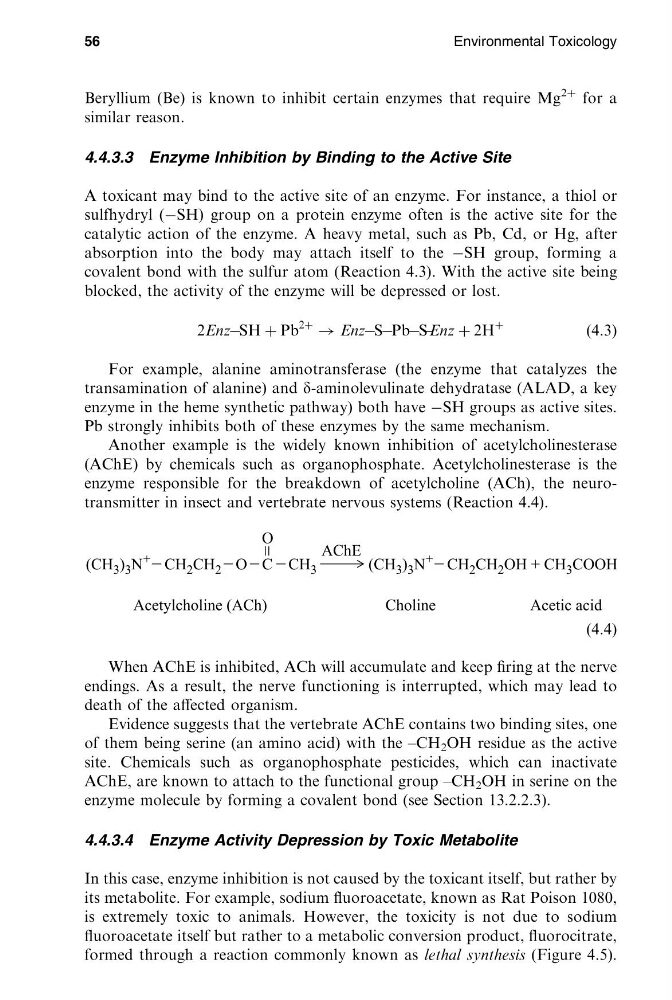
Another example is the widely known inhibition of acetylcholinesterase
(AChE) by chemicals such as organophosphate. Acetylcholinesterase is the
enzyme responsible for the breakdown of acetylcholine (ACh), the neurotransmitter in insect and vertebrate nervous systems (Reaction 4.4).
ð4:4Þ
When AChE is inhibited, ACh will accumulate and keep firing at the nerve
endings. As a result, the nerve functioning is interrupted, which may lead to
death of the affected organism.
Evidence suggests that the vertebrate AChE contains two binding sites, one
of them being serine (an amino acid) with the –CH 2 OH residue as the active
site. Chemicals such as organophosphate pesticides, which can inactivate
AChE, are known to attach to the functional group –CH 2 OH in serine on the
enzyme molecule by forming a covalent bond (see Section 13.2.2.3).
4.4.3.4 Enzyme Activity Depression by Toxic Metabolite
In this case, enzyme inhibition is not caused by the toxicant itself, but rather by
its metabolite. For example, sodium fluoroacetate, known as Rat Poison 1080,
is extremely toxic to animals. However, the toxicity is not due to sodium
fluoroacetate itself but rather to a metabolic conversion product, fluorocitrate,
formed through a reaction commonly known as lethal synthesis (Figure 4.5).
56
Environmental Toxicology
[16:54 26/8/04 P:/CRC PRESS/4365 MING-HO.751 (1670)/4365-004.3d]
Ref: 4365 MING-HO YU Chap-004 Page: 56 45-64
2þ for a
similar reason.
4.4.3.3 Enzyme Inhibition by Binding to the Active Site
A toxicant may bind to the active site of an enzyme. For instance, a thiol or
sulfhydryl (ÀSH) group on a protein enzyme often is the active site for the
catalytic action of the enzyme. A heavy metal, such as Pb, Cd, or Hg, after
absorption into the body may attach itself to the ÀSH group, forming a
covalent bond with the sulfur atom (Reaction 4.3). With the active site being
blocked, the activity of the enzyme will be depressed or lost.
2EnzÀSH þ Pb
2þ ! EnzÀSÀPbÀS À Enz þ 2H
þ
ð4:3Þ
For example, alanine aminotransferase (the enzyme that catalyzes the
transamination of alanine) and d-aminolevulinate dehydratase (ALAD, a key
enzyme in the heme synthetic pathway) both have ÀSH groups as active sites.
Pb strongly inhibits both of these enzymes by the same mechanism.
Another example is the widely known inhibition of acetylcholinesterase
(AChE) by chemicals such as organophosphate. Acetylcholinesterase is the
enzyme responsible for the breakdown of acetylcholine (ACh), the neurotransmitter in insect and vertebrate nervous systems (Reaction 4.4).
ð4:4Þ
When AChE is inhibited, ACh will accumulate and keep firing at the nerve
endings. As a result, the nerve functioning is interrupted, which may lead to
death of the affected organism.
Evidence suggests that the vertebrate AChE contains two binding sites, one
of them being serine (an amino acid) with the –CH 2 OH residue as the active
site. Chemicals such as organophosphate pesticides, which can inactivate
AChE, are known to attach to the functional group –CH 2 OH in serine on the
enzyme molecule by forming a covalent bond (see Section 13.2.2.3).
4.4.3.4 Enzyme Activity Depression by Toxic Metabolite
In this case, enzyme inhibition is not caused by the toxicant itself, but rather by
its metabolite. For example, sodium fluoroacetate, known as Rat Poison 1080,
is extremely toxic to animals. However, the toxicity is not due to sodium
fluoroacetate itself but rather to a metabolic conversion product, fluorocitrate,
formed through a reaction commonly known as lethal synthesis (Figure 4.5).
56
Environmental Toxicology
[16:54 26/8/04 P:/CRC PRESS/4365 MING-HO.751 (1670)/4365-004.3d]
Ref: 4365 MING-HO YU Chap-004 Page: 56 45-64