

enzyme responsible for the breakdown of starch into maltose and eventually
glucose – the released glucose is then used as energy source. a-amylase is
known to require Ca
2þ for its stability as well as catalytic action.
8,9 In the
presence of F
À ions, a-amylase activity is depressed.
10,11 The mechanism
involved in the inhibition appears to involve removal of the Ca
2þ cofactor by
F
À ions. Evidence supporting this observation was obtained when a crude
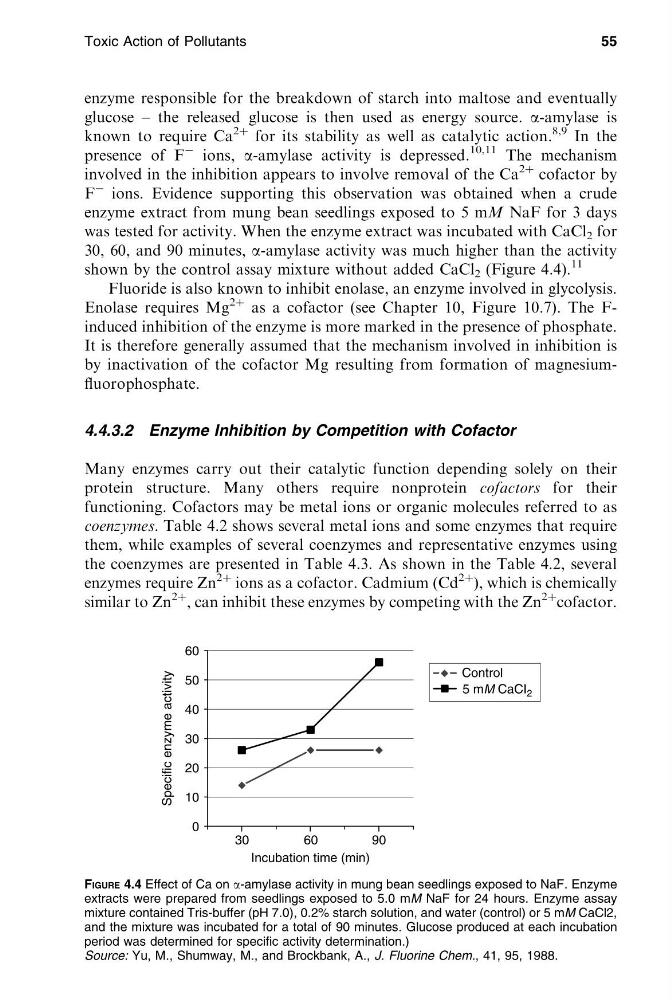
enzyme extract from mung bean seedlings exposed to 5 mM NaF for 3 days
was tested for activity. When the enzyme extract was incubated with CaCl 2 for
30, 60, and 90 minutes, a-amylase activity was much higher than the activity
shown by the control assay mixture without added CaCl 2 (Figure 4.4).
11
Fluoride is also known to inhibit enolase, an enzyme involved in glycolysis.
Enolase requires Mg
2þ as a cofactor (see Chapter 10, Figure 10.7). The Finduced inhibition of the enzyme is more marked in the presence of phosphate.
It is therefore generally assumed that the mechanism involved in inhibition is
by inactivation of the cofactor Mg resulting from formation of magnesiumfluorophosphate.
4.4.3.2 Enzyme Inhibition by Competition with Cofactor
Many enzymes carry out their catalytic function depending solely on their
protein structure. Many others require nonprotein cofactors for their
functioning. Cofactors may be metal ions or organic molecules referred to as
coenzymes. Table 4.2 shows several metal ions and some enzymes that require
them, while examples of several coenzymes and representative enzymes using
the coenzymes are presented in Table 4.3. As shown in the Table 4.2, several
enzymes require Zn
2þ ions as a cofactor. Cadmium (Cd
2þ
), which is chemically
similar to Zn
2þ
, can inhibit these enzymes by competing with the Zn
2þ cofactor.
Toxic Action of Pollutants
55
[16:54 26/8/04 P:/CRC PRESS/4365 MING-HO.751 (1670)/4365-004.3d]
Ref: 4365 MING-HO YU Chap-004 Page: 55 45-64
FIGURE 4.4 Effect of Ca on a-amylase activity in mung bean seedlings exposed to NaF. Enzyme
extracts were prepared from seedlings exposed to 5.0 mM NaF for 24 hours. Enzyme assay
mixture contained Tris-buffer (pH 7.0), 0.2% starch solution, and water (control) or 5 mM CaCl2,
and the mixture was incubated for a total of 90 minutes. Glucose produced at each incubation
period was determined for specific activity determination.)
Source: Yu, M., Shumway, M., and Brockbank, A., J. Fluorine Chem., 41, 95, 1988.
glucose – the released glucose is then used as energy source. a-amylase is
known to require Ca
2þ for its stability as well as catalytic action.
8,9 In the
presence of F
À ions, a-amylase activity is depressed.
10,11 The mechanism
involved in the inhibition appears to involve removal of the Ca
2þ cofactor by
F
À ions. Evidence supporting this observation was obtained when a crude
enzyme extract from mung bean seedlings exposed to 5 mM NaF for 3 days
was tested for activity. When the enzyme extract was incubated with CaCl 2 for
30, 60, and 90 minutes, a-amylase activity was much higher than the activity
shown by the control assay mixture without added CaCl 2 (Figure 4.4).
11
Fluoride is also known to inhibit enolase, an enzyme involved in glycolysis.
Enolase requires Mg
2þ as a cofactor (see Chapter 10, Figure 10.7). The Finduced inhibition of the enzyme is more marked in the presence of phosphate.
It is therefore generally assumed that the mechanism involved in inhibition is
by inactivation of the cofactor Mg resulting from formation of magnesiumfluorophosphate.
4.4.3.2 Enzyme Inhibition by Competition with Cofactor
Many enzymes carry out their catalytic function depending solely on their
protein structure. Many others require nonprotein cofactors for their
functioning. Cofactors may be metal ions or organic molecules referred to as
coenzymes. Table 4.2 shows several metal ions and some enzymes that require
them, while examples of several coenzymes and representative enzymes using
the coenzymes are presented in Table 4.3. As shown in the Table 4.2, several
enzymes require Zn
2þ ions as a cofactor. Cadmium (Cd
2þ
), which is chemically
similar to Zn
2þ
, can inhibit these enzymes by competing with the Zn
2þ cofactor.
Toxic Action of Pollutants
55
[16:54 26/8/04 P:/CRC PRESS/4365 MING-HO.751 (1670)/4365-004.3d]
Ref: 4365 MING-HO YU Chap-004 Page: 55 45-64
FIGURE 4.4 Effect of Ca on a-amylase activity in mung bean seedlings exposed to NaF. Enzyme
extracts were prepared from seedlings exposed to 5.0 mM NaF for 24 hours. Enzyme assay
mixture contained Tris-buffer (pH 7.0), 0.2% starch solution, and water (control) or 5 mM CaCl2,
and the mixture was incubated for a total of 90 minutes. Glucose produced at each incubation
period was determined for specific activity determination.)
Source: Yu, M., Shumway, M., and Brockbank, A., J. Fluorine Chem., 41, 95, 1988.