

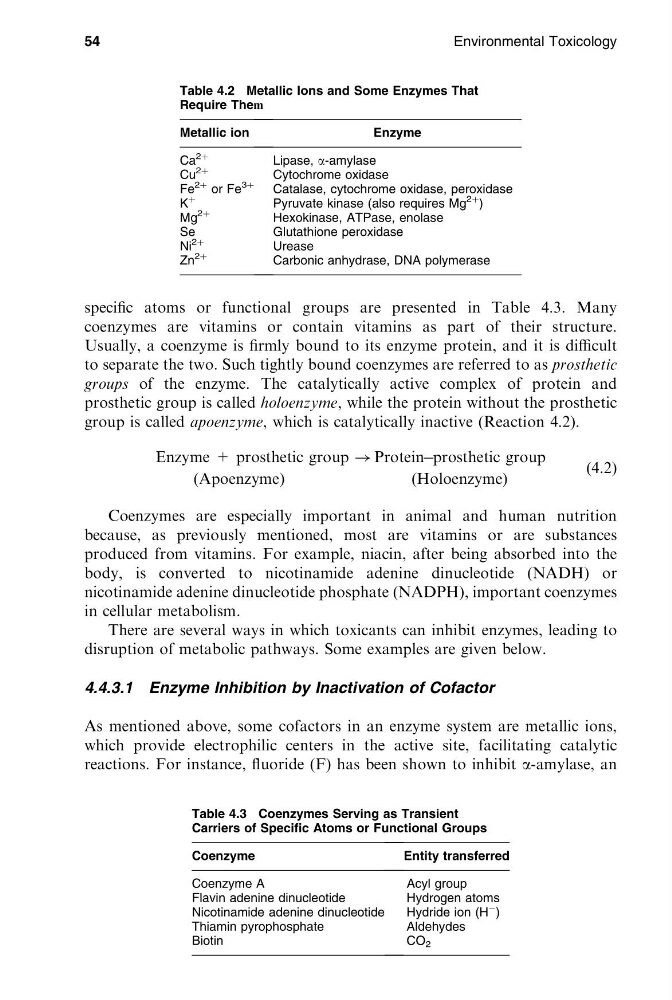
specific atoms or functional groups are presented in Table 4.3. Many
coenzymes are vitamins or contain vitamins as part of their structure.
Usually, a coenzyme is firmly bound to its enzyme protein, and it is difficult
to separate the two. Such tightly bound coenzymes are referred to as prosthetic
groups of the enzyme. The catalytically active complex of protein and
prosthetic group is called holoenzyme, while the protein without the prosthetic
group is called apoenzyme, which is catalytically inactive (Reaction 4.2).
Enzyme + prosthetic group ! ProteinÀprosthetic group
ðApoenzymeÞ
ð HoloenzymeÞ
ð4:2Þ
Coenzymes are especially important in animal and human nutrition
because, as previously mentioned, most are vitamins or are substances
produced from vitamins. For example, niacin, after being absorbed into the
body, is converted to nicotinamide adenine dinucleotide (NADH) or
nicotinamide adenine dinucleotide phosphate (NADPH), important coenzymes
in cellular metabolism.
There are several ways in which toxicants can inhibit enzymes, leading to
disruption of metabolic pathways. Some examples are given below.
4.4.3.1 Enzyme Inhibition by Inactivation of Cofactor
As mentioned above, some cofactors in an enzyme system are metallic ions,
which provide electrophilic centers in the active site, facilitating catalytic
reactions. For instance, fluoride (F) has been shown to inhibit a-amylase, an
54
Environmental Toxicology
[16:54 26/8/04 P:/CRC PRESS/4365 MING-HO.751 (1670)/4365-004.3d]
Ref: 4365 MING-HO YU Chap-004 Page: 54 45-64
Table 4.2 Metallic Ions and Some Enzymes That
Require Them
Metallic ion
Enzyme
Ca
2þ
Lipase, a-amylase
Cu
2þ
Cytochrome oxidase
Fe
2þ or Fe
3þ
Catalase, cytochrome oxidase, peroxidase
K
þ
Pyruvate kinase (also requires Mg
2þ
)
Mg
2þ
Hexokinase, ATPase, enolase
Se
Glutathione peroxidase
Ni
2þ
Urease
Zn
2þ
Carbonic anhydrase, DNA polymerase
Table 4.3 Coenzymes Serving as Transient
Carriers of Specific Atoms or Functional Groups
Coenzyme
Entity transferred
Coenzyme A
Acyl group
Flavin adenine dinucleotide
Hydrogen atoms
Nicotinamide adenine dinucleotide
Hydride ion (H
À
)
Thiamin pyrophosphate
Aldehydes
Biotin
CO 2
coenzymes are vitamins or contain vitamins as part of their structure.
Usually, a coenzyme is firmly bound to its enzyme protein, and it is difficult
to separate the two. Such tightly bound coenzymes are referred to as prosthetic
groups of the enzyme. The catalytically active complex of protein and
prosthetic group is called holoenzyme, while the protein without the prosthetic
group is called apoenzyme, which is catalytically inactive (Reaction 4.2).
Enzyme + prosthetic group ! ProteinÀprosthetic group
ðApoenzymeÞ
ð HoloenzymeÞ
ð4:2Þ
Coenzymes are especially important in animal and human nutrition
because, as previously mentioned, most are vitamins or are substances
produced from vitamins. For example, niacin, after being absorbed into the
body, is converted to nicotinamide adenine dinucleotide (NADH) or
nicotinamide adenine dinucleotide phosphate (NADPH), important coenzymes
in cellular metabolism.
There are several ways in which toxicants can inhibit enzymes, leading to
disruption of metabolic pathways. Some examples are given below.
4.4.3.1 Enzyme Inhibition by Inactivation of Cofactor
As mentioned above, some cofactors in an enzyme system are metallic ions,
which provide electrophilic centers in the active site, facilitating catalytic
reactions. For instance, fluoride (F) has been shown to inhibit a-amylase, an
54
Environmental Toxicology
[16:54 26/8/04 P:/CRC PRESS/4365 MING-HO.751 (1670)/4365-004.3d]
Ref: 4365 MING-HO YU Chap-004 Page: 54 45-64
Table 4.2 Metallic Ions and Some Enzymes That
Require Them
Metallic ion
Enzyme
Ca
2þ
Lipase, a-amylase
Cu
2þ
Cytochrome oxidase
Fe
2þ or Fe
3þ
Catalase, cytochrome oxidase, peroxidase
K
þ
Pyruvate kinase (also requires Mg
2þ
)
Mg
2þ
Hexokinase, ATPase, enolase
Se
Glutathione peroxidase
Ni
2þ
Urease
Zn
2þ
Carbonic anhydrase, DNA polymerase
Table 4.3 Coenzymes Serving as Transient
Carriers of Specific Atoms or Functional Groups
Coenzyme
Entity transferred
Coenzyme A
Acyl group
Flavin adenine dinucleotide
Hydrogen atoms
Nicotinamide adenine dinucleotide
Hydride ion (H
À
)
Thiamin pyrophosphate
Aldehydes
Biotin
CO 2