

that CO can tie up a substantial quantity of Hb when HbCO is formed.
Consequently, Hb will not be able to transport O 2 to tissues, thus severely
impairing bodily function, especially of the heart and central nervous system.
Although increase in oxygen concentrations can shift the equilibrium in
Reaction 8.29 to the left, recovery of Hb is slow, while the asphyxiating effect
of binding Hb with CO is rapid. People with cardiovascular disease,
particularly those with angina or peripheral vascular disease, are much more
susceptible to the health effects of CO. Furthermore, research showed that the
fetus is particularly susceptible to lack of O 2 supply, therefore maternal CO
poisoning during pregnancy can lead to fetal death. Animal studies have shown
that the offspring of pregnant female rats exposed to CO have lower birth
weights and significant learning deficits.
51
The normal or background level of blood HbCO is about 0.5%. Part of the
CO in background HbCO is derived from the ambient air, while the rest is
originated by the body as a result of heme catabolism. The equilibrium
percentage of HbCO in the bloodstream of a person continually exposed to an
ambient air CO concentration of less than 100 ppm can be calculated from the
following equation:
HbCO in blood (%) ¼ 0.16 Â (CO conc. in the air in ppm) þ 0.5
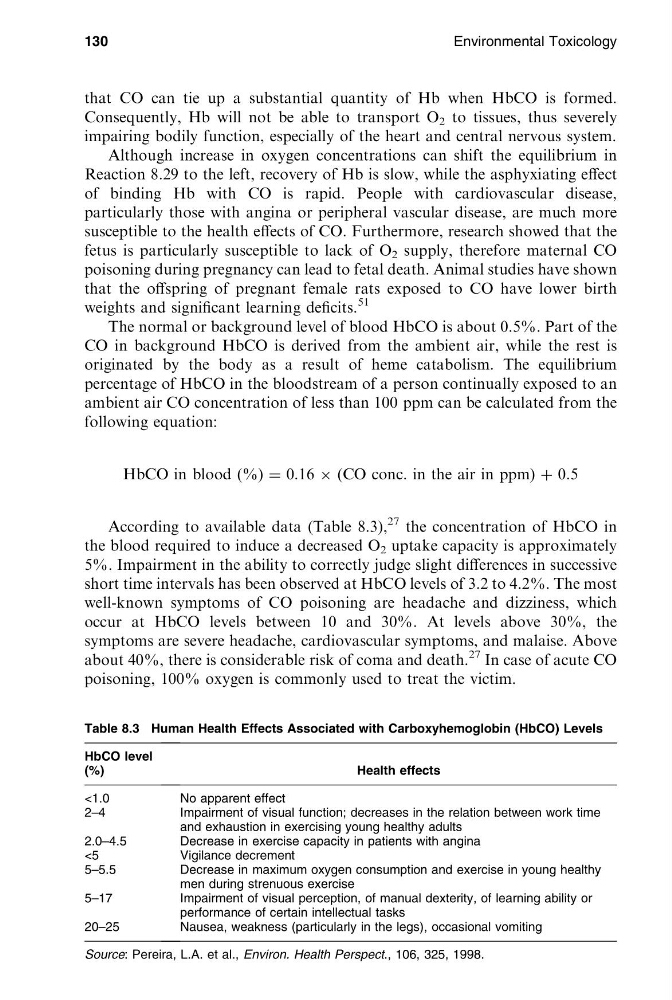
According to available data (Table 8.3),
27 the concentration of HbCO in
the blood required to induce a decreased O 2 uptake capacity is approximately
5%. Impairment in the ability to correctly judge slight differences in successive
short time intervals has been observed at HbCO levels of 3.2 to 4.2%. The most
well-known symptoms of CO poisoning are headache and dizziness, which
occur at HbCO levels between 10 and 30%. At levels above 30%, the
symptoms are severe headache, cardiovascular symptoms, and malaise. Above
about 40%, there is considerable risk of coma and death.
27 In case of acute CO
poisoning, 100% oxygen is commonly used to treat the victim.
130
Environmental Toxicology
[16:53 26/8/04 P:/CRC PRESS/4365 MING-HO.751 (1670)/4365-008.3d]
Ref: 4365 MING-HO YU Chap-008 Page: 130 111-134
Table 8.3 Human Health Effects Associated with Carboxyhemoglobin (HbCO) Levels
HbCO level
(%)
Health effects
<1.0
No apparent effect
2–4
Impairment of visual function; decreases in the relation between work time
and exhaustion in exercising young healthy adults
2.0–4.5
Decrease in exercise capacity in patients with angina
<5
Vigilance decrement
5–5.5
Decrease in maximum oxygen consumption and exercise in young healthy
men during strenuous exercise
5–17
Impairment of visual perception, of manual dexterity, of learning ability or
performance of certain intellectual tasks
20–25
Nausea, weakness (particularly in the legs), occasional vomiting
Source: Pereira, L.A. et al., Environ. Health Perspect., 106, 325, 1998.
Consequently, Hb will not be able to transport O 2 to tissues, thus severely
impairing bodily function, especially of the heart and central nervous system.
Although increase in oxygen concentrations can shift the equilibrium in
Reaction 8.29 to the left, recovery of Hb is slow, while the asphyxiating effect
of binding Hb with CO is rapid. People with cardiovascular disease,
particularly those with angina or peripheral vascular disease, are much more
susceptible to the health effects of CO. Furthermore, research showed that the
fetus is particularly susceptible to lack of O 2 supply, therefore maternal CO
poisoning during pregnancy can lead to fetal death. Animal studies have shown
that the offspring of pregnant female rats exposed to CO have lower birth
weights and significant learning deficits.
51
The normal or background level of blood HbCO is about 0.5%. Part of the
CO in background HbCO is derived from the ambient air, while the rest is
originated by the body as a result of heme catabolism. The equilibrium
percentage of HbCO in the bloodstream of a person continually exposed to an
ambient air CO concentration of less than 100 ppm can be calculated from the
following equation:
HbCO in blood (%) ¼ 0.16 Â (CO conc. in the air in ppm) þ 0.5
According to available data (Table 8.3),
27 the concentration of HbCO in
the blood required to induce a decreased O 2 uptake capacity is approximately
5%. Impairment in the ability to correctly judge slight differences in successive
short time intervals has been observed at HbCO levels of 3.2 to 4.2%. The most
well-known symptoms of CO poisoning are headache and dizziness, which
occur at HbCO levels between 10 and 30%. At levels above 30%, the
symptoms are severe headache, cardiovascular symptoms, and malaise. Above
about 40%, there is considerable risk of coma and death.
27 In case of acute CO
poisoning, 100% oxygen is commonly used to treat the victim.
130
Environmental Toxicology
[16:53 26/8/04 P:/CRC PRESS/4365 MING-HO.751 (1670)/4365-008.3d]
Ref: 4365 MING-HO YU Chap-008 Page: 130 111-134
Table 8.3 Human Health Effects Associated with Carboxyhemoglobin (HbCO) Levels
HbCO level
(%)
Health effects
<1.0
No apparent effect
2–4
Impairment of visual function; decreases in the relation between work time
and exhaustion in exercising young healthy adults
2.0–4.5
Decrease in exercise capacity in patients with angina
<5
Vigilance decrement
5–5.5
Decrease in maximum oxygen consumption and exercise in young healthy
men during strenuous exercise
5–17
Impairment of visual perception, of manual dexterity, of learning ability or
performance of certain intellectual tasks
20–25
Nausea, weakness (particularly in the legs), occasional vomiting
Source: Pereira, L.A. et al., Environ. Health Perspect., 106, 325, 1998.