

8.5.3 HUMAN EXPOSURE
Human exposure to CO occurs mainly from three sources: ambient air,
occupational exposure, and cigarette smoke.
CO in the surrounding ambient environment is largely emitted in exhaust
gases (automobiles, industrial machinery), but other sources of accidental
intoxication include house fires (which may contain more than 50,000 ppm
CO) and environmental problems in the house (such as defective furnaces,
charcoal burning in poorly vented houses, or garages connected to living
quarters).
Individuals particularly at risk from occupational exposure include fire
fighters (>10,000 ppm CO), traffic police, coal miners, coke-oven and smelter
workers, tollbooth attendants, and transportation mechanics.
8.5.4 HEALTH EFFECTS
A constant supply of O 2 is needed in order for physiological functions to
proceed normally in the body. Oxygen is carried to body tissue by hemoglobin
(Hb), a complex component of red blood cells that consists of two pairs of
proteins (a and b chains), which themselves are bonded around an iron.
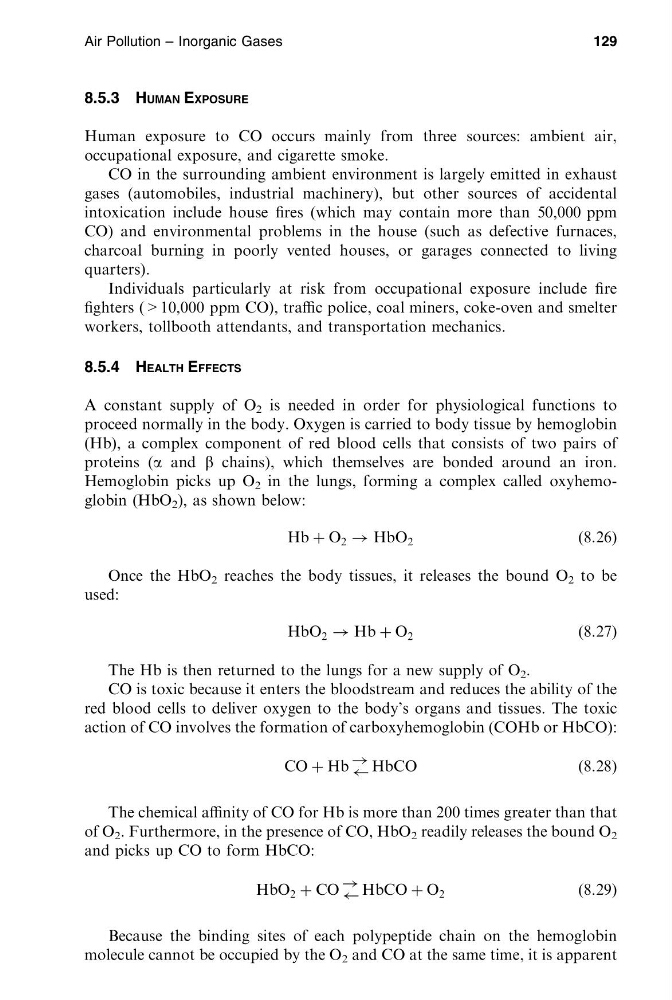
Hemoglobin picks up O 2 in the lungs, forming a complex called oxyhemoglobin (HbO 2 ), as shown below:
Hb þ O 2 ! HbO 2
ð8:26Þ
Once the HbO 2 reaches the body tissues, it releases the bound O 2 to be
used:
HbO 2 ! Hb þ O 2
ð8:27Þ
The Hb is then returned to the lungs for a new supply of O 2 .
CO is toxic because it enters the bloodstream and reduces the ability of the
red blood cells to deliver oxygen to the body’s organs and tissues. The toxic
action of CO involves the formation of carboxyhemoglobin (COHb or HbCO):
CO þ Hb ! HbCO
ð8:28Þ
The chemical affinity of CO for Hb is more than 200 times greater than that
of O 2 . Furthermore, in the presence of CO, HbO 2 readily releases the bound O 2
and picks up CO to form HbCO:
HbO 2 þ CO ! HbCO þ O 2
ð8:29Þ
Because the binding sites of each polypeptide chain on the hemoglobin
molecule cannot be occupied by the O 2 and CO at the same time, it is apparent
Air Pollution – Inorganic Gases
129
[16:53 26/8/04 P:/CRC PRESS/4365 MING-HO.751 (1670)/4365-008.3d]
Ref: 4365 MING-HO YU Chap-008 Page: 129 111-134
Human exposure to CO occurs mainly from three sources: ambient air,
occupational exposure, and cigarette smoke.
CO in the surrounding ambient environment is largely emitted in exhaust
gases (automobiles, industrial machinery), but other sources of accidental
intoxication include house fires (which may contain more than 50,000 ppm
CO) and environmental problems in the house (such as defective furnaces,
charcoal burning in poorly vented houses, or garages connected to living
quarters).
Individuals particularly at risk from occupational exposure include fire
fighters (>10,000 ppm CO), traffic police, coal miners, coke-oven and smelter
workers, tollbooth attendants, and transportation mechanics.
8.5.4 HEALTH EFFECTS
A constant supply of O 2 is needed in order for physiological functions to
proceed normally in the body. Oxygen is carried to body tissue by hemoglobin
(Hb), a complex component of red blood cells that consists of two pairs of
proteins (a and b chains), which themselves are bonded around an iron.
Hemoglobin picks up O 2 in the lungs, forming a complex called oxyhemoglobin (HbO 2 ), as shown below:
Hb þ O 2 ! HbO 2
ð8:26Þ
Once the HbO 2 reaches the body tissues, it releases the bound O 2 to be
used:
HbO 2 ! Hb þ O 2
ð8:27Þ
The Hb is then returned to the lungs for a new supply of O 2 .
CO is toxic because it enters the bloodstream and reduces the ability of the
red blood cells to deliver oxygen to the body’s organs and tissues. The toxic
action of CO involves the formation of carboxyhemoglobin (COHb or HbCO):
CO þ Hb ! HbCO
ð8:28Þ
The chemical affinity of CO for Hb is more than 200 times greater than that
of O 2 . Furthermore, in the presence of CO, HbO 2 readily releases the bound O 2
and picks up CO to form HbCO:
HbO 2 þ CO ! HbCO þ O 2
ð8:29Þ
Because the binding sites of each polypeptide chain on the hemoglobin
molecule cannot be occupied by the O 2 and CO at the same time, it is apparent
Air Pollution – Inorganic Gases
129
[16:53 26/8/04 P:/CRC PRESS/4365 MING-HO.751 (1670)/4365-008.3d]
Ref: 4365 MING-HO YU Chap-008 Page: 129 111-134