

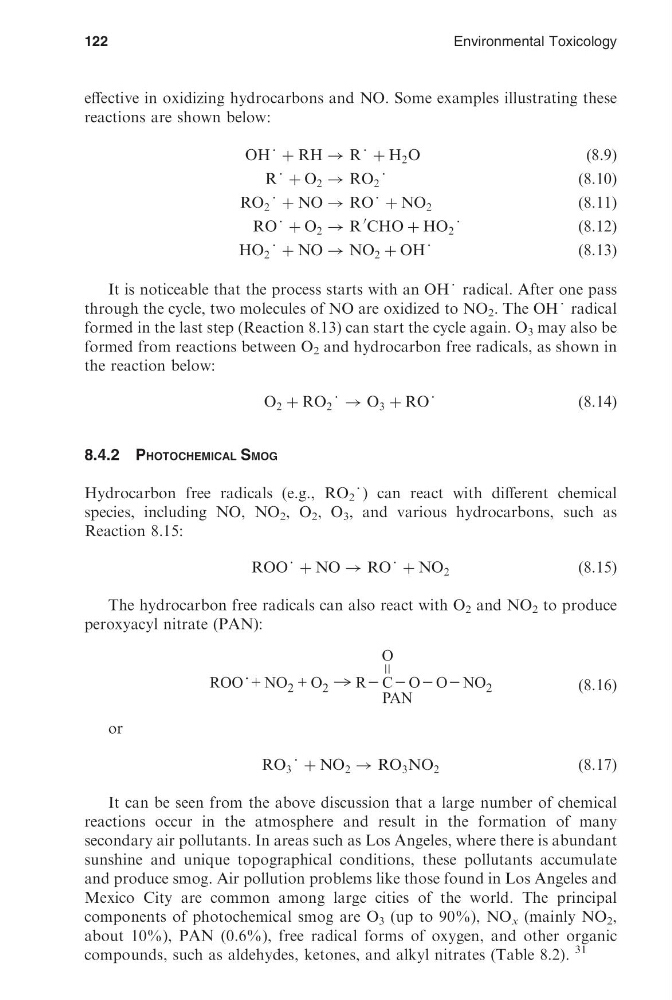
effective in oxidizing hydrocarbons and NO. Some examples illustrating these
reactions are shown below:
OH
Á þ RH ! R
Á þ H 2 O
ð8:9Þ
R
Á þ O 2 ! RO 2
Á
ð8:10Þ
RO 2
Á þ NO ! RO
Á þ NO 2
ð8:11Þ
RO
Á þ O 2 ! R
0 CHO þ HO 2
Á
ð8:12Þ
HO 2
Á þ NO ! NO 2 þ OH
Á
ð8:13Þ
It is noticeable that the process starts with an OH
Á radical. After one pass
through the cycle, two molecules of NO are oxidized to NO 2 . The OH
Á radical
formed in the last step (Reaction 8.13) can start the cycle again. O 3 may also be
formed from reactions between O 2 and hydrocarbon free radicals, as shown in
the reaction below:
O 2 þ RO 2
Á ! O 3 þ RO
Á
ð8:14Þ
8.4.2 PHOTOCHEMICAL SMOG
Hydrocarbon free radicals (e.g., RO 2
Á ) can react with different chemical
species, including NO, NO 2 , O 2 , O 3 , and various hydrocarbons, such as
Reaction 8.15:
ROO
Á þ NO ! RO
Á þ NO 2
ð8:15Þ
The hydrocarbon free radicals can also react with O 2 and NO 2 to produce
peroxyacyl nitrate (PAN):
ð8:16Þ
or
RO 3
Á þ NO 2 ! RO 3 NO 2
ð8:17Þ
It can be seen from the above discussion that a large number of chemical
reactions occur in the atmosphere and result in the formation of many
secondary air pollutants. In areas such as Los Angeles, where there is abundant
sunshine and unique topographical conditions, these pollutants accumulate
and produce smog. Air pollution problems like those found in Los Angeles and
Mexico City are common among large cities of the world. The principal
components of photochemical smog are O 3 (up to 90%), NO x (mainly NO 2 ,
about 10%), PAN (0.6%), free radical forms of oxygen, and other organic
compounds, such as aldehydes, ketones, and alkyl nitrates (Table 8.2).
31
122
Environmental Toxicology
[16:53 26/8/04 P:/CRC PRESS/4365 MING-HO.751 (1670)/4365-008.3d]
Ref: 4365 MING-HO YU Chap-008 Page: 122 111-134
reactions are shown below:
OH
Á þ RH ! R
Á þ H 2 O
ð8:9Þ
R
Á þ O 2 ! RO 2
Á
ð8:10Þ
RO 2
Á þ NO ! RO
Á þ NO 2
ð8:11Þ
RO
Á þ O 2 ! R
0 CHO þ HO 2
Á
ð8:12Þ
HO 2
Á þ NO ! NO 2 þ OH
Á
ð8:13Þ
It is noticeable that the process starts with an OH
Á radical. After one pass
through the cycle, two molecules of NO are oxidized to NO 2 . The OH
Á radical
formed in the last step (Reaction 8.13) can start the cycle again. O 3 may also be
formed from reactions between O 2 and hydrocarbon free radicals, as shown in
the reaction below:
O 2 þ RO 2
Á ! O 3 þ RO
Á
ð8:14Þ
8.4.2 PHOTOCHEMICAL SMOG
Hydrocarbon free radicals (e.g., RO 2
Á ) can react with different chemical
species, including NO, NO 2 , O 2 , O 3 , and various hydrocarbons, such as
Reaction 8.15:
ROO
Á þ NO ! RO
Á þ NO 2
ð8:15Þ
The hydrocarbon free radicals can also react with O 2 and NO 2 to produce
peroxyacyl nitrate (PAN):
ð8:16Þ
or
RO 3
Á þ NO 2 ! RO 3 NO 2
ð8:17Þ
It can be seen from the above discussion that a large number of chemical
reactions occur in the atmosphere and result in the formation of many
secondary air pollutants. In areas such as Los Angeles, where there is abundant
sunshine and unique topographical conditions, these pollutants accumulate
and produce smog. Air pollution problems like those found in Los Angeles and
Mexico City are common among large cities of the world. The principal
components of photochemical smog are O 3 (up to 90%), NO x (mainly NO 2 ,
about 10%), PAN (0.6%), free radical forms of oxygen, and other organic
compounds, such as aldehydes, ketones, and alkyl nitrates (Table 8.2).
31
122
Environmental Toxicology
[16:53 26/8/04 P:/CRC PRESS/4365 MING-HO.751 (1670)/4365-008.3d]
Ref: 4365 MING-HO YU Chap-008 Page: 122 111-134