

physiological alterations include a slowing of weight gain and decreased
swimming ability in rats, alteration in blood cellular constituents, such as
polycythemia, lowered hemoglobin content, thinner erythrocytes, leukocytosis
(an increase in the number of leukocytes in the circulating blood), and
depressed phagocytic activity. Methemoglobin formation occurred only at high
concentrations. Methemoglobinemia is a disorder manifested by high concentrations of methemoglobin in the blood. Under this condition, hemoglobin
contains an Fe
3þ ion and is thus unable to combine reversibly with molecular
oxygen. The lipid material extracted from the lung of rats exposed to NO 2 has
revealed that oxidation had occurred. Lipid peroxidation was more severe in
animals fed a diet deficient in vitamin E.
27 In contrast to O 3 , reaction of NO 2
with fatty acids appears to be incomplete and phenolic antioxidants can retard
the oxidation from NO 2 .
Exposure to NO 2 may cause changes in the molecular structure of lung
collagen. In a series of studies, Buckley and Balchum
28,29,30 showed that
exposure for 10 weeks or longer at 10 ppm, or for 2 hours at 50 ppm, increased
both tissue oxygen consumption and the activities of lactate dehydrogenase
and aldolase. Stimulation of glycolysis has also been reported.
8.4 OZONE
8.4.1 SOURCES
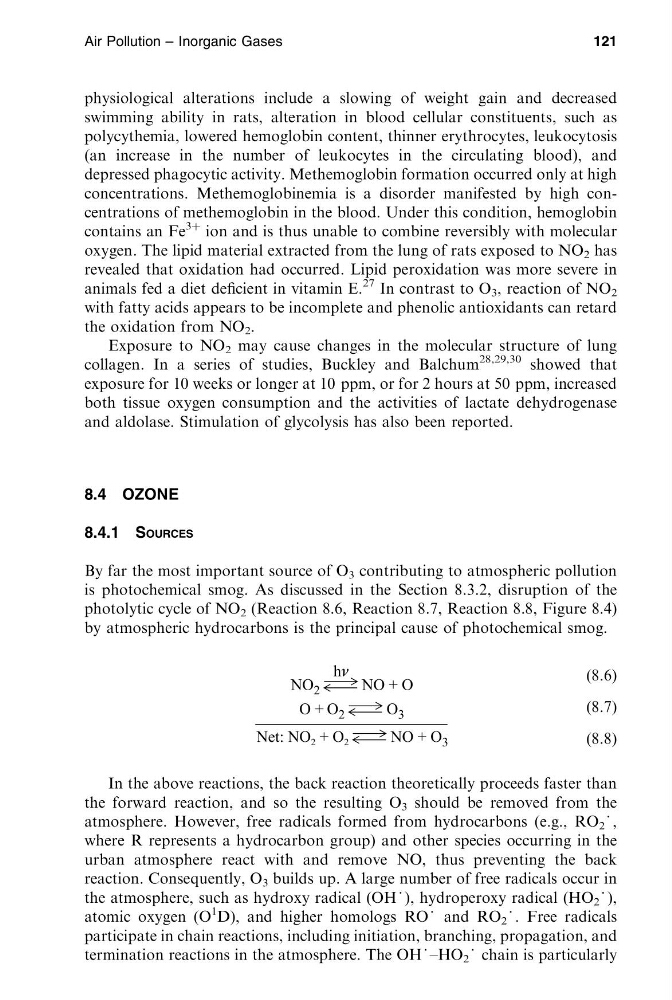
By far the most important source of O 3 contributing to atmospheric pollution
is photochemical smog. As discussed in the Section 8.3.2, disruption of the
photolytic cycle of NO 2 (Reaction 8.6, Reaction 8.7, Reaction 8.8, Figure 8.4)
by atmospheric hydrocarbons is the principal cause of photochemical smog.
In the above reactions, the back reaction theoretically proceeds faster than
the forward reaction, and so the resulting O 3 should be removed from the
atmosphere. However, free radicals formed from hydrocarbons (e.g., RO 2
Á ,
where R represents a hydrocarbon group) and other species occurring in the
urban atmosphere react with and remove NO, thus preventing the back
reaction. Consequently, O 3 builds up. A large number of free radicals occur in
the atmosphere, such as hydroxy radical (OH
Á ), hydroperoxy radical (HO 2
Á ),
atomic oxygen (O
1 D), and higher homologs RO
Á and RO 2
Á . Free radicals
participate in chain reactions, including initiation, branching, propagation, and
termination reactions in the atmosphere. The OH
Á –HO 2
Á chain is particularly
Air Pollution – Inorganic Gases
121
[16:53 26/8/04 P:/CRC PRESS/4365 MING-HO.751 (1670)/4365-008.3d]
Ref: 4365 MING-HO YU Chap-008 Page: 121 111-134
(8.6)
(8.7)
(8.8)
swimming ability in rats, alteration in blood cellular constituents, such as
polycythemia, lowered hemoglobin content, thinner erythrocytes, leukocytosis
(an increase in the number of leukocytes in the circulating blood), and
depressed phagocytic activity. Methemoglobin formation occurred only at high
concentrations. Methemoglobinemia is a disorder manifested by high concentrations of methemoglobin in the blood. Under this condition, hemoglobin
contains an Fe
3þ ion and is thus unable to combine reversibly with molecular
oxygen. The lipid material extracted from the lung of rats exposed to NO 2 has
revealed that oxidation had occurred. Lipid peroxidation was more severe in
animals fed a diet deficient in vitamin E.
27 In contrast to O 3 , reaction of NO 2
with fatty acids appears to be incomplete and phenolic antioxidants can retard
the oxidation from NO 2 .
Exposure to NO 2 may cause changes in the molecular structure of lung
collagen. In a series of studies, Buckley and Balchum
28,29,30 showed that
exposure for 10 weeks or longer at 10 ppm, or for 2 hours at 50 ppm, increased
both tissue oxygen consumption and the activities of lactate dehydrogenase
and aldolase. Stimulation of glycolysis has also been reported.
8.4 OZONE
8.4.1 SOURCES
By far the most important source of O 3 contributing to atmospheric pollution
is photochemical smog. As discussed in the Section 8.3.2, disruption of the
photolytic cycle of NO 2 (Reaction 8.6, Reaction 8.7, Reaction 8.8, Figure 8.4)
by atmospheric hydrocarbons is the principal cause of photochemical smog.
In the above reactions, the back reaction theoretically proceeds faster than
the forward reaction, and so the resulting O 3 should be removed from the
atmosphere. However, free radicals formed from hydrocarbons (e.g., RO 2
Á ,
where R represents a hydrocarbon group) and other species occurring in the
urban atmosphere react with and remove NO, thus preventing the back
reaction. Consequently, O 3 builds up. A large number of free radicals occur in
the atmosphere, such as hydroxy radical (OH
Á ), hydroperoxy radical (HO 2
Á ),
atomic oxygen (O
1 D), and higher homologs RO
Á and RO 2
Á . Free radicals
participate in chain reactions, including initiation, branching, propagation, and
termination reactions in the atmosphere. The OH
Á –HO 2
Á chain is particularly
Air Pollution – Inorganic Gases
121
[16:53 26/8/04 P:/CRC PRESS/4365 MING-HO.751 (1670)/4365-008.3d]
Ref: 4365 MING-HO YU Chap-008 Page: 121 111-134
(8.6)
(8.7)
(8.8)