

air. The toxic action of NO 2 is mainly on the deep lung and peripheral airway.
In various species of animals studied, exposure to NO 2 at 10 to 25 ppm for 24
hours was shown to induce the production of fibrin in the airway, an increased
number of macrophages, and altered appearance of the cells in the distal
airway and adjacent pulmonary alveoli. Terminal bronchioles showed
hyperplasia and hypertrophy, loss of cilia, and disturbed ciliagenesis. Large
crystaloid depositions also occurred in the cuboidal cells. Continuous exposure
for several months produced thickening of the basement membranes, resulting
in narrowing and fibrosis of the bronchioles. Emphysema-like alterations of the
lungs developed, followed by death of the animals.
24
As mentioned previously, although almost all the studies reported were
conducted by using much higher concentrations of NO 2 than are found in
ambient air, a few studies have dealt with low NO 2 concentrations. Orehek et
al.
25 showed that asthmatic subjects exposed to 0.1 ppm of NO 2 resulted in
significantly aggravated hyper-reactivity in the airway. While the health effects
of prevailing concentrations of NO 2 are generally considered insignificant, NO 2
pollution may be an important aspect of indoor pollution. Evidence suggests
that gas cooking and heating of homes, when not well vented, can increase
NO 2 exposure and that such exposure may cause increased respiratory
problems among individuals, particularly young children.
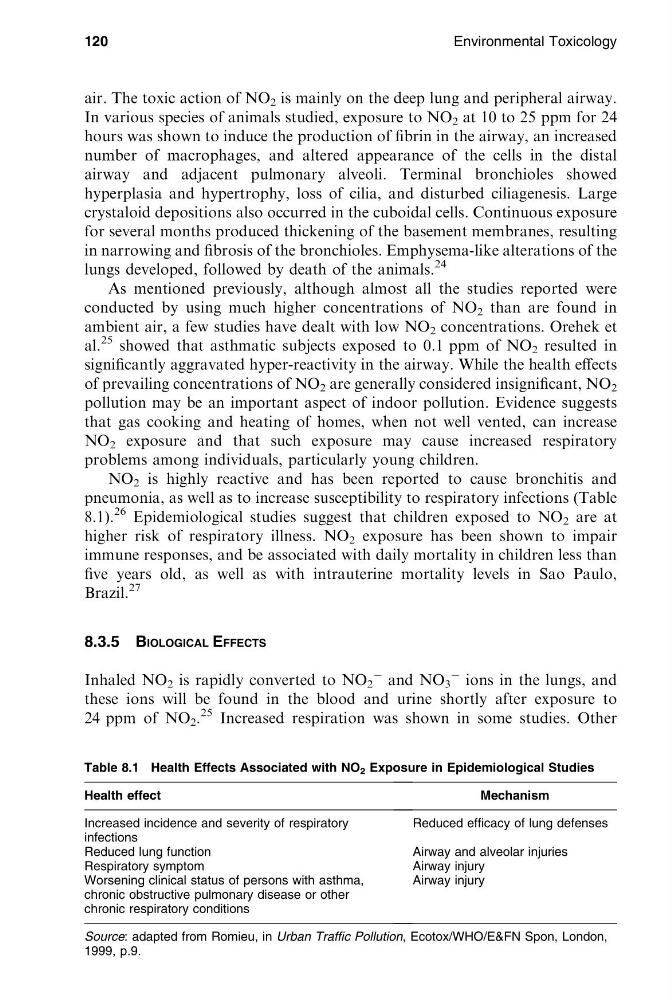
NO 2 is highly reactive and has been reported to cause bronchitis and
pneumonia, as well as to increase susceptibility to respiratory infections (Table
8.1).
26 Epidemiological studies suggest that children exposed to NO 2 are at
higher risk of respiratory illness. NO 2 exposure has been shown to impair
immune responses, and be associated with daily mortality in children less than
five years old, as well as with intrauterine mortality levels in Sao Paulo,
Brazil.
27
8.3.5 BIOLOGICAL EFFECTS
Inhaled NO 2 is rapidly converted to NO 2
À and NO 3
À ions in the lungs, and
these ions will be found in the blood and urine shortly after exposure to
24 ppm of NO 2 .
25 Increased respiration was shown in some studies. Other
120
Environmental Toxicology
[16:53 26/8/04 P:/CRC PRESS/4365 MING-HO.751 (1670)/4365-008.3d]
Ref: 4365 MING-HO YU Chap-008 Page: 120 111-134
Table 8.1 Health Effects Associated with NO 2 Exposure in Epidemiological Studies
Health effect
Mechanism
Increased incidence and severity of respiratory
infections
Reduced efficacy of lung defenses
Reduced lung function
Airway and alveolar injuries
Respiratory symptom
Airway injury
Worsening clinical status of persons with asthma,
chronic obstructive pulmonary disease or other
chronic respiratory conditions
Airway injury
Source: adapted from Romieu, in Urban Traffic Pollution, Ecotox/WHO/E&FN Spon, London,
1999, p.9.
In various species of animals studied, exposure to NO 2 at 10 to 25 ppm for 24
hours was shown to induce the production of fibrin in the airway, an increased
number of macrophages, and altered appearance of the cells in the distal
airway and adjacent pulmonary alveoli. Terminal bronchioles showed
hyperplasia and hypertrophy, loss of cilia, and disturbed ciliagenesis. Large
crystaloid depositions also occurred in the cuboidal cells. Continuous exposure
for several months produced thickening of the basement membranes, resulting
in narrowing and fibrosis of the bronchioles. Emphysema-like alterations of the
lungs developed, followed by death of the animals.
24
As mentioned previously, although almost all the studies reported were
conducted by using much higher concentrations of NO 2 than are found in
ambient air, a few studies have dealt with low NO 2 concentrations. Orehek et
al.
25 showed that asthmatic subjects exposed to 0.1 ppm of NO 2 resulted in
significantly aggravated hyper-reactivity in the airway. While the health effects
of prevailing concentrations of NO 2 are generally considered insignificant, NO 2
pollution may be an important aspect of indoor pollution. Evidence suggests
that gas cooking and heating of homes, when not well vented, can increase
NO 2 exposure and that such exposure may cause increased respiratory
problems among individuals, particularly young children.
NO 2 is highly reactive and has been reported to cause bronchitis and
pneumonia, as well as to increase susceptibility to respiratory infections (Table
8.1).
26 Epidemiological studies suggest that children exposed to NO 2 are at
higher risk of respiratory illness. NO 2 exposure has been shown to impair
immune responses, and be associated with daily mortality in children less than
five years old, as well as with intrauterine mortality levels in Sao Paulo,
Brazil.
27
8.3.5 BIOLOGICAL EFFECTS
Inhaled NO 2 is rapidly converted to NO 2
À and NO 3
À ions in the lungs, and
these ions will be found in the blood and urine shortly after exposure to
24 ppm of NO 2 .
25 Increased respiration was shown in some studies. Other
120
Environmental Toxicology
[16:53 26/8/04 P:/CRC PRESS/4365 MING-HO.751 (1670)/4365-008.3d]
Ref: 4365 MING-HO YU Chap-008 Page: 120 111-134
Table 8.1 Health Effects Associated with NO 2 Exposure in Epidemiological Studies
Health effect
Mechanism
Increased incidence and severity of respiratory
infections
Reduced efficacy of lung defenses
Reduced lung function
Airway and alveolar injuries
Respiratory symptom
Airway injury
Worsening clinical status of persons with asthma,
chronic obstructive pulmonary disease or other
chronic respiratory conditions
Airway injury
Source: adapted from Romieu, in Urban Traffic Pollution, Ecotox/WHO/E&FN Spon, London,
1999, p.9.