

7.2.2 GASTROINTESTINAL TRACT
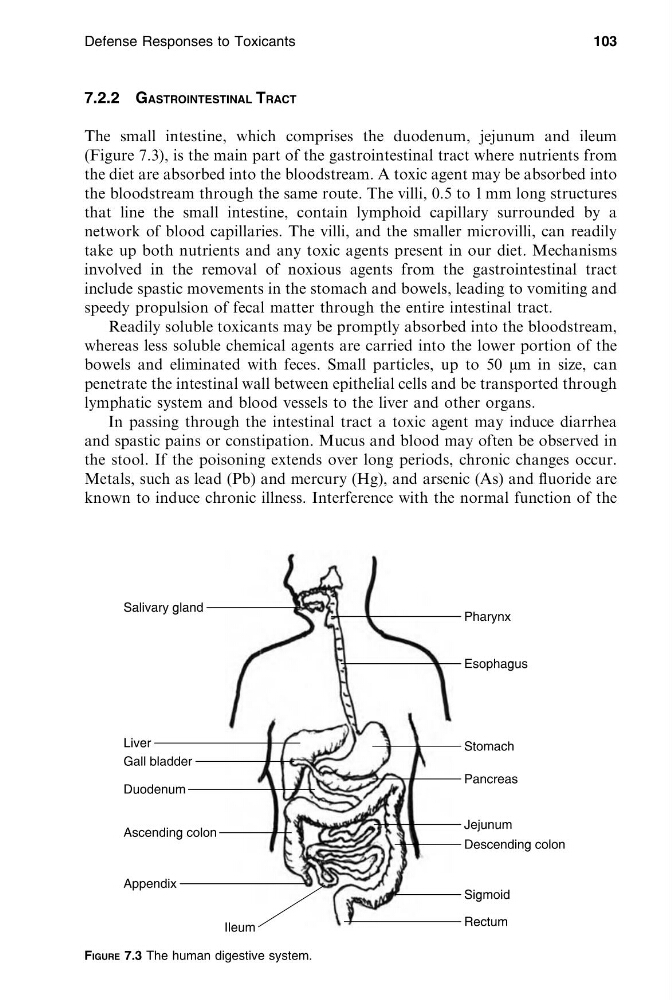
The small intestine, which comprises the duodenum, jejunum and ileum
(Figure 7.3), is the main part of the gastrointestinal tract where nutrients from
the diet are absorbed into the bloodstream. A toxic agent may be absorbed into
the bloodstream through the same route. The villi, 0.5 to 1 mm long structures
that line the small intestine, contain lymphoid capillary surrounded by a
network of blood capillaries. The villi, and the smaller microvilli, can readily
take up both nutrients and any toxic agents present in our diet. Mechanisms
involved in the removal of noxious agents from the gastrointestinal tract
include spastic movements in the stomach and bowels, leading to vomiting and
speedy propulsion of fecal matter through the entire intestinal tract.
Readily soluble toxicants may be promptly absorbed into the bloodstream,
whereas less soluble chemical agents are carried into the lower portion of the
bowels and eliminated with feces. Small particles, up to 50 mm in size, can
penetrate the intestinal wall between epithelial cells and be transported through
lymphatic system and blood vessels to the liver and other organs.
In passing through the intestinal tract a toxic agent may induce diarrhea
and spastic pains or constipation. Mucus and blood may often be observed in
the stool. If the poisoning extends over long periods, chronic changes occur.
Metals, such as lead (Pb) and mercury (Hg), and arsenic (As) and fluoride are
known to induce chronic illness. Interference with the normal function of the
Defense Responses to Toxicants
103
[16:53 26/8/04 P:/CRC PRESS/4365 MING-HO.751 (1670)/4365-007.3d]
Ref: 4365 MING-HO YU Chap-007 Page: 103 99-110
FIGURE 7.3 The human digestive system.
The small intestine, which comprises the duodenum, jejunum and ileum
(Figure 7.3), is the main part of the gastrointestinal tract where nutrients from
the diet are absorbed into the bloodstream. A toxic agent may be absorbed into
the bloodstream through the same route. The villi, 0.5 to 1 mm long structures
that line the small intestine, contain lymphoid capillary surrounded by a
network of blood capillaries. The villi, and the smaller microvilli, can readily
take up both nutrients and any toxic agents present in our diet. Mechanisms
involved in the removal of noxious agents from the gastrointestinal tract
include spastic movements in the stomach and bowels, leading to vomiting and
speedy propulsion of fecal matter through the entire intestinal tract.
Readily soluble toxicants may be promptly absorbed into the bloodstream,
whereas less soluble chemical agents are carried into the lower portion of the
bowels and eliminated with feces. Small particles, up to 50 mm in size, can
penetrate the intestinal wall between epithelial cells and be transported through
lymphatic system and blood vessels to the liver and other organs.
In passing through the intestinal tract a toxic agent may induce diarrhea
and spastic pains or constipation. Mucus and blood may often be observed in
the stool. If the poisoning extends over long periods, chronic changes occur.
Metals, such as lead (Pb) and mercury (Hg), and arsenic (As) and fluoride are
known to induce chronic illness. Interference with the normal function of the
Defense Responses to Toxicants
103
[16:53 26/8/04 P:/CRC PRESS/4365 MING-HO.751 (1670)/4365-007.3d]
Ref: 4365 MING-HO YU Chap-007 Page: 103 99-110
FIGURE 7.3 The human digestive system.