

lower bowels by toxic agents leads to loss of water, sodium (Na), and other
vital minerals and vitamins.
7.2.3 MEMBRANES
The plasma and intracellular membranes of mammalian cells have similar
overall compositions: about 60% protein and 40% lipid by weight. In addition,
some membranes also contain small amounts of carbohydrate, as glycoproteins
or glycolipids. The human erythrocyte membrane, for example, contains
approximately 10% carbohydrate, which appears to be localized on the outer
surface of the membranes.
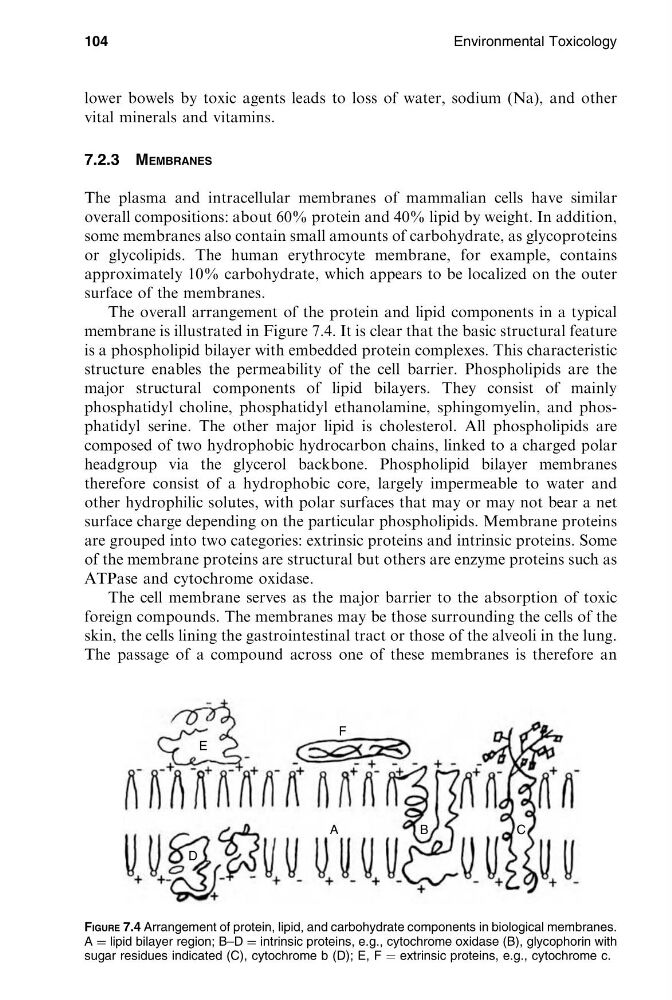
The overall arrangement of the protein and lipid components in a typical
membrane is illustrated in Figure 7.4. It is clear that the basic structural feature
is a phospholipid bilayer with embedded protein complexes. This characteristic
structure enables the permeability of the cell barrier. Phospholipids are the
major structural components of lipid bilayers. They consist of mainly
phosphatidyl choline, phosphatidyl ethanolamine, sphingomyelin, and phosphatidyl serine. The other major lipid is cholesterol. All phospholipids are
composed of two hydrophobic hydrocarbon chains, linked to a charged polar
headgroup via the glycerol backbone. Phospholipid bilayer membranes
therefore consist of a hydrophobic core, largely impermeable to water and
other hydrophilic solutes, with polar surfaces that may or may not bear a net
surface charge depending on the particular phospholipids. Membrane proteins
are grouped into two categories: extrinsic proteins and intrinsic proteins. Some
of the membrane proteins are structural but others are enzyme proteins such as
ATPase and cytochrome oxidase.
The cell membrane serves as the major barrier to the absorption of toxic
foreign compounds. The membranes may be those surrounding the cells of the
skin, the cells lining the gastrointestinal tract or those of the alveoli in the lung.
The passage of a compound across one of these membranes is therefore an
104
Environmental Toxicology
[16:53 26/8/04 P:/CRC PRESS/4365 MING-HO.751 (1670)/4365-007.3d]
Ref: 4365 MING-HO YU Chap-007 Page: 104 99-110
FIGURE 7.4 Arrangement of protein, lipid, and carbohydrate components in biological membranes.
A ¼ lipid bilayer region; B–D ¼ intrinsic proteins, e.g., cytochrome oxidase (B), glycophorin with
sugar residues indicated (C), cytochrome b (D); E, F ¼ extrinsic proteins, e.g., cytochrome c.
vital minerals and vitamins.
7.2.3 MEMBRANES
The plasma and intracellular membranes of mammalian cells have similar
overall compositions: about 60% protein and 40% lipid by weight. In addition,
some membranes also contain small amounts of carbohydrate, as glycoproteins
or glycolipids. The human erythrocyte membrane, for example, contains
approximately 10% carbohydrate, which appears to be localized on the outer
surface of the membranes.
The overall arrangement of the protein and lipid components in a typical
membrane is illustrated in Figure 7.4. It is clear that the basic structural feature
is a phospholipid bilayer with embedded protein complexes. This characteristic
structure enables the permeability of the cell barrier. Phospholipids are the
major structural components of lipid bilayers. They consist of mainly
phosphatidyl choline, phosphatidyl ethanolamine, sphingomyelin, and phosphatidyl serine. The other major lipid is cholesterol. All phospholipids are
composed of two hydrophobic hydrocarbon chains, linked to a charged polar
headgroup via the glycerol backbone. Phospholipid bilayer membranes
therefore consist of a hydrophobic core, largely impermeable to water and
other hydrophilic solutes, with polar surfaces that may or may not bear a net
surface charge depending on the particular phospholipids. Membrane proteins
are grouped into two categories: extrinsic proteins and intrinsic proteins. Some
of the membrane proteins are structural but others are enzyme proteins such as
ATPase and cytochrome oxidase.
The cell membrane serves as the major barrier to the absorption of toxic
foreign compounds. The membranes may be those surrounding the cells of the
skin, the cells lining the gastrointestinal tract or those of the alveoli in the lung.
The passage of a compound across one of these membranes is therefore an
104
Environmental Toxicology
[16:53 26/8/04 P:/CRC PRESS/4365 MING-HO.751 (1670)/4365-007.3d]
Ref: 4365 MING-HO YU Chap-007 Page: 104 99-110
FIGURE 7.4 Arrangement of protein, lipid, and carbohydrate components in biological membranes.
A ¼ lipid bilayer region; B–D ¼ intrinsic proteins, e.g., cytochrome oxidase (B), glycophorin with
sugar residues indicated (C), cytochrome b (D); E, F ¼ extrinsic proteins, e.g., cytochrome c.