

The term emphysema derives from Greek words meaning ‘‘overinflated,’’
the overinflated structures being alveoli. Tiny bronchioles through which air
flows to and from the air sacs have muscle fibers in their walls. In an
emphysematous patient, the structures of bronchioles and air sacs may become
hypertrophied and lose elasticity. Air will flow into the air sacs easily but
cannot flow out easily because of the narrowed diameter of bronchioles. The
patient can breathe in but cannot breathe out efficiently, resulting in too much
stale air in the lungs. As pressure builds up in the air cells, their thin walls are
stretched to the point of rupture, so several air spaces communicate and the
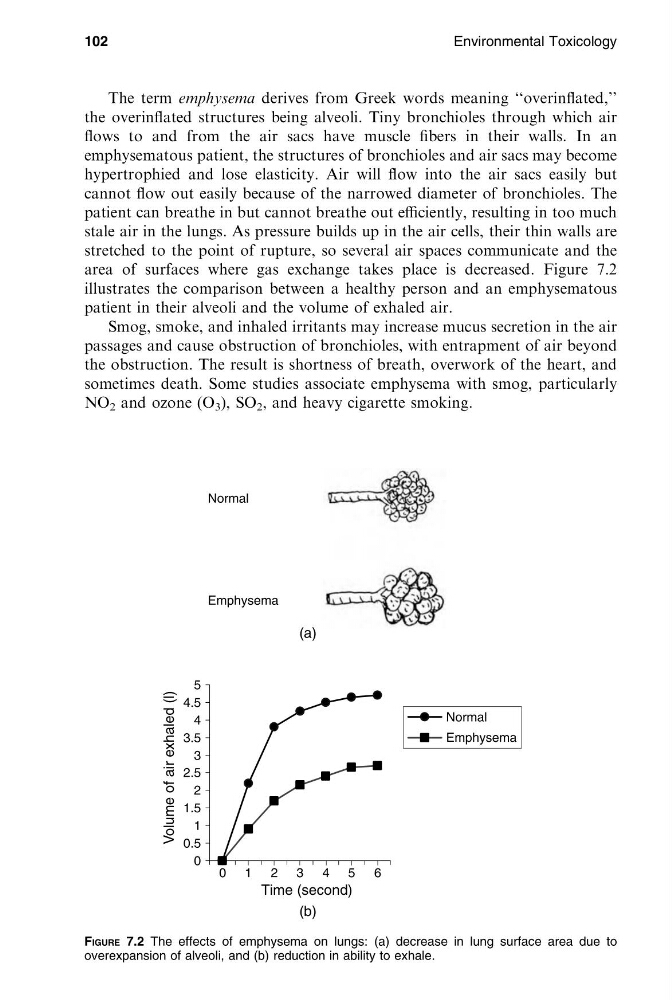
area of surfaces where gas exchange takes place is decreased. Figure 7.2
illustrates the comparison between a healthy person and an emphysematous
patient in their alveoli and the volume of exhaled air.
Smog, smoke, and inhaled irritants may increase mucus secretion in the air
passages and cause obstruction of bronchioles, with entrapment of air beyond
the obstruction. The result is shortness of breath, overwork of the heart, and
sometimes death. Some studies associate emphysema with smog, particularly
NO 2 and ozone (O 3 ), SO 2 , and heavy cigarette smoking.
102
Environmental Toxicology
[16:53 26/8/04 P:/CRC PRESS/4365 MING-HO.751 (1670)/4365-007.3d]
Ref: 4365 MING-HO YU Chap-007 Page: 102 99-110
(a)
(b)
Time (second)
Volume of air exhaled (l)
FIGURE 7.2 The effects of emphysema on lungs: (a) decrease in lung surface area due to
overexpansion of alveoli, and (b) reduction in ability to exhale.
the overinflated structures being alveoli. Tiny bronchioles through which air
flows to and from the air sacs have muscle fibers in their walls. In an
emphysematous patient, the structures of bronchioles and air sacs may become
hypertrophied and lose elasticity. Air will flow into the air sacs easily but
cannot flow out easily because of the narrowed diameter of bronchioles. The
patient can breathe in but cannot breathe out efficiently, resulting in too much
stale air in the lungs. As pressure builds up in the air cells, their thin walls are
stretched to the point of rupture, so several air spaces communicate and the
area of surfaces where gas exchange takes place is decreased. Figure 7.2
illustrates the comparison between a healthy person and an emphysematous
patient in their alveoli and the volume of exhaled air.
Smog, smoke, and inhaled irritants may increase mucus secretion in the air
passages and cause obstruction of bronchioles, with entrapment of air beyond
the obstruction. The result is shortness of breath, overwork of the heart, and
sometimes death. Some studies associate emphysema with smog, particularly
NO 2 and ozone (O 3 ), SO 2 , and heavy cigarette smoking.
102
Environmental Toxicology
[16:53 26/8/04 P:/CRC PRESS/4365 MING-HO.751 (1670)/4365-007.3d]
Ref: 4365 MING-HO YU Chap-007 Page: 102 99-110
(a)
(b)
Time (second)
Volume of air exhaled (l)
FIGURE 7.2 The effects of emphysema on lungs: (a) decrease in lung surface area due to
overexpansion of alveoli, and (b) reduction in ability to exhale.