

breakdown, of endogenous substances. For example, the hormone testosterone
is deactivated by cytochrome P450. The S-methylases detoxify hydrogen sulfide
(H 2 S) formed by anaerobic bacteria in the intestinal tract. (It follows that
chemicals or conditions that influence the activity of Phase I and Phase II
enzymes can affect the normal metabolism of endogenous substances.)
6.5.2 ACTIVATION OF XENOBIOTICS
Although the biotransformation of lipophilic xenobiotics often results in the
production of a more stable, water-soluble, and more readily excretable
metabolite, the activation of xenobiotics also occurs. In other words, certain
xenobiotics may be converted through biotransofrmation to reactive electrophilic species that are more potent than the parent compounds. For example,
the biotransformation of benzo[a]pyrene (BaP), which is both mutagenic and
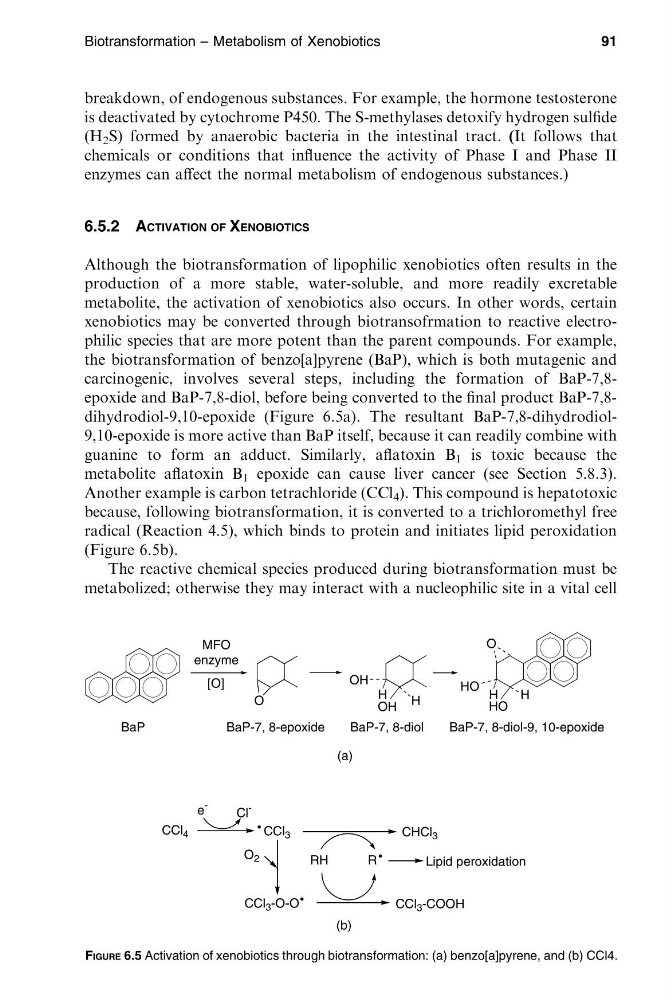
carcinogenic, involves several steps, including the formation of BaP-7,8epoxide and BaP-7,8-diol, before being converted to the final product BaP-7,8dihydrodiol-9,10-epoxide (Figure 6.5a). The resultant BaP-7,8-dihydrodiol9,10-epoxide is more active than BaP itself, because it can readily combine with
guanine to form an adduct. Similarly, aflatoxin B 1 is toxic because the
metabolite aflatoxin B 1 epoxide can cause liver cancer (see Section 5.8.3).
Another example is carbon tetrachloride (CCl 4 ). This compound is hepatotoxic
because, following biotransformation, it is converted to a trichloromethyl free
radical (Reaction 4.5), which binds to protein and initiates lipid peroxidation
(Figure 6.5b).
The reactive chemical species produced during biotransformation must be
metabolized; otherwise they may interact with a nucleophilic site in a vital cell
Biotransformation – Metabolism of Xenobiotics
91
[16:54 26/8/04 P:/CRC PRESS/4365 MING-HO.751 (1670)/4365-006.3d]
Ref: 4365 MING-HO YU Chap-006 Page: 91 85-98
FIGURE 6.5 Activation of xenobiotics through biotransformation: (a) benzo[a]pyrene, and (b) CCl4.
is deactivated by cytochrome P450. The S-methylases detoxify hydrogen sulfide
(H 2 S) formed by anaerobic bacteria in the intestinal tract. (It follows that
chemicals or conditions that influence the activity of Phase I and Phase II
enzymes can affect the normal metabolism of endogenous substances.)
6.5.2 ACTIVATION OF XENOBIOTICS
Although the biotransformation of lipophilic xenobiotics often results in the
production of a more stable, water-soluble, and more readily excretable
metabolite, the activation of xenobiotics also occurs. In other words, certain
xenobiotics may be converted through biotransofrmation to reactive electrophilic species that are more potent than the parent compounds. For example,
the biotransformation of benzo[a]pyrene (BaP), which is both mutagenic and
carcinogenic, involves several steps, including the formation of BaP-7,8epoxide and BaP-7,8-diol, before being converted to the final product BaP-7,8dihydrodiol-9,10-epoxide (Figure 6.5a). The resultant BaP-7,8-dihydrodiol9,10-epoxide is more active than BaP itself, because it can readily combine with
guanine to form an adduct. Similarly, aflatoxin B 1 is toxic because the
metabolite aflatoxin B 1 epoxide can cause liver cancer (see Section 5.8.3).
Another example is carbon tetrachloride (CCl 4 ). This compound is hepatotoxic
because, following biotransformation, it is converted to a trichloromethyl free
radical (Reaction 4.5), which binds to protein and initiates lipid peroxidation
(Figure 6.5b).
The reactive chemical species produced during biotransformation must be
metabolized; otherwise they may interact with a nucleophilic site in a vital cell
Biotransformation – Metabolism of Xenobiotics
91
[16:54 26/8/04 P:/CRC PRESS/4365 MING-HO.751 (1670)/4365-006.3d]
Ref: 4365 MING-HO YU Chap-006 Page: 91 85-98
FIGURE 6.5 Activation of xenobiotics through biotransformation: (a) benzo[a]pyrene, and (b) CCl4.