

constituent and induce cellular damage.
3 As mentioned earlier, many of the
reactive metabolites can bind covalently to macromolecules in liver cells. For
instance, the hepatotoxic CCl 4 noted above can covalently bind to lipid
components of the liver endoplasmic reticulum.
4 Some of the reactive
electrophiles are also carcinogenic.
Although liver cells depend on detoxification enzymes for protection against
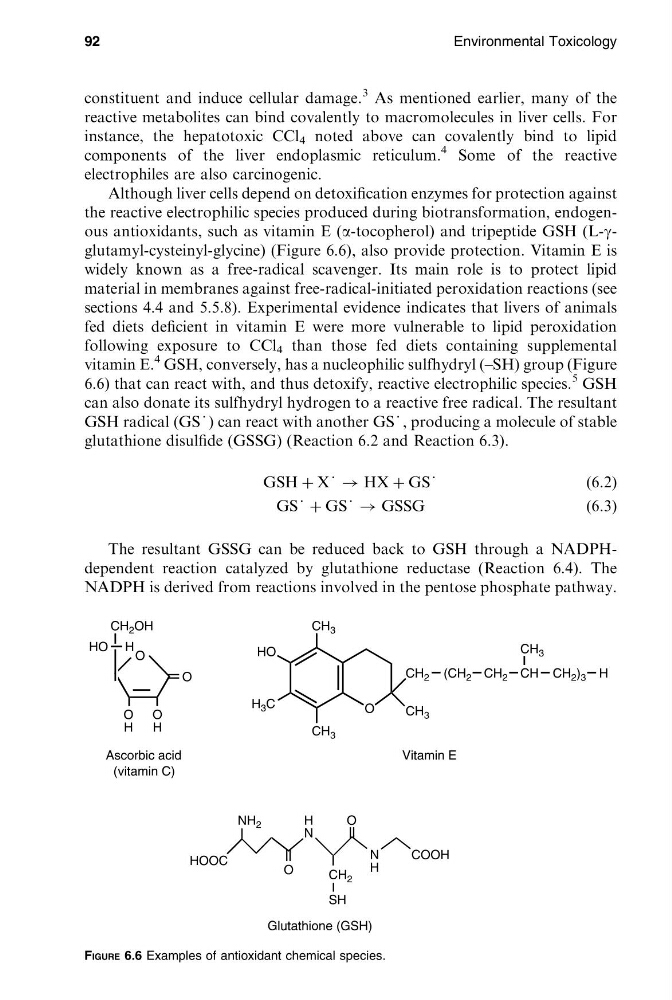
the reactive electrophilic species produced during biotransformation, endogenous antioxidants, such as vitamin E (a-tocopherol) and tripeptide GSH (L-gglutamyl-cysteinyl-glycine) (Figure 6.6), also provide protection. Vitamin E is
widely known as a free-radical scavenger. Its main role is to protect lipid
material in membranes against free-radical-initiated peroxidation reactions (see
sections 4.4 and 5.5.8). Experimental evidence indicates that livers of animals
fed diets deficient in vitamin E were more vulnerable to lipid peroxidation
following exposure to CCl 4 than those fed diets containing supplemental
vitamin E.
4 GSH, conversely, has a nucleophilic sulfhydryl (–SH) group (Figure
6.6) that can react with, and thus detoxify, reactive electrophilic species.
5 GSH
can also donate its sulfhydryl hydrogen to a reactive free radical. The resultant
GSH radical (GS
Á ) can react with another GS
Á , producing a molecule of stable
glutathione disulfide (GSSG) (Reaction 6.2 and Reaction 6.3).
GSH þ X
Á ! HX þ GS
Á
ð6:2Þ
GS
Á þ GS
Á ! GSSG
ð6:3Þ
The resultant GSSG can be reduced back to GSH through a NADPHdependent reaction catalyzed by glutathione reductase (Reaction 6.4). The
NADPH is derived from reactions involved in the pentose phosphate pathway.
92
Environmental Toxicology
[16:54 26/8/04 P:/CRC PRESS/4365 MING-HO.751 (1670)/4365-006.3d]
Ref: 4365 MING-HO YU Chap-006 Page: 92 85-98
FIGURE 6.6 Examples of antioxidant chemical species.
3 As mentioned earlier, many of the
reactive metabolites can bind covalently to macromolecules in liver cells. For
instance, the hepatotoxic CCl 4 noted above can covalently bind to lipid
components of the liver endoplasmic reticulum.
4 Some of the reactive
electrophiles are also carcinogenic.
Although liver cells depend on detoxification enzymes for protection against
the reactive electrophilic species produced during biotransformation, endogenous antioxidants, such as vitamin E (a-tocopherol) and tripeptide GSH (L-gglutamyl-cysteinyl-glycine) (Figure 6.6), also provide protection. Vitamin E is
widely known as a free-radical scavenger. Its main role is to protect lipid
material in membranes against free-radical-initiated peroxidation reactions (see
sections 4.4 and 5.5.8). Experimental evidence indicates that livers of animals
fed diets deficient in vitamin E were more vulnerable to lipid peroxidation
following exposure to CCl 4 than those fed diets containing supplemental
vitamin E.
4 GSH, conversely, has a nucleophilic sulfhydryl (–SH) group (Figure
6.6) that can react with, and thus detoxify, reactive electrophilic species.
5 GSH
can also donate its sulfhydryl hydrogen to a reactive free radical. The resultant
GSH radical (GS
Á ) can react with another GS
Á , producing a molecule of stable
glutathione disulfide (GSSG) (Reaction 6.2 and Reaction 6.3).
GSH þ X
Á ! HX þ GS
Á
ð6:2Þ
GS
Á þ GS
Á ! GSSG
ð6:3Þ
The resultant GSSG can be reduced back to GSH through a NADPHdependent reaction catalyzed by glutathione reductase (Reaction 6.4). The
NADPH is derived from reactions involved in the pentose phosphate pathway.
92
Environmental Toxicology
[16:54 26/8/04 P:/CRC PRESS/4365 MING-HO.751 (1670)/4365-006.3d]
Ref: 4365 MING-HO YU Chap-006 Page: 92 85-98
FIGURE 6.6 Examples of antioxidant chemical species.