

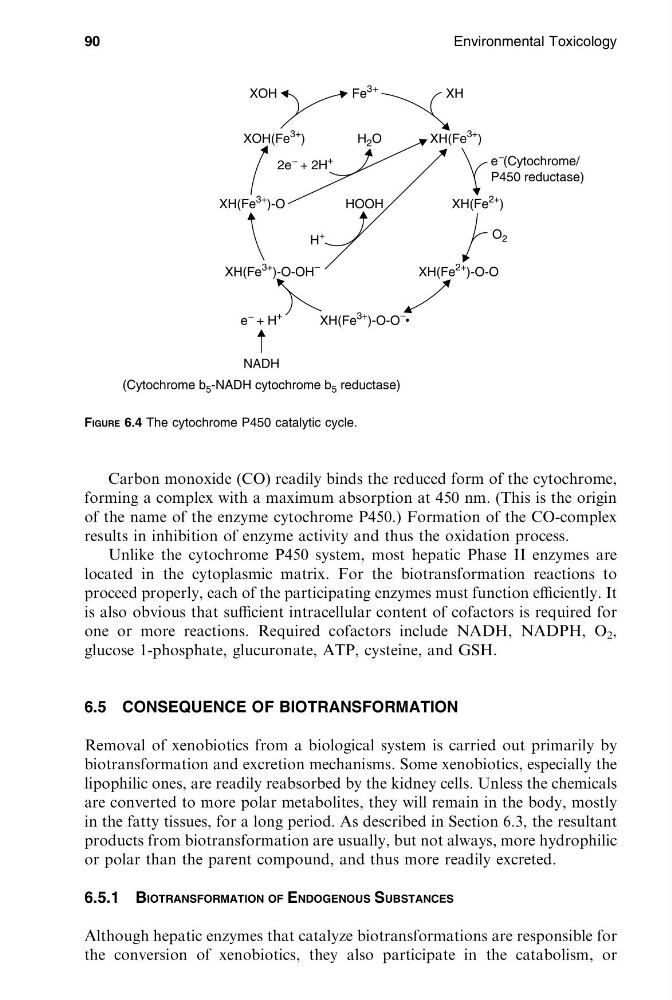
Carbon monoxide (CO) readily binds the reduced form of the cytochrome,
forming a complex with a maximum absorption at 450 nm. (This is the origin
of the name of the enzyme cytochrome P450.) Formation of the CO-complex
results in inhibition of enzyme activity and thus the oxidation process.
Unlike the cytochrome P450 system, most hepatic Phase II enzymes are
located in the cytoplasmic matrix. For the biotransformation reactions to
proceed properly, each of the participating enzymes must function efficiently. It
is also obvious that sufficient intracellular content of cofactors is required for
one or more reactions. Required cofactors include NADH, NADPH, O 2 ,
glucose 1-phosphate, glucuronate, ATP, cysteine, and GSH.
6.5 CONSEQUENCE OF BIOTRANSFORMATION
Removal of xenobiotics from a biological system is carried out primarily by
biotransformation and excretion mechanisms. Some xenobiotics, especially the
lipophilic ones, are readily reabsorbed by the kidney cells. Unless the chemicals
are converted to more polar metabolites, they will remain in the body, mostly
in the fatty tissues, for a long period. As described in Section 6.3, the resultant
products from biotransformation are usually, but not always, more hydrophilic
or polar than the parent compound, and thus more readily excreted.
6.5.1 BIOTRANSFORMATION OF ENDOGENOUS SUBSTANCES
Although hepatic enzymes that catalyze biotransformations are responsible for
the conversion of xenobiotics, they also participate in the catabolism, or
90
Environmental Toxicology
[16:54 26/8/04 P:/CRC PRESS/4365 MING-HO.751 (1670)/4365-006.3d]
Ref: 4365 MING-HO YU Chap-006 Page: 90 85-98
FIGURE 6.4 The cytochrome P450 catalytic cycle.
forming a complex with a maximum absorption at 450 nm. (This is the origin
of the name of the enzyme cytochrome P450.) Formation of the CO-complex
results in inhibition of enzyme activity and thus the oxidation process.
Unlike the cytochrome P450 system, most hepatic Phase II enzymes are
located in the cytoplasmic matrix. For the biotransformation reactions to
proceed properly, each of the participating enzymes must function efficiently. It
is also obvious that sufficient intracellular content of cofactors is required for
one or more reactions. Required cofactors include NADH, NADPH, O 2 ,
glucose 1-phosphate, glucuronate, ATP, cysteine, and GSH.
6.5 CONSEQUENCE OF BIOTRANSFORMATION
Removal of xenobiotics from a biological system is carried out primarily by
biotransformation and excretion mechanisms. Some xenobiotics, especially the
lipophilic ones, are readily reabsorbed by the kidney cells. Unless the chemicals
are converted to more polar metabolites, they will remain in the body, mostly
in the fatty tissues, for a long period. As described in Section 6.3, the resultant
products from biotransformation are usually, but not always, more hydrophilic
or polar than the parent compound, and thus more readily excreted.
6.5.1 BIOTRANSFORMATION OF ENDOGENOUS SUBSTANCES
Although hepatic enzymes that catalyze biotransformations are responsible for
the conversion of xenobiotics, they also participate in the catabolism, or
90
Environmental Toxicology
[16:54 26/8/04 P:/CRC PRESS/4365 MING-HO.751 (1670)/4365-006.3d]
Ref: 4365 MING-HO YU Chap-006 Page: 90 85-98
FIGURE 6.4 The cytochrome P450 catalytic cycle.