

Vitamins C and E were shown to be beneficial in the amelioration of the
detrimental effects induced by fluoride.
34
The most outstanding chemical characteristics of the ascorbate system
(ascorbic acid/ascorbate, ascorbate free radical, dehydroascorbic acid) are its
redox properties. Ascorbate is a reactive reductant, but its free radical (A
Á À ) is
relatively nonreactive. Interestingly, there is evidence that vitamins E and C
probably act synergistically, i.e., vitamin E acts as the primary antioxidant
(particularly in biomembranes) and the resulting vitamin E radical (E
Á ) then
reacts with ascorbate (AH
À ) to regenerate vitamin E,
35 as shown in Reaction
5.3.
vitamin E
Á þ AH
À ! vitamin E þ A
Á À
ð5:3Þ
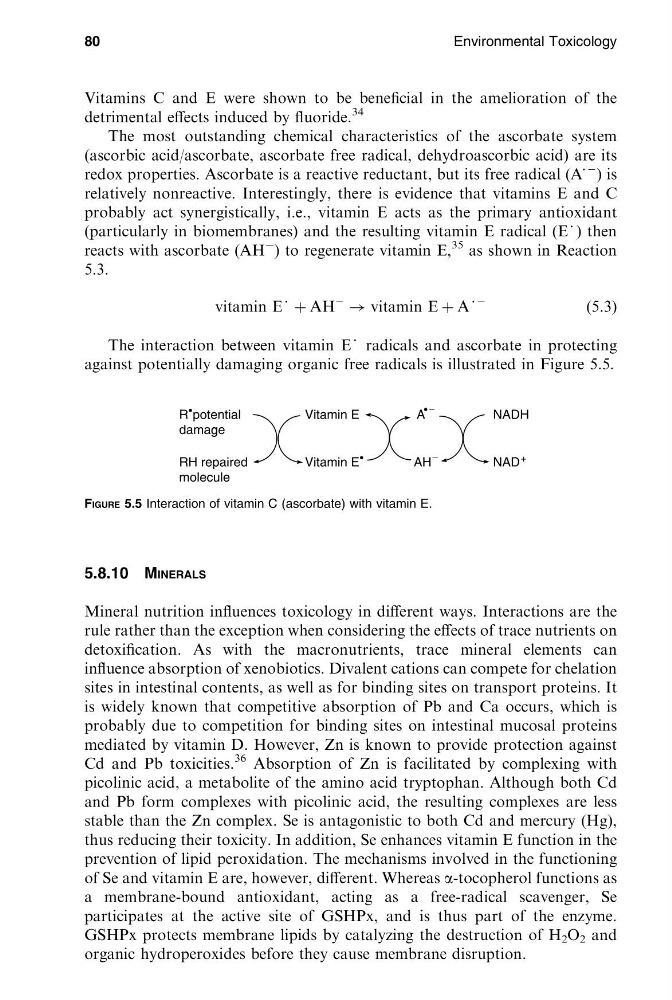
The interaction between vitamin E
Á radicals and ascorbate in protecting
against potentially damaging organic free radicals is illustrated in Figure 5.5.
5.8.10 MINERALS
Mineral nutrition influences toxicology in different ways. Interactions are the
rule rather than the exception when considering the effects of trace nutrients on
detoxification. As with the macronutrients, trace mineral elements can
influence absorption of xenobiotics. Divalent cations can compete for chelation
sites in intestinal contents, as well as for binding sites on transport proteins. It
is widely known that competitive absorption of Pb and Ca occurs, which is
probably due to competition for binding sites on intestinal mucosal proteins
mediated by vitamin D. However, Zn is known to provide protection against
Cd and Pb toxicities.
36 Absorption of Zn is facilitated by complexing with
picolinic acid, a metabolite of the amino acid tryptophan. Although both Cd
and Pb form complexes with picolinic acid, the resulting complexes are less
stable than the Zn complex. Se is antagonistic to both Cd and mercury (Hg),
thus reducing their toxicity. In addition, Se enhances vitamin E function in the
prevention of lipid peroxidation. The mechanisms involved in the functioning
of Se and vitamin E are, however, different. Whereas a-tocopherol functions as
a membrane-bound antioxidant, acting as a free-radical scavenger, Se
participates at the active site of GSHPx, and is thus part of the enzyme.
GSHPx protects membrane lipids by catalyzing the destruction of H 2 O 2 and
organic hydroperoxides before they cause membrane disruption.
80
Environmental Toxicology
[16:54 26/8/04 P:/CRC PRESS/4365 MING-HO.751 (1670)/4365-005.3d]
Ref: 4365 MING-HO YU Chap-005 Page: 80 65-84
FIGURE 5.5 Interaction of vitamin C (ascorbate) with vitamin E.
detrimental effects induced by fluoride.
34
The most outstanding chemical characteristics of the ascorbate system
(ascorbic acid/ascorbate, ascorbate free radical, dehydroascorbic acid) are its
redox properties. Ascorbate is a reactive reductant, but its free radical (A
Á À ) is
relatively nonreactive. Interestingly, there is evidence that vitamins E and C
probably act synergistically, i.e., vitamin E acts as the primary antioxidant
(particularly in biomembranes) and the resulting vitamin E radical (E
Á ) then
reacts with ascorbate (AH
À ) to regenerate vitamin E,
35 as shown in Reaction
5.3.
vitamin E
Á þ AH
À ! vitamin E þ A
Á À
ð5:3Þ
The interaction between vitamin E
Á radicals and ascorbate in protecting
against potentially damaging organic free radicals is illustrated in Figure 5.5.
5.8.10 MINERALS
Mineral nutrition influences toxicology in different ways. Interactions are the
rule rather than the exception when considering the effects of trace nutrients on
detoxification. As with the macronutrients, trace mineral elements can
influence absorption of xenobiotics. Divalent cations can compete for chelation
sites in intestinal contents, as well as for binding sites on transport proteins. It
is widely known that competitive absorption of Pb and Ca occurs, which is
probably due to competition for binding sites on intestinal mucosal proteins
mediated by vitamin D. However, Zn is known to provide protection against
Cd and Pb toxicities.
36 Absorption of Zn is facilitated by complexing with
picolinic acid, a metabolite of the amino acid tryptophan. Although both Cd
and Pb form complexes with picolinic acid, the resulting complexes are less
stable than the Zn complex. Se is antagonistic to both Cd and mercury (Hg),
thus reducing their toxicity. In addition, Se enhances vitamin E function in the
prevention of lipid peroxidation. The mechanisms involved in the functioning
of Se and vitamin E are, however, different. Whereas a-tocopherol functions as
a membrane-bound antioxidant, acting as a free-radical scavenger, Se
participates at the active site of GSHPx, and is thus part of the enzyme.
GSHPx protects membrane lipids by catalyzing the destruction of H 2 O 2 and
organic hydroperoxides before they cause membrane disruption.
80
Environmental Toxicology
[16:54 26/8/04 P:/CRC PRESS/4365 MING-HO.751 (1670)/4365-005.3d]
Ref: 4365 MING-HO YU Chap-005 Page: 80 65-84
FIGURE 5.5 Interaction of vitamin C (ascorbate) with vitamin E.