

The effect of vitamin C appears to be tissue-dependent.
25 Epidemiological
studies show that persons with high intakes of dietary vitamin C or citrus fruit
have a lower than normal risk of developing cancer. Cancer prevention by
vitamin C is thought to be mainly due to its role as an antioxidant and freeradical scavenger. Oxidative and free-radical-induced damage to DNA and cell
membranes has been considered as the most important factor in cancer
initiation – substantial evidence indicates that vitamin C can help prevent such
damage.
26
A variety of experimental tumors of the gastrointestinal tract, liver, lung,
and bladder can be produced by nitroso compounds.
27,28 Nitroso compounds
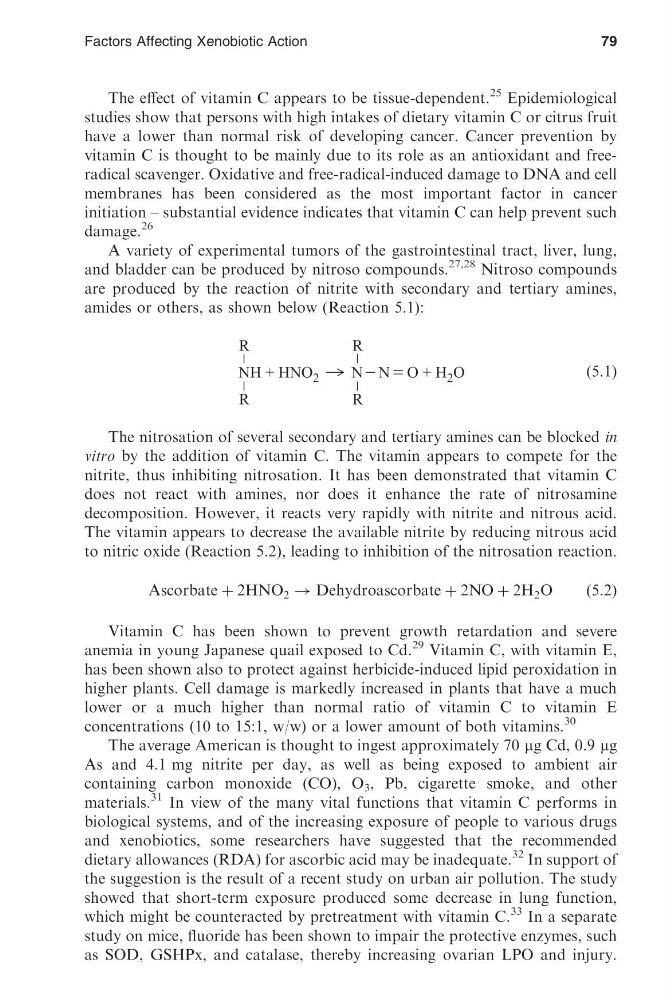
are produced by the reaction of nitrite with secondary and tertiary amines,
amides or others, as shown below (Reaction 5.1):
ð5:1Þ
The nitrosation of several secondary and tertiary amines can be blocked in
vitro by the addition of vitamin C. The vitamin appears to compete for the
nitrite, thus inhibiting nitrosation. It has been demonstrated that vitamin C
does not react with amines, nor does it enhance the rate of nitrosamine
decomposition. However, it reacts very rapidly with nitrite and nitrous acid.
The vitamin appears to decrease the available nitrite by reducing nitrous acid
to nitric oxide (Reaction 5.2), leading to inhibition of the nitrosation reaction.
Ascorbate þ 2HNO 2 ! Dehydroascorbate þ 2NO þ 2H 2 O
ð5:2Þ
Vitamin C has been shown to prevent growth retardation and severe
anemia in young Japanese quail exposed to Cd.
29 Vitamin C, with vitamin E,
has been shown also to protect against herbicide-induced lipid peroxidation in
higher plants. Cell damage is markedly increased in plants that have a much
lower or a much higher than normal ratio of vitamin C to vitamin E
concentrations (10 to 15:1, w/w) or a lower amount of both vitamins.
30
The average American is thought to ingest approximately 70 mg Cd, 0.9 mg
As and 4.1 mg nitrite per day, as well as being exposed to ambient air
containing carbon monoxide (CO), O 3 , Pb, cigarette smoke, and other
materials.
31 In view of the many vital functions that vitamin C performs in
biological systems, and of the increasing exposure of people to various drugs
and xenobiotics, some researchers have suggested that the recommended
dietary allowances (RDA) for ascorbic acid may be inadequate.
32 In support of
the suggestion is the result of a recent study on urban air pollution. The study
showed that short-term exposure produced some decrease in lung function,
which might be counteracted by pretreatment with vitamin C.
33 In a separate
study on mice, fluoride has been shown to impair the protective enzymes, such
as SOD, GSHPx, and catalase, thereby increasing ovarian LPO and injury.
Factors Affecting Xenobiotic Action
79
[16:54 26/8/04 P:/CRC PRESS/4365 MING-HO.751 (1670)/4365-005.3d]
Ref: 4365 MING-HO YU Chap-005 Page: 79 65-84
25 Epidemiological
studies show that persons with high intakes of dietary vitamin C or citrus fruit
have a lower than normal risk of developing cancer. Cancer prevention by
vitamin C is thought to be mainly due to its role as an antioxidant and freeradical scavenger. Oxidative and free-radical-induced damage to DNA and cell
membranes has been considered as the most important factor in cancer
initiation – substantial evidence indicates that vitamin C can help prevent such
damage.
26
A variety of experimental tumors of the gastrointestinal tract, liver, lung,
and bladder can be produced by nitroso compounds.
27,28 Nitroso compounds
are produced by the reaction of nitrite with secondary and tertiary amines,
amides or others, as shown below (Reaction 5.1):
ð5:1Þ
The nitrosation of several secondary and tertiary amines can be blocked in
vitro by the addition of vitamin C. The vitamin appears to compete for the
nitrite, thus inhibiting nitrosation. It has been demonstrated that vitamin C
does not react with amines, nor does it enhance the rate of nitrosamine
decomposition. However, it reacts very rapidly with nitrite and nitrous acid.
The vitamin appears to decrease the available nitrite by reducing nitrous acid
to nitric oxide (Reaction 5.2), leading to inhibition of the nitrosation reaction.
Ascorbate þ 2HNO 2 ! Dehydroascorbate þ 2NO þ 2H 2 O
ð5:2Þ
Vitamin C has been shown to prevent growth retardation and severe
anemia in young Japanese quail exposed to Cd.
29 Vitamin C, with vitamin E,
has been shown also to protect against herbicide-induced lipid peroxidation in
higher plants. Cell damage is markedly increased in plants that have a much
lower or a much higher than normal ratio of vitamin C to vitamin E
concentrations (10 to 15:1, w/w) or a lower amount of both vitamins.
30
The average American is thought to ingest approximately 70 mg Cd, 0.9 mg
As and 4.1 mg nitrite per day, as well as being exposed to ambient air
containing carbon monoxide (CO), O 3 , Pb, cigarette smoke, and other
materials.
31 In view of the many vital functions that vitamin C performs in
biological systems, and of the increasing exposure of people to various drugs
and xenobiotics, some researchers have suggested that the recommended
dietary allowances (RDA) for ascorbic acid may be inadequate.
32 In support of
the suggestion is the result of a recent study on urban air pollution. The study
showed that short-term exposure produced some decrease in lung function,
which might be counteracted by pretreatment with vitamin C.
33 In a separate
study on mice, fluoride has been shown to impair the protective enzymes, such
as SOD, GSHPx, and catalase, thereby increasing ovarian LPO and injury.
Factors Affecting Xenobiotic Action
79
[16:54 26/8/04 P:/CRC PRESS/4365 MING-HO.751 (1670)/4365-005.3d]
Ref: 4365 MING-HO YU Chap-005 Page: 79 65-84