

3. Polarisation : photon et spin 1/2
79
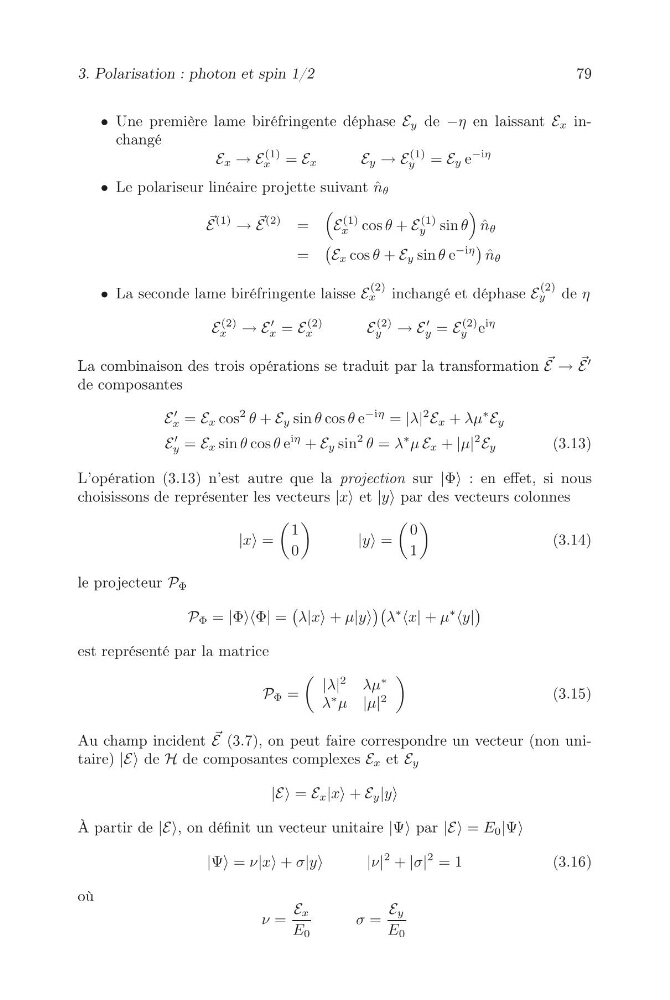
• Une première lame biréfringente déphase E y de −η en laissant E x inchangé
E x →E
(1)
x = E x
E y →E
(1)
y = E y e
−iη
• Le polariseur linéaire projette suivant ˆ
n θ
E
(1) →
E
(2) =
E
(1)
x cos θ + E
(1)
y sin θ
ˆ
n θ
=
E x cos θ + E y sin θ e
−iη
ˆ
n θ
• La seconde lame biréfringente laisse E
(2)
x inchangé et déphase E
(2)
y
de η
E
(2)
x →E
′
x = E
(2)
x
E
(2)
y →E
′
y = E
(2)
y e
iη
La combinaison des trois opérations se traduit par la transformation
E→
E
′
de composantes
E
′
x = E x cos
2 θ + E y sin θ cos θ e
−iη = |λ|
2 E x + λµ
∗ E y
E
′
y = E x sin θ cos θ e
iη + E y sin
2 θ = λ
∗ µ E x + |µ|
2 E y
(3.13)
L’opération (3.13) n’est autre que la projection sur |Φ : en effet, si nous
choisissons de représenter les vecteurs |x et |y par des vecteurs colonnes
|x =
1
0
|y =
0
1
(3.14)
le projecteur P Φ
P Φ = |ΦΦ| =
λ|x + µ|y
λ
∗ x| + µ
∗ y|
est représenté par la matrice
P Φ =
|λ|
2
λµ
∗
λ
∗ µ |µ|
2
(3.15)
Au champ incident
E (3.7), on peut faire correspondre un vecteur (non unitaire) |EE de H de composantes complexes E x et E y
|EE = E x |x + E y |y
Àp a r t i rd e|EE, on définit un vecteur unitaire |Ψ par |EE = E 0 |Ψ
|Ψ = ν|x + σ|y| ν|
2 + |σ|
2 =1
(3.16)
où
ν =
E x
E 0
σ =
E y
E 0
79
• Une première lame biréfringente déphase E y de −η en laissant E x inchangé
E x →E
(1)
x = E x
E y →E
(1)
y = E y e
−iη
• Le polariseur linéaire projette suivant ˆ
n θ
E
(1) →
E
(2) =
E
(1)
x cos θ + E
(1)
y sin θ
ˆ
n θ
=
E x cos θ + E y sin θ e
−iη
ˆ
n θ
• La seconde lame biréfringente laisse E
(2)
x inchangé et déphase E
(2)
y
de η
E
(2)
x →E
′
x = E
(2)
x
E
(2)
y →E
′
y = E
(2)
y e
iη
La combinaison des trois opérations se traduit par la transformation
E→
E
′
de composantes
E
′
x = E x cos
2 θ + E y sin θ cos θ e
−iη = |λ|
2 E x + λµ
∗ E y
E
′
y = E x sin θ cos θ e
iη + E y sin
2 θ = λ
∗ µ E x + |µ|
2 E y
(3.13)
L’opération (3.13) n’est autre que la projection sur |Φ : en effet, si nous
choisissons de représenter les vecteurs |x et |y par des vecteurs colonnes
|x =
1
0
|y =
0
1
(3.14)
le projecteur P Φ
P Φ = |ΦΦ| =
λ|x + µ|y
λ
∗ x| + µ
∗ y|
est représenté par la matrice
P Φ =
|λ|
2
λµ
∗
λ
∗ µ |µ|
2
(3.15)
Au champ incident
E (3.7), on peut faire correspondre un vecteur (non unitaire) |EE de H de composantes complexes E x et E y
|EE = E x |x + E y |y
Àp a r t i rd e|EE, on définit un vecteur unitaire |Ψ par |EE = E 0 |Ψ
|Ψ = ν|x + σ|y| ν|
2 + |σ|
2 =1
(3.16)
où
ν =
E x
E 0
σ =
E y
E 0