

58
2 Particle Dynamics
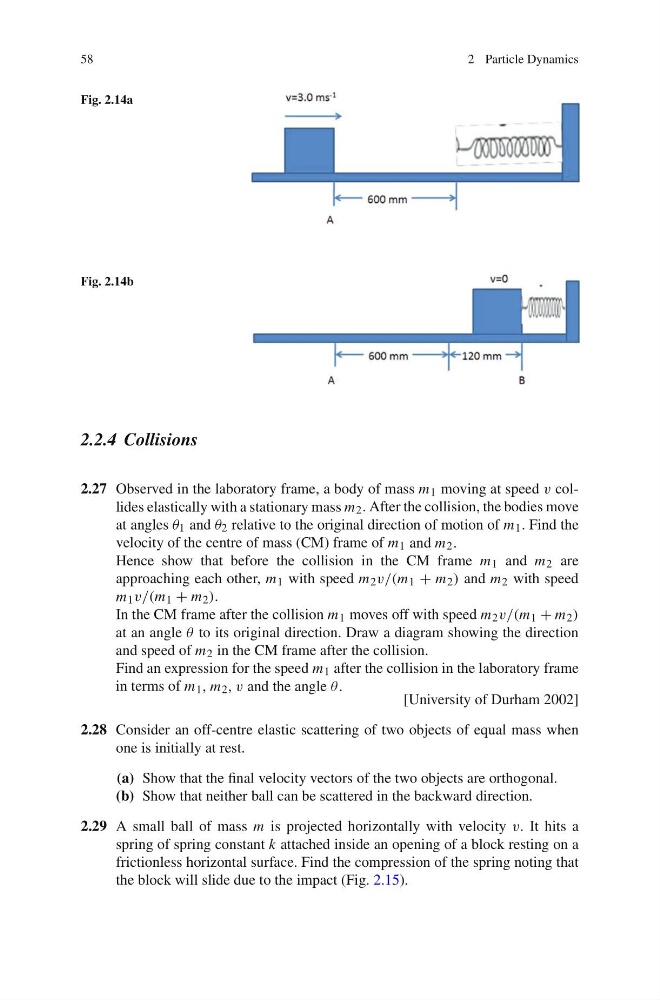
Fig. 2.14a
Fig. 2.14b
2.2.4 Collisions
2.27 Observed in the laboratory frame, a body of mass m 1 moving at speed v collides elastically with a stationary mass m 2 . After the collision, the bodies move
at angles θ 1 and θ 2 relative to the original direction of motion of m 1 . Find the
velocity of the centre of mass (CM) frame of m 1 and m 2 .
Hence show that before the collision in the CM frame m 1 and m 2 are
approaching each other, m 1 with speed m 2 v/(m 1 + m 2 ) and m 2 with speed
m 1 v/(m 1 + m 2 ).
In the CM frame after the collision m 1 moves off with speed m 2 v/(m 1 + m 2 )
at an angle θ to its original direction. Draw a diagram showing the direction
and speed of m 2 in the CM frame after the collision.
Find an expression for the speed m 1 after the collision in the laboratory frame
in terms of m 1 , m 2 , v and the angle θ .
[University of Durham 2002]
2.28 Consider an off-centre elastic scattering of two objects of equal mass when
one is initially at rest.
(a) Show that the final velocity vectors of the two objects are orthogonal.
(b) Show that neither ball can be scattered in the backward direction.
2.29 A small ball of mass m is projected horizontally with velocity v. It hits a
spring of spring constant k attached inside an opening of a block resting on a
frictionless horizontal surface. Find the compression of the spring noting that
the block will slide due to the impact (Fig. 2.15).
2 Particle Dynamics
Fig. 2.14a
Fig. 2.14b
2.2.4 Collisions
2.27 Observed in the laboratory frame, a body of mass m 1 moving at speed v collides elastically with a stationary mass m 2 . After the collision, the bodies move
at angles θ 1 and θ 2 relative to the original direction of motion of m 1 . Find the
velocity of the centre of mass (CM) frame of m 1 and m 2 .
Hence show that before the collision in the CM frame m 1 and m 2 are
approaching each other, m 1 with speed m 2 v/(m 1 + m 2 ) and m 2 with speed
m 1 v/(m 1 + m 2 ).
In the CM frame after the collision m 1 moves off with speed m 2 v/(m 1 + m 2 )
at an angle θ to its original direction. Draw a diagram showing the direction
and speed of m 2 in the CM frame after the collision.
Find an expression for the speed m 1 after the collision in the laboratory frame
in terms of m 1 , m 2 , v and the angle θ .
[University of Durham 2002]
2.28 Consider an off-centre elastic scattering of two objects of equal mass when
one is initially at rest.
(a) Show that the final velocity vectors of the two objects are orthogonal.
(b) Show that neither ball can be scattered in the backward direction.
2.29 A small ball of mass m is projected horizontally with velocity v. It hits a
spring of spring constant k attached inside an opening of a block resting on a
frictionless horizontal surface. Find the compression of the spring noting that
the block will slide due to the impact (Fig. 2.15).