

2.2 Problems
57
2.23 The potential energy of an object is given by
U (x) = 5x
2
− 4x
3
where U is in joules and x is in metres.
(i) What is the force, F(x), acting on the object?
(ii) Determine the positions where the object is in equilibrium and state
whether they are stable or unstable.
2.24 A body slides down a rough plane inclined to the horizontal at 30 ◦ . If 70% of
the initial potential energy is dissipated during the descent, find the coefficient
of sliding friction.
[University of Bristol]
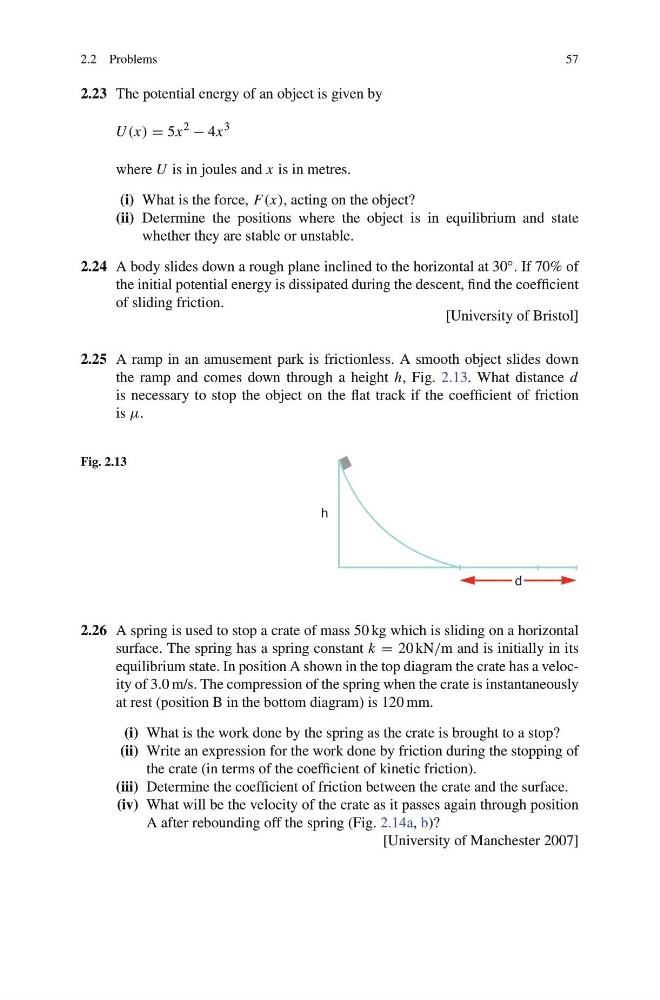
2.25 A ramp in an amusement park is frictionless. A smooth object slides down
the ramp and comes down through a height h, Fig. 2.13. What distance d
is necessary to stop the object on the flat track if the coefficient of friction
is μ.
Fig. 2.13
2.26 A spring is used to stop a crate of mass 50 kg which is sliding on a horizontal
surface. The spring has a spring constant k = 20 kN/m and is initially in its
equilibrium state. In position A shown in the top diagram the crate has a velocity of 3.0 m/s. The compression of the spring when the crate is instantaneously
at rest (position B in the bottom diagram) is 120 mm.
(i) What is the work done by the spring as the crate is brought to a stop?
(ii) Write an expression for the work done by friction during the stopping of
the crate (in terms of the coefficient of kinetic friction).
(iii) Determine the coefficient of friction between the crate and the surface.
(iv) What will be the velocity of the crate as it passes again through position
A after rebounding off the spring (Fig. 2.14a, b)?
[University of Manchester 2007]
57
2.23 The potential energy of an object is given by
U (x) = 5x
2
− 4x
3
where U is in joules and x is in metres.
(i) What is the force, F(x), acting on the object?
(ii) Determine the positions where the object is in equilibrium and state
whether they are stable or unstable.
2.24 A body slides down a rough plane inclined to the horizontal at 30 ◦ . If 70% of
the initial potential energy is dissipated during the descent, find the coefficient
of sliding friction.
[University of Bristol]
2.25 A ramp in an amusement park is frictionless. A smooth object slides down
the ramp and comes down through a height h, Fig. 2.13. What distance d
is necessary to stop the object on the flat track if the coefficient of friction
is μ.
Fig. 2.13
2.26 A spring is used to stop a crate of mass 50 kg which is sliding on a horizontal
surface. The spring has a spring constant k = 20 kN/m and is initially in its
equilibrium state. In position A shown in the top diagram the crate has a velocity of 3.0 m/s. The compression of the spring when the crate is instantaneously
at rest (position B in the bottom diagram) is 120 mm.
(i) What is the work done by the spring as the crate is brought to a stop?
(ii) Write an expression for the work done by friction during the stopping of
the crate (in terms of the coefficient of kinetic friction).
(iii) Determine the coefficient of friction between the crate and the surface.
(iv) What will be the velocity of the crate as it passes again through position
A after rebounding off the spring (Fig. 2.14a, b)?
[University of Manchester 2007]