

56
2 Particle Dynamics
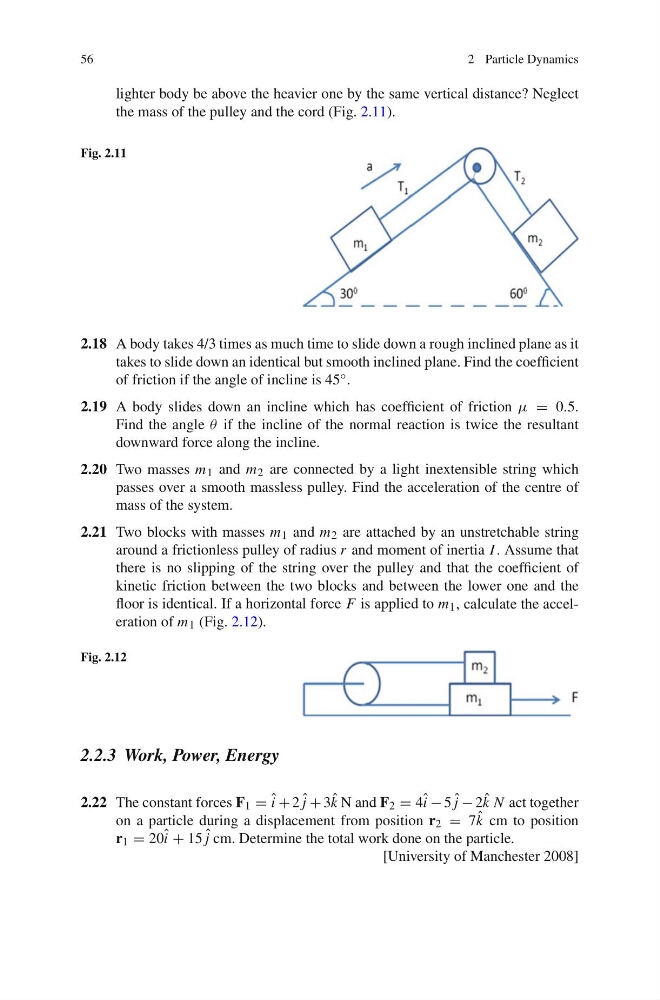
lighter body be above the heavier one by the same vertical distance? Neglect
the mass of the pulley and the cord (Fig. 2.11).
Fig. 2.11
2.18 A body takes 4/3 times as much time to slide down a rough inclined plane as it
takes to slide down an identical but smooth inclined plane. Find the coefficient
of friction if the angle of incline is 45 ◦ .
2.19 A body slides down an incline which has coefficient of friction μ = 0.5.
Find the angle θ if the incline of the normal reaction is twice the resultant
downward force along the incline.
2.20 Two masses m 1 and m 2 are connected by a light inextensible string which
passes over a smooth massless pulley. Find the acceleration of the centre of
mass of the system.
2.21 Two blocks with masses m 1 and m 2 are attached by an unstretchable string
around a frictionless pulley of radius r and moment of inertia I . Assume that
there is no slipping of the string over the pulley and that the coefficient of
kinetic friction between the two blocks and between the lower one and the
floor is identical. If a horizontal force F is applied to m 1 , calculate the acceleration of m 1 (Fig. 2.12).
Fig. 2.12
2.2.3 Work, Power, Energy
2.22 The constant forces F 1 = ˆ
i + 2 ˆ
j + 3 ˆ
k N and F 2 = 4 ˆ
i − 5 ˆ
j − 2 ˆ
k N act together
on a particle during a displacement from position r 2 = 7 ˆ
k cm to position
r 1 = 20 ˆ
i + 15 ˆ
j cm. Determine the total work done on the particle.
[University of Manchester 2008]
2 Particle Dynamics
lighter body be above the heavier one by the same vertical distance? Neglect
the mass of the pulley and the cord (Fig. 2.11).
Fig. 2.11
2.18 A body takes 4/3 times as much time to slide down a rough inclined plane as it
takes to slide down an identical but smooth inclined plane. Find the coefficient
of friction if the angle of incline is 45 ◦ .
2.19 A body slides down an incline which has coefficient of friction μ = 0.5.
Find the angle θ if the incline of the normal reaction is twice the resultant
downward force along the incline.
2.20 Two masses m 1 and m 2 are connected by a light inextensible string which
passes over a smooth massless pulley. Find the acceleration of the centre of
mass of the system.
2.21 Two blocks with masses m 1 and m 2 are attached by an unstretchable string
around a frictionless pulley of radius r and moment of inertia I . Assume that
there is no slipping of the string over the pulley and that the coefficient of
kinetic friction between the two blocks and between the lower one and the
floor is identical. If a horizontal force F is applied to m 1 , calculate the acceleration of m 1 (Fig. 2.12).
Fig. 2.12
2.2.3 Work, Power, Energy
2.22 The constant forces F 1 = ˆ
i + 2 ˆ
j + 3 ˆ
k N and F 2 = 4 ˆ
i − 5 ˆ
j − 2 ˆ
k N act together
on a particle during a displacement from position r 2 = 7 ˆ
k cm to position
r 1 = 20 ˆ
i + 15 ˆ
j cm. Determine the total work done on the particle.
[University of Manchester 2008]