

2.2 Problems
55
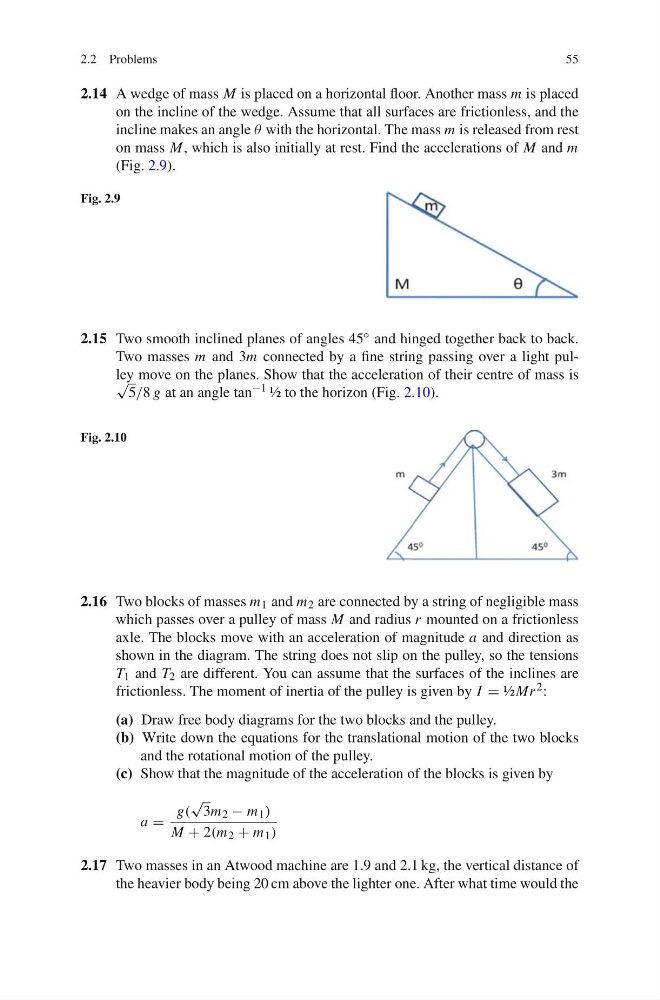
2.14 A wedge of mass M is placed on a horizontal floor. Another mass m is placed
on the incline of the wedge. Assume that all surfaces are frictionless, and the
incline makes an angle θ with the horizontal. The mass m is released from rest
on mass M, which is also initially at rest. Find the accelerations of M and m
(Fig. 2.9).
Fig. 2.9
2.15 Two smooth inclined planes of angles 45 ◦ and hinged together back to back.
Two masses m and 3m connected by a fine string passing over a light pulley move on the planes. Show that the acceleration of their centre of mass is
√
5/8 g at an angle tan −1 ½ to the horizon (Fig. 2.10).
Fig. 2.10
2.16 Two blocks of masses m 1 and m 2 are connected by a string of negligible mass
which passes over a pulley of mass M and radius r mounted on a frictionless
axle. The blocks move with an acceleration of magnitude a and direction as
shown in the diagram. The string does not slip on the pulley, so the tensions
T 1 and T 2 are different. You can assume that the surfaces of the inclines are
frictionless. The moment of inertia of the pulley is given by I = ½Mr 2 :
(a) Draw free body diagrams for the two blocks and the pulley.
(b) Write down the equations for the translational motion of the two blocks
and the rotational motion of the pulley.
(c) Show that the magnitude of the acceleration of the blocks is given by
a =
g(
√
3m 2 − m 1 )
M + 2(m 2 + m 1 )
2.17 Two masses in an Atwood machine are 1.9 and 2.1 kg, the vertical distance of
the heavier body being 20 cm above the lighter one. After what time would the
55
2.14 A wedge of mass M is placed on a horizontal floor. Another mass m is placed
on the incline of the wedge. Assume that all surfaces are frictionless, and the
incline makes an angle θ with the horizontal. The mass m is released from rest
on mass M, which is also initially at rest. Find the accelerations of M and m
(Fig. 2.9).
Fig. 2.9
2.15 Two smooth inclined planes of angles 45 ◦ and hinged together back to back.
Two masses m and 3m connected by a fine string passing over a light pulley move on the planes. Show that the acceleration of their centre of mass is
√
5/8 g at an angle tan −1 ½ to the horizon (Fig. 2.10).
Fig. 2.10
2.16 Two blocks of masses m 1 and m 2 are connected by a string of negligible mass
which passes over a pulley of mass M and radius r mounted on a frictionless
axle. The blocks move with an acceleration of magnitude a and direction as
shown in the diagram. The string does not slip on the pulley, so the tensions
T 1 and T 2 are different. You can assume that the surfaces of the inclines are
frictionless. The moment of inertia of the pulley is given by I = ½Mr 2 :
(a) Draw free body diagrams for the two blocks and the pulley.
(b) Write down the equations for the translational motion of the two blocks
and the rotational motion of the pulley.
(c) Show that the magnitude of the acceleration of the blocks is given by
a =
g(
√
3m 2 − m 1 )
M + 2(m 2 + m 1 )
2.17 Two masses in an Atwood machine are 1.9 and 2.1 kg, the vertical distance of
the heavier body being 20 cm above the lighter one. After what time would the