

54
2 Particle Dynamics
2.10 A block is placed on a ramp of parabolic shape given by the equation y =
x 2 /20, Fig. 2.7. If μ s = 0.5, what is the maximum height above the ground at
which the block can be placed without slipping?
Fig. 2.7
2.11 A block slides with constant velocity down an inclined plane that has slope
angle θ = 30 ◦ .
(a) Find the coefficient of kinetic friction between the block and the plane.
(b) If the block is projected up the same plane with initial speed v 0 =
2.5 m/s, how far up the plane will it move before coming to rest? What
fraction of the initial kinetic energy is transformed into potential energy?
What happens to the remaining energy?
(c) After the block comes to rest, will it slide down the plane again? Justify
your answer.
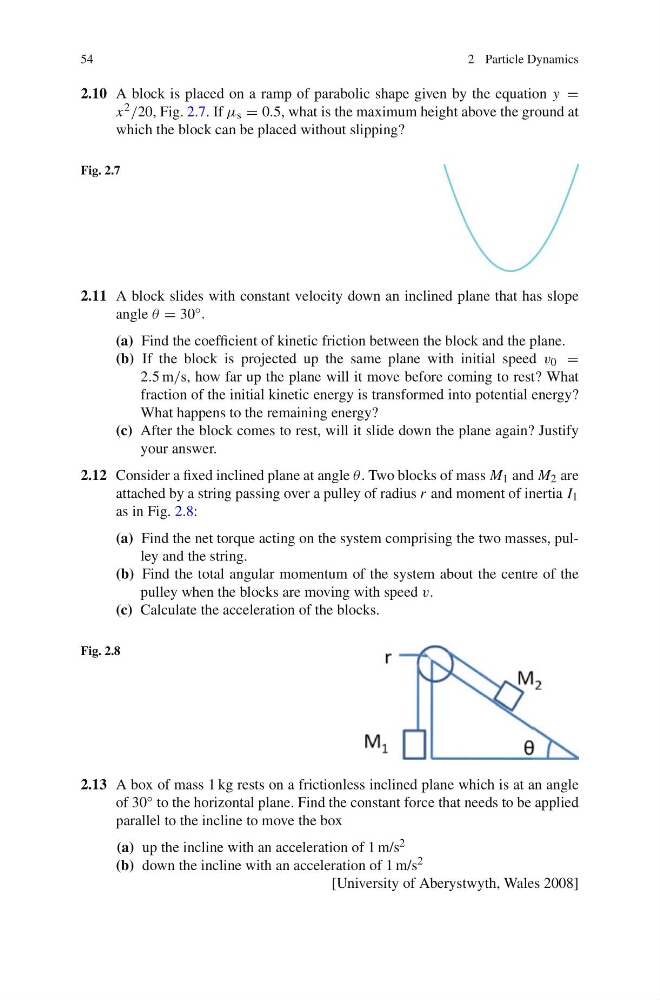
2.12 Consider a fixed inclined plane at angle θ . Two blocks of mass M 1 and M 2 are
attached by a string passing over a pulley of radius r and moment of inertia I 1
as in Fig. 2.8:
(a) Find the net torque acting on the system comprising the two masses, pulley and the string.
(b) Find the total angular momentum of the system about the centre of the
pulley when the blocks are moving with speed v.
(c) Calculate the acceleration of the blocks.
Fig. 2.8
2.13 A box of mass 1 kg rests on a frictionless inclined plane which is at an angle
of 30 ◦ to the horizontal plane. Find the constant force that needs to be applied
parallel to the incline to move the box
(a) up the incline with an acceleration of 1 m/s 2
(b) down the incline with an acceleration of 1 m/s 2
[University of Aberystwyth, Wales 2008]
2 Particle Dynamics
2.10 A block is placed on a ramp of parabolic shape given by the equation y =
x 2 /20, Fig. 2.7. If μ s = 0.5, what is the maximum height above the ground at
which the block can be placed without slipping?
Fig. 2.7
2.11 A block slides with constant velocity down an inclined plane that has slope
angle θ = 30 ◦ .
(a) Find the coefficient of kinetic friction between the block and the plane.
(b) If the block is projected up the same plane with initial speed v 0 =
2.5 m/s, how far up the plane will it move before coming to rest? What
fraction of the initial kinetic energy is transformed into potential energy?
What happens to the remaining energy?
(c) After the block comes to rest, will it slide down the plane again? Justify
your answer.
2.12 Consider a fixed inclined plane at angle θ . Two blocks of mass M 1 and M 2 are
attached by a string passing over a pulley of radius r and moment of inertia I 1
as in Fig. 2.8:
(a) Find the net torque acting on the system comprising the two masses, pulley and the string.
(b) Find the total angular momentum of the system about the centre of the
pulley when the blocks are moving with speed v.
(c) Calculate the acceleration of the blocks.
Fig. 2.8
2.13 A box of mass 1 kg rests on a frictionless inclined plane which is at an angle
of 30 ◦ to the horizontal plane. Find the constant force that needs to be applied
parallel to the incline to move the box
(a) up the incline with an acceleration of 1 m/s 2
(b) down the incline with an acceleration of 1 m/s 2
[University of Aberystwyth, Wales 2008]