

2.2 Problems
53
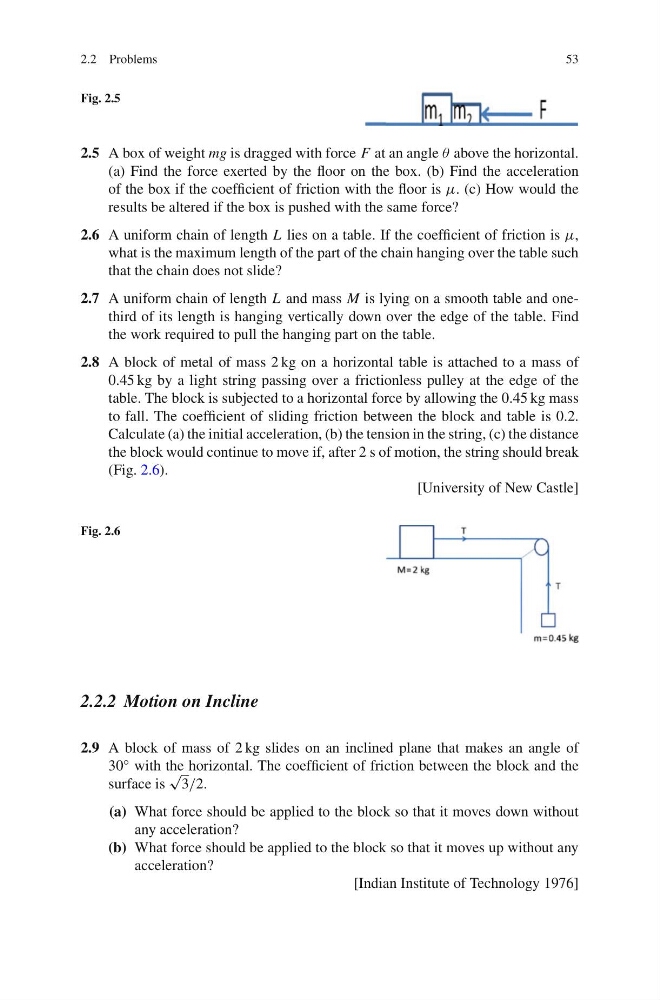
Fig. 2.5
2.5 A box of weight mg is dragged with force F at an angle θ above the horizontal.
(a) Find the force exerted by the floor on the box. (b) Find the acceleration
of the box if the coefficient of friction with the floor is μ. (c) How would the
results be altered if the box is pushed with the same force?
2.6 A uniform chain of length L lies on a table. If the coefficient of friction is μ,
what is the maximum length of the part of the chain hanging over the table such
that the chain does not slide?
2.7 A uniform chain of length L and mass M is lying on a smooth table and onethird of its length is hanging vertically down over the edge of the table. Find
the work required to pull the hanging part on the table.
2.8 A block of metal of mass 2 kg on a horizontal table is attached to a mass of
0.45 kg by a light string passing over a frictionless pulley at the edge of the
table. The block is subjected to a horizontal force by allowing the 0.45 kg mass
to fall. The coefficient of sliding friction between the block and table is 0.2.
Calculate (a) the initial acceleration, (b) the tension in the string, (c) the distance
the block would continue to move if, after 2 s of motion, the string should break
(Fig. 2.6).
[University of New Castle]
Fig. 2.6
2.2.2 Motion on Incline
2.9 A block of mass of 2 kg slides on an inclined plane that makes an angle of
30 ◦ with the horizontal. The coefficient of friction between the block and the
surface is
√
3/2.
(a) What force should be applied to the block so that it moves down without
any acceleration?
(b) What force should be applied to the block so that it moves up without any
acceleration?
[Indian Institute of Technology 1976]
53
Fig. 2.5
2.5 A box of weight mg is dragged with force F at an angle θ above the horizontal.
(a) Find the force exerted by the floor on the box. (b) Find the acceleration
of the box if the coefficient of friction with the floor is μ. (c) How would the
results be altered if the box is pushed with the same force?
2.6 A uniform chain of length L lies on a table. If the coefficient of friction is μ,
what is the maximum length of the part of the chain hanging over the table such
that the chain does not slide?
2.7 A uniform chain of length L and mass M is lying on a smooth table and onethird of its length is hanging vertically down over the edge of the table. Find
the work required to pull the hanging part on the table.
2.8 A block of metal of mass 2 kg on a horizontal table is attached to a mass of
0.45 kg by a light string passing over a frictionless pulley at the edge of the
table. The block is subjected to a horizontal force by allowing the 0.45 kg mass
to fall. The coefficient of sliding friction between the block and table is 0.2.
Calculate (a) the initial acceleration, (b) the tension in the string, (c) the distance
the block would continue to move if, after 2 s of motion, the string should break
(Fig. 2.6).
[University of New Castle]
Fig. 2.6
2.2.2 Motion on Incline
2.9 A block of mass of 2 kg slides on an inclined plane that makes an angle of
30 ◦ with the horizontal. The coefficient of friction between the block and the
surface is
√
3/2.
(a) What force should be applied to the block so that it moves down without
any acceleration?
(b) What force should be applied to the block so that it moves up without any
acceleration?
[Indian Institute of Technology 1976]