

2.2 Problems
59
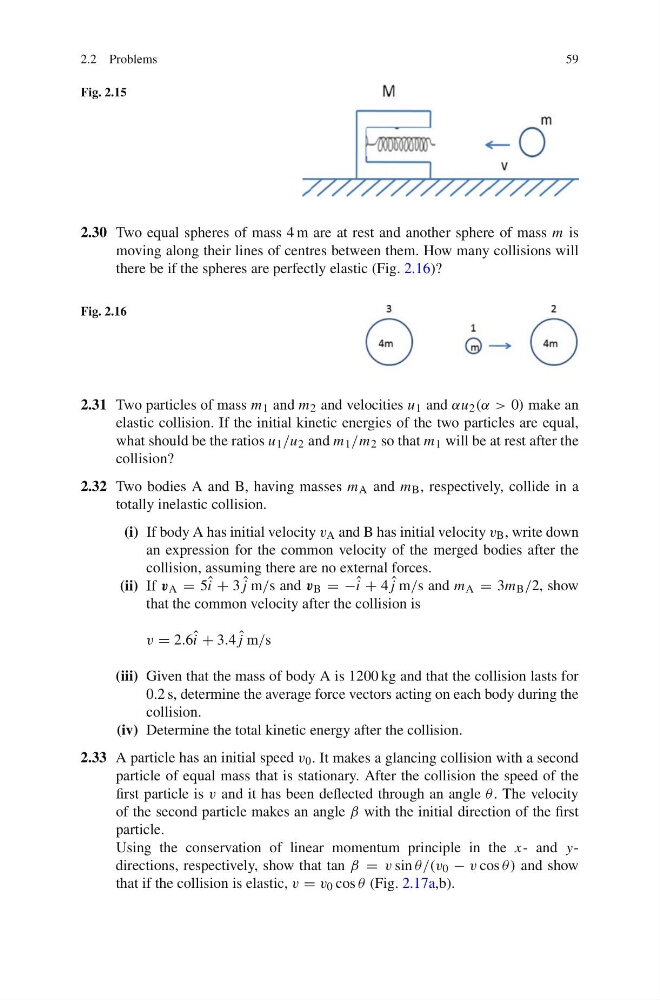
Fig. 2.15
2.30 Two equal spheres of mass 4 m are at rest and another sphere of mass m is
moving along their lines of centres between them. How many collisions will
there be if the spheres are perfectly elastic (Fig. 2.16)?
Fig. 2.16
2.31 Two particles of mass m 1 and m 2 and velocities u 1 and αu 2 (α > 0) make an
elastic collision. If the initial kinetic energies of the two particles are equal,
what should be the ratios u 1 /u 2 and m 1 /m 2 so that m 1 will be at rest after the
collision?
2.32 Two bodies A and B, having masses m A and m B , respectively, collide in a
totally inelastic collision.
(i) If body A has initial velocity v A and B has initial velocity v B , write down
an expression for the common velocity of the merged bodies after the
collision, assuming there are no external forces.
(ii) If v A = 5 ˆ
i + 3 ˆ
j m/s and v B = − ˆ
i + 4 ˆ
j m/s and m A = 3m B /2, show
that the common velocity after the collision is
v = 2.6 ˆ
i + 3.4 ˆ
j m/s
(iii) Given that the mass of body A is 1200 kg and that the collision lasts for
0.2 s, determine the average force vectors acting on each body during the
collision.
(iv) Determine the total kinetic energy after the collision.
2.33 A particle has an initial speed v 0 . It makes a glancing collision with a second
particle of equal mass that is stationary. After the collision the speed of the
first particle is v and it has been deflected through an angle θ . The velocity
of the second particle makes an angle β with the initial direction of the first
particle.
Using the conservation of linear momentum principle in the x- and ydirections, respectively, show that tan β = v sin θ/(v 0 − v cos θ) and show
that if the collision is elastic, v = v 0 cos θ (Fig. 2.17a,b).
59
Fig. 2.15
2.30 Two equal spheres of mass 4 m are at rest and another sphere of mass m is
moving along their lines of centres between them. How many collisions will
there be if the spheres are perfectly elastic (Fig. 2.16)?
Fig. 2.16
2.31 Two particles of mass m 1 and m 2 and velocities u 1 and αu 2 (α > 0) make an
elastic collision. If the initial kinetic energies of the two particles are equal,
what should be the ratios u 1 /u 2 and m 1 /m 2 so that m 1 will be at rest after the
collision?
2.32 Two bodies A and B, having masses m A and m B , respectively, collide in a
totally inelastic collision.
(i) If body A has initial velocity v A and B has initial velocity v B , write down
an expression for the common velocity of the merged bodies after the
collision, assuming there are no external forces.
(ii) If v A = 5 ˆ
i + 3 ˆ
j m/s and v B = − ˆ
i + 4 ˆ
j m/s and m A = 3m B /2, show
that the common velocity after the collision is
v = 2.6 ˆ
i + 3.4 ˆ
j m/s
(iii) Given that the mass of body A is 1200 kg and that the collision lasts for
0.2 s, determine the average force vectors acting on each body during the
collision.
(iv) Determine the total kinetic energy after the collision.
2.33 A particle has an initial speed v 0 . It makes a glancing collision with a second
particle of equal mass that is stationary. After the collision the speed of the
first particle is v and it has been deflected through an angle θ . The velocity
of the second particle makes an angle β with the initial direction of the first
particle.
Using the conservation of linear momentum principle in the x- and ydirections, respectively, show that tan β = v sin θ/(v 0 − v cos θ) and show
that if the collision is elastic, v = v 0 cos θ (Fig. 2.17a,b).