

714
15 Optics
15.3 Define optical path and state Fermat’s principle. Using Fermat’s principle,
derive Snell’s law of refraction at the plate interface between two materials of
refractive index n and n .
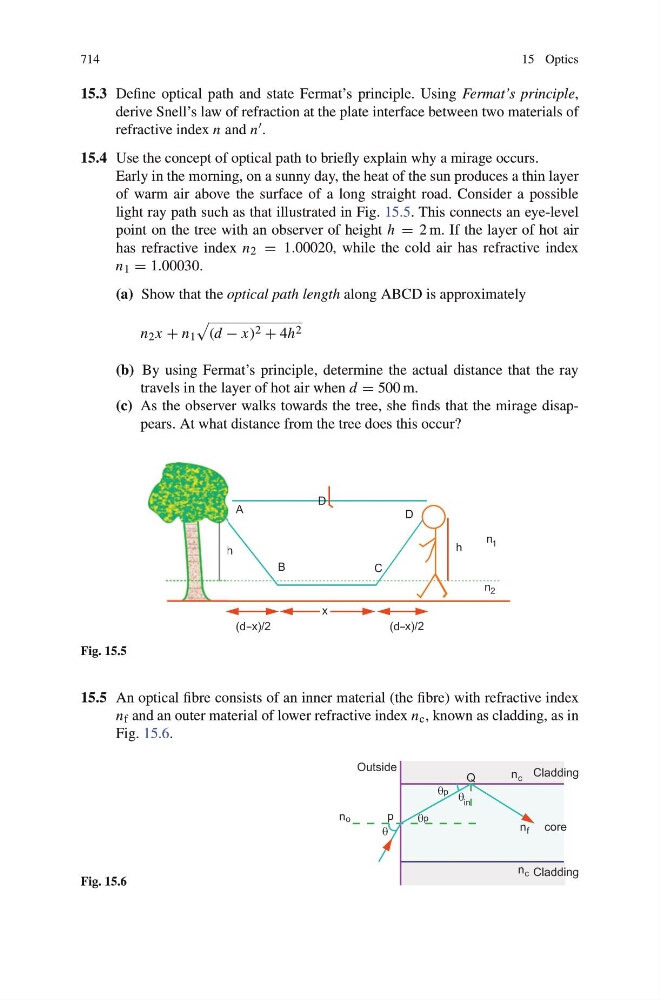
15.4 Use the concept of optical path to briefly explain why a mirage occurs.
Early in the morning, on a sunny day, the heat of the sun produces a thin layer
of warm air above the surface of a long straight road. Consider a possible
light ray path such as that illustrated in Fig. 15.5. This connects an eye-level
point on the tree with an observer of height h = 2 m. If the layer of hot air
has refractive index n 2 = 1.00020, while the cold air has refractive index
n 1 = 1.00030.
(a) Show that the optical path length along ABCD is approximately
n 2 x + n 1
(d − x) 2 + 4h 2
(b) By using Fermat’s principle, determine the actual distance that the ray
travels in the layer of hot air when d = 500 m.
(c) As the observer walks towards the tree, she finds that the mirage disappears. At what distance from the tree does this occur?
Fig. 15.5
15.5 An optical fibre consists of an inner material (the fibre) with refractive index
n f and an outer material of lower refractive index n c , known as cladding, as in
Fig. 15.6.
Fig. 15.6