

15.2 Problems
715
(a) What is the purpose of cladding?
(b) Show that the maximum acceptance angle θ max is given by
n 0 sin θ max =
n 2
f − n 2
c
(c) Discuss two main fibre loss mechanisms.
15.2.2 Prisms and Lenses
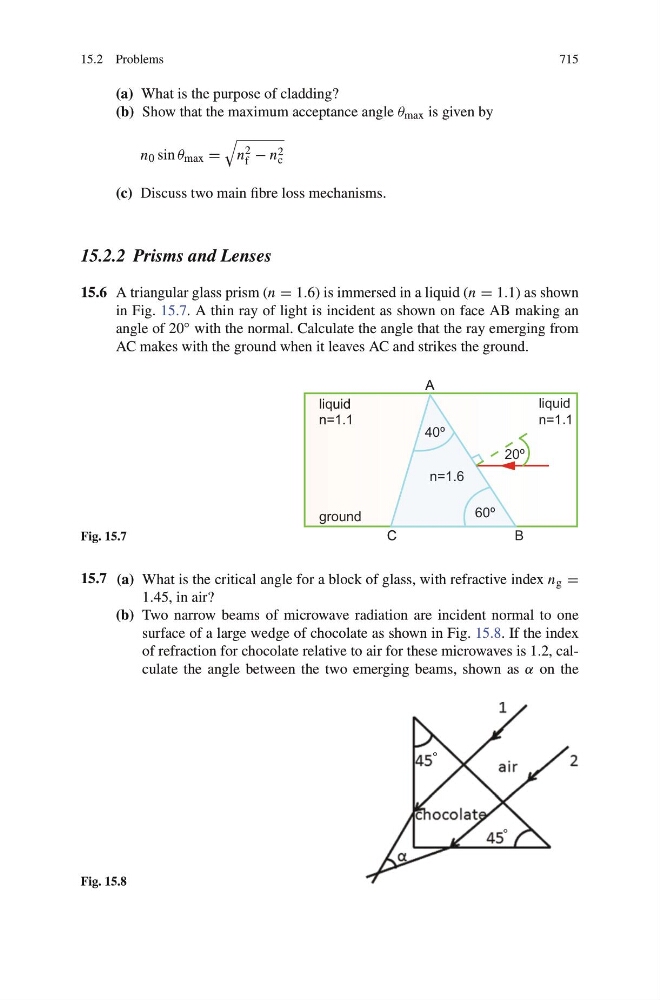
15.6 A triangular glass prism (n = 1.6) is immersed in a liquid (n = 1.1) as shown
in Fig. 15.7. A thin ray of light is incident as shown on face AB making an
angle of 20 ◦ with the normal. Calculate the angle that the ray emerging from
AC makes with the ground when it leaves AC and strikes the ground.
Fig. 15.7
15.7 (a) What is the critical angle for a block of glass, with refractive index n g =
1.45, in air?
(b) Two narrow beams of microwave radiation are incident normal to one
surface of a large wedge of chocolate as shown in Fig. 15.8. If the index
of refraction for chocolate relative to air for these microwaves is 1.2, calculate the angle between the two emerging beams, shown as α on the
Fig. 15.8
°
°