

15.2 Problems
713
For half-wave plate
(n slow − n fast )t = (2m + 1)λ/2
(15.55)
This implies that if two components enter the slab in phase, they emerge from the
slab 180 ◦ out of phase. The half-wave plate rotates the polarization direction but
otherwise leaves the polarization unaffected.
For quarter wave plate
(n slow − n fast )t = (2m + 1)λ/4
(15.56)
Here, the two components have the phase difference of 90 ◦ as they emerge from the
slab of thickness t.
If two quarter wave plates are put together the combination acts as a half-wave
plate.
When an unpolarized beam is incident on a birefringent material, it is split up
into an ordinary ray which travels in a normal way, obeying Snell’s law, and an
extraordinary ray which is displaced, the two emerging rays being linearly polarized
at right angles to each other.
Polarimeter: When a polarized beam of light is passed through an optically active
liquid such as sugar solution then the polarizing plane rotates through an angle θ :
θ = αL D
(15.57)
where α is the specific rotation, L is the length of the tube in decimetres and D is
the amount of solvent in grams per 100 c.c.
15.2 Problems
15.2.1 Geometrical Optics
General
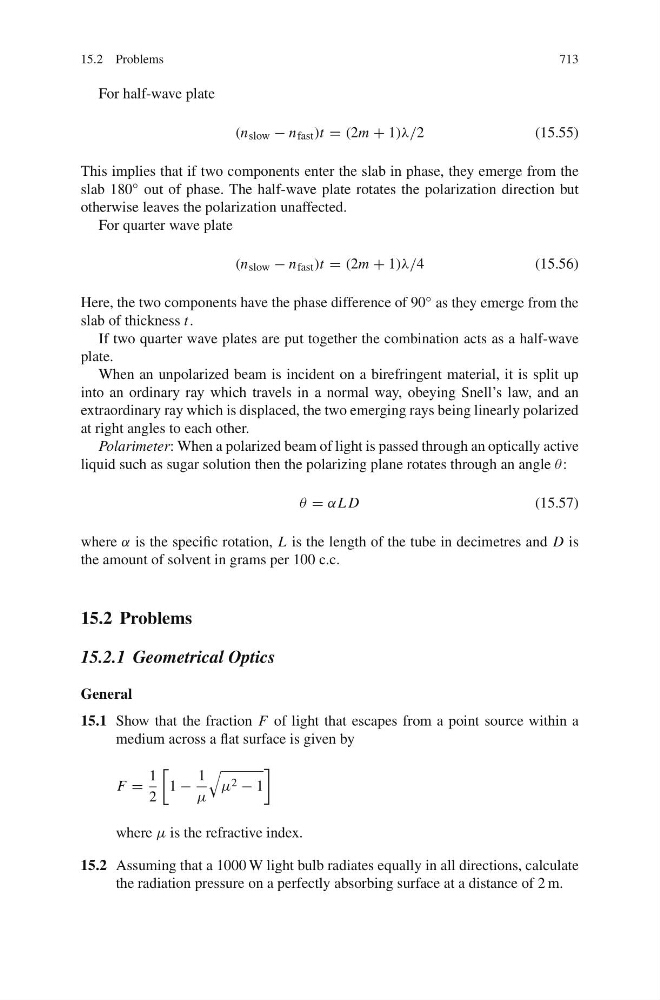
15.1 Show that the fraction F of light that escapes from a point source within a
medium across a flat surface is given by
F =
1
2
1 −
1
μ
μ 2 − 1
where μ is the refractive index.
15.2 Assuming that a 1000 W light bulb radiates equally in all directions, calculate
the radiation pressure on a perfectly absorbing surface at a distance of 2 m.