

14.3 Solutions
699
ω − k plot is always above the ω = kc line. This implies that the phase
velocity ν p = ω/k is always larger than c.
The group velocity v g = dω/dk is determined by the slope of the curve
which is less than the slope of the line ω = kc, and so v g is always less
than c.
There is a minimum frequency, known as the cut-off frequency, below
which k becomes imaginary and the wave ceases to exist. As the frequency
approaches the cut-off frequency the phase velocity becomes infinite and
the group velocity becomes zero.
14.104 (a)
∂ 2
∂ x 2 +
∂ 2
∂ y 2
E z = (k
2
− ω
2
με)E z
(1)
For TM waves H z vanishes, and E z must be a solution of (1). Let
E z = (A cos k x x + B sin k x x)(C cos k y y + D sin k y y) e –jkz
(2)
where A, B, C, D are arbitrary constants and k x and k y are constants to
be determined by boundary conditions. Substitution of (2) in (1) yields
k
2
x + k
2
y
= ω
2
με − k
2
(3)
The form of (2) is further constrained by the boundary conditions.
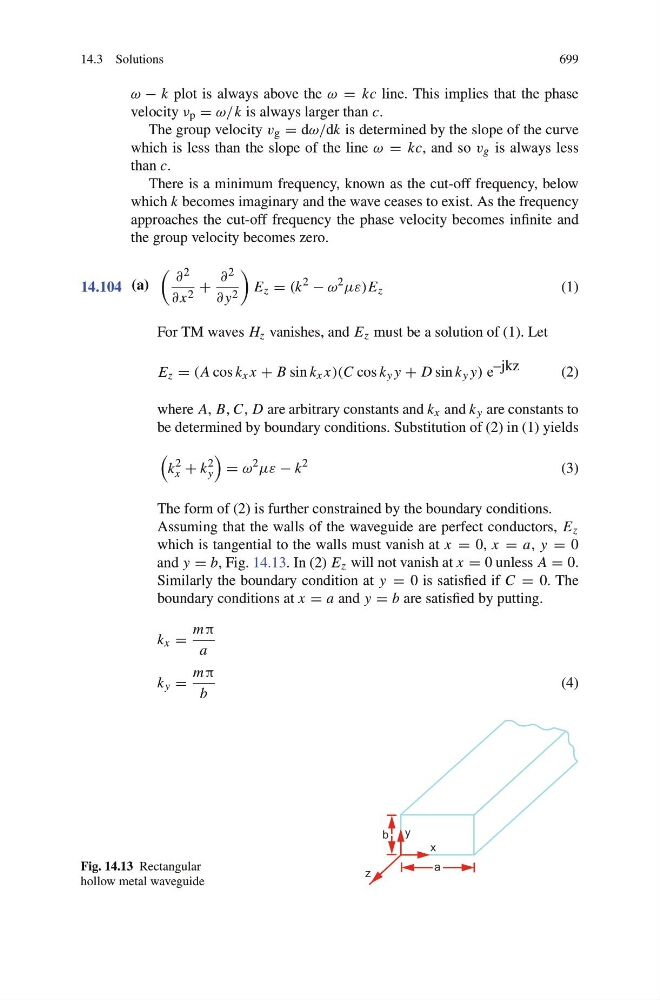
Assuming that the walls of the waveguide are perfect conductors, E z
which is tangential to the walls must vanish at x = 0, x = a, y = 0
and y = b, Fig. 14.13. In (2) E z will not vanish at x = 0 unless A = 0.
Similarly the boundary condition at y = 0 is satisfied if C = 0. The
boundary conditions at x = a and y = b are satisfied by putting.
k x =
mπ
a
k y =
mπ
b
(4)
Fig. 14.13 Rectangular
hollow metal waveguide